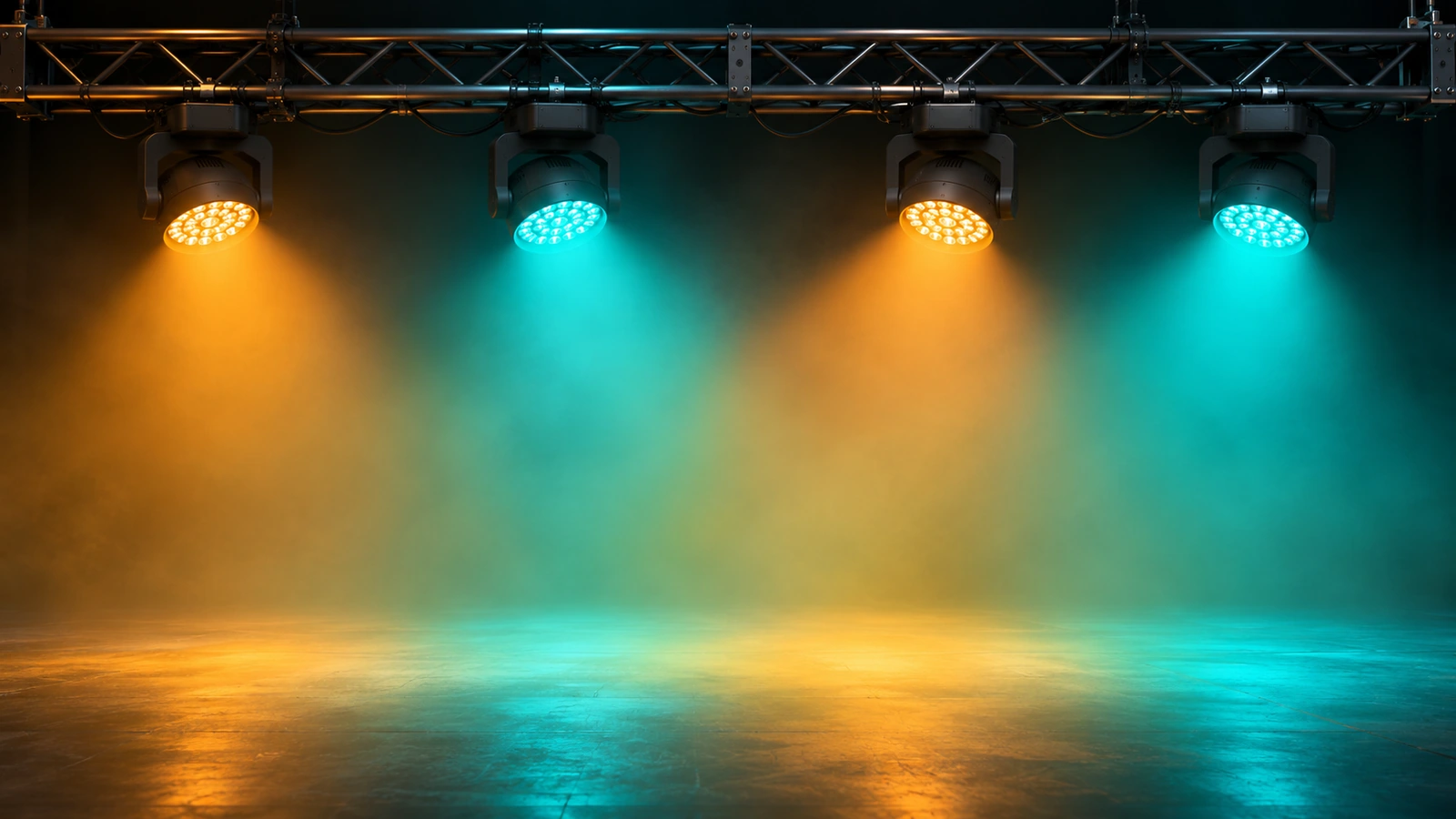
In professional stage production, what is a wash light? A stage wash light is a soft-edged lighting fixture engineered to cover wide performance zones—such as actors’ faces, musicians, backdrops, and concert decks—with smooth, even color and intensity so adjacent beams blend together without harsh borders or dark shadows. Unlike architectural wall washers built into residential ceilings, a theatrical or touring LED wash light stage fixture uses wide beam angles (25°–60°), frosted or honeycomb optical lenses, motorized zoom, and multi-chip RGBW/warm-white LED arrays controlled via DMX512 to form the foundational visual layer of concerts, worship stages, theaters, and corporate events.
Every lighting designer learns early on that aerial beams and gobos look dramatic for ten seconds, yet audiences and broadcast cameras judge an entire show by the quality of the stage wash lighting. When wash overlap is too thin, performers walk in and out of bright hotspots and muddy dark pockets; when color mixing lacks true white or amber balance, skin tones look washed out on livestreams and IMAG screens.
This engineering guide explains the exact wash light meaning in modern touring and fixed-venue rigs, gives you an interactive Stage Wash Coverage & Truss Spacing Calculator that exports a 1600×900 Stage Wash Layout Card PNG, settles wash light vs spot light, wash light vs beam light, and wash light vs flood light trade-offs, compares fixed LED PARs against zoom moving head wash light and rotating bee-eye fixtures, and maps verified specs from our LED Wash Light and LED PAR Light lines into practical rigging plans.
1. Interactive Tool: Stage Wash Coverage & Truss Spacing Calculator
Guessing fixture count from a spec sheet alone is the fastest way to end up with scalloped dark zones across a stage. Enter your stage width, trim height, target fixture wash light beam angle, and desired edge overlap below to calculate single-fixture pool diameter, recommended fixture count, center-to-center truss spacing, and DMX channel footprint—then export a 1600×900 Stage Wash Layout Card PNG for your lighting plot or rental quote.
Stage Wash Coverage & Truss Spacing Calculator
Calculate wash pool diameter, overlap spacing, fixture count, and DMX footprint for concerts, churches, and theaters.
Balanced wash pool blending verified
2. Exact Wash Light Meaning in Stage Lighting (vs. Architectural Wall Washers)
Search engines and lighting catalogs use the word "wash" across two completely different industries, which routinely trips up venue buyers:
- Architectural wall washer: A recessed ceiling downlight or linear exterior bar built to graze drywall, brick facades, or retail displays at fixed color temperatures.
- Stage wash light (Entertainment & Live Production): A DMX-controllable fixture with a soft, feathering field edge designed to illuminate people, instruments, cycloramas, and stage decks evenly from overhead trusses, side booms, or front-of-house (FOH) bridges.
What defines a true stage wash light optically is not just a wide wash light beam angle—it is the beam-to-field ratio. As explained in our Beam Angle vs Field Angle Guide, the beam angle marks where intensity drops to 50% of center peak, while the field angle marks the outer 10% falloff edge. A well-designed wash lens produces a gradual drop from 100% down to 10% across a wide field so that when two fixtures overlap by 30%, the audience sees one continuous wall of light instead of hard circles on the floor.
3. Wash Light vs. Spot Light vs. Beam Light vs. Flood Light
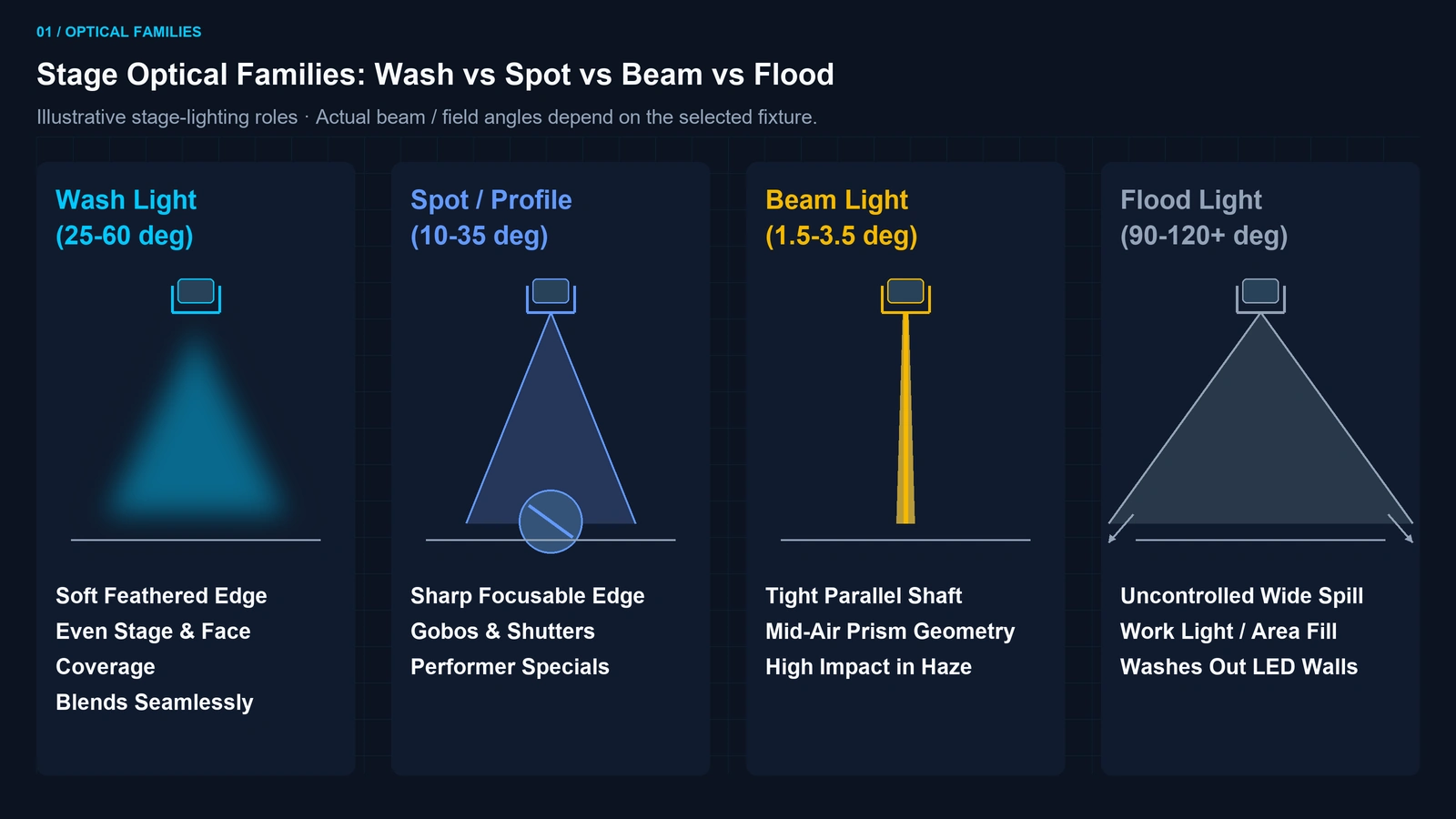
Choosing the right fixture mix starts with separating the four core optical families. Many first-time rental buyers accidentally order narrow beam lights hoping to wash a band, or order cheap floodlights expecting tight stage control.
| Optical Family | Typical Beam Angle | Edge Quality | Primary Stage Role | Best Matching WUYESTAGE Category |
|---|---|---|---|---|
| Wash Light | 25°–60° (zoom washes 4°–60°) | Soft, feathered edge | Even color coverage, front wash stage lighting, choir/band fill, backdrop toning | LED Wash Lights & LED PAR Lights |
| Spot / Profile Light | 10°–35° | Hard, focusable edge | Gobos, framing shutters, sharp performer specials, logo projection | Profile & Spot Moving Heads |
| Beam Light | 1.5°–3.5° | Razor-tight parallel shaft | High-impact mid-air columns, multi-prism aerial geometry in haze | Beam Moving Head Lights & What Is a Beam Light? |
| Flood Light | 90°–120°+ | Uncontrolled wide spill | Work light, cyclorama flooding, outdoor area illumination (high spill onto screens) | Outdoor Stage Lights |
Wash Light vs. Spot Light
In a wash light vs spot light comparison, the spotlight is an emphasis tool while the wash light is a canvas tool. A spot or profile fixture carries a sharp optical gate for gobos, iris blades, and shutters so you can outline a podium or project texture across a set. Try lighting a ten-piece worship team purely with spots and you will create jarring bright rings and heavy shadows between singers. Put a soft wash across the stage first, then layer spots over the lead vocalist or speaker. For a full three-way sample test protocol, see Beam vs. Spot vs. Wash Moving Heads.
Wash Light vs. Beam Light
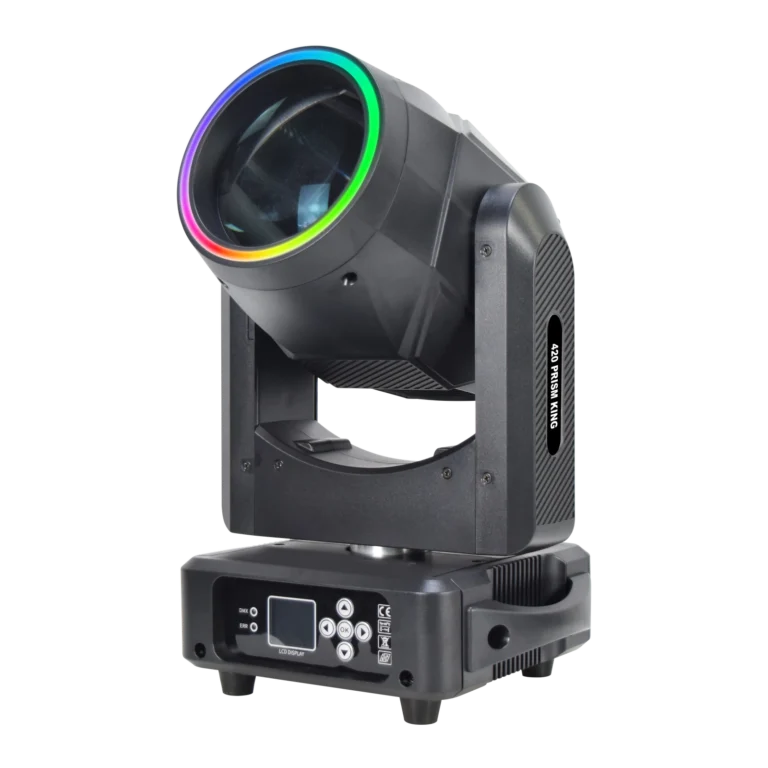
In a wash light vs beam light comparison, the two fixtures operate at opposite ends of optical physics. A pure concert beam like our 420 Prism King Beam Moving Head (300W lamp / 450W rated power / 9 kg) concentrates intense output into a tight aerial shaft designed to cut through stage haze with stacked prisms. A wash light spreads energy broadly across performers and scenery so people remain visible even with zero haze in the room.
Wash Light vs. Flood Light
Buyers evaluating wash light vs flood light often overlook spill control. A 110° architectural floodlight throws light everywhere—straight onto your LED video wall, black masking curtains, and front-row audience eyes, destroying screen contrast. A controlled 25°–45° stage wash (or a COB face light fitted with barn doors) keeps illumination tightly on the talent while keeping your stage LED screen black levels crisp.
4. The Four Main Types of Stage Wash Lights (And When to Buy Each)
Not every stage wash light needs pan and tilt motors. Smart rental companies and venue integrators split their wash inventory across four distinct hardware tiers:
1. Fixed LED PAR Wash Cans (Indoor & IP65 Outdoor)
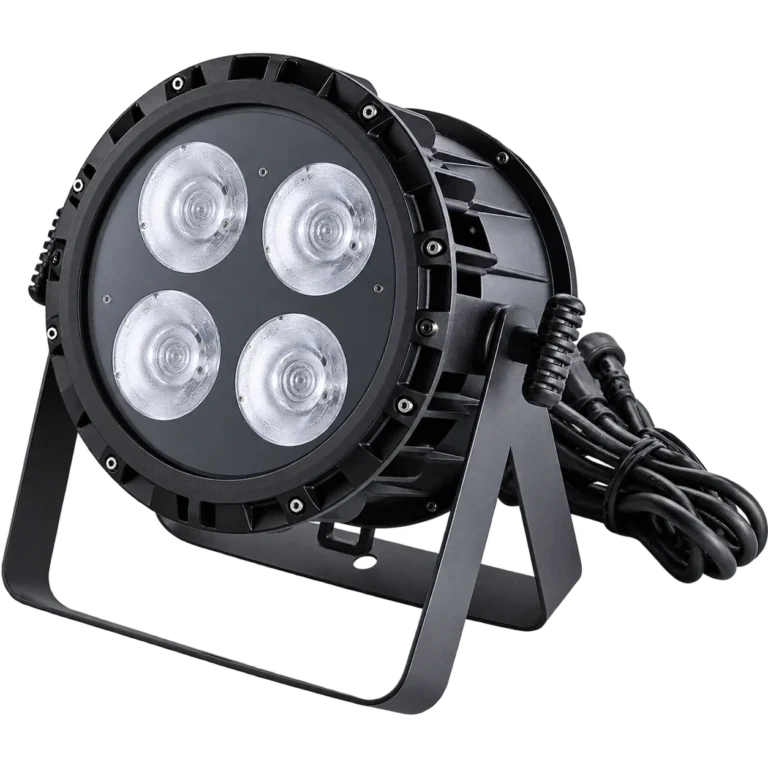
Cast-aluminum LED PARs remain the workhorse of mobile DJ rigs, hotel ballrooms, wedding uplighting, and budget concert backlighting. Modern fixtures use 4-in-1 (RGBW), 5-in-1 (RGBWA), or 6-in-1 (RGBWA+UV) LED packages—typically with a 25° fixed beam—giving compact, quiet, low-channel (6–9 CH) washes you can drop along truss pipes or floor bases. See our PAR Light Meaning Guide and LED PAR Light catalog for waterproof IP65 and mute indoor configurations.
2. COB Face Lights (Front Wash Stage Lighting)
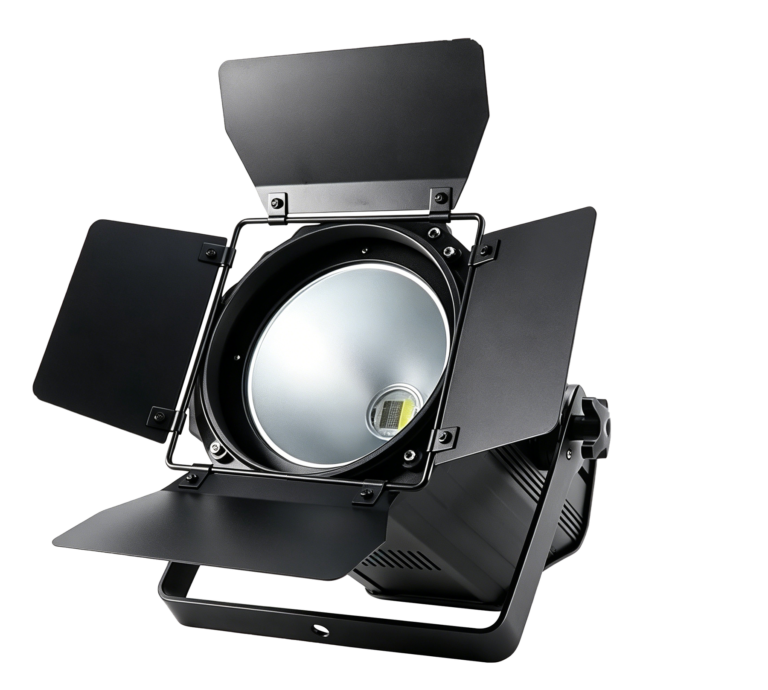
When lighting faces for churches, theaters, and broadcast livestreams, multi-chip RGB PARs often create multicolored shadows and poor red-skin rendering. Dedicated dual-white COB face lights—such as our 200W Dual-White COB Face Light (3200K warm white + 5600K daylight white, 45° field, adjustable barn doors) or outdoor 180W 4-Eye IP65 COB Face Light—deliver single-source smooth white light that flatters skin tones on camera. Learn how camera color accuracy is measured in our CRI for Stage Lighting Guide and Stage Lighting Colors Guide.
3. Zoom Moving Head Wash Lights & Rotating Bee-Eye Fixtures
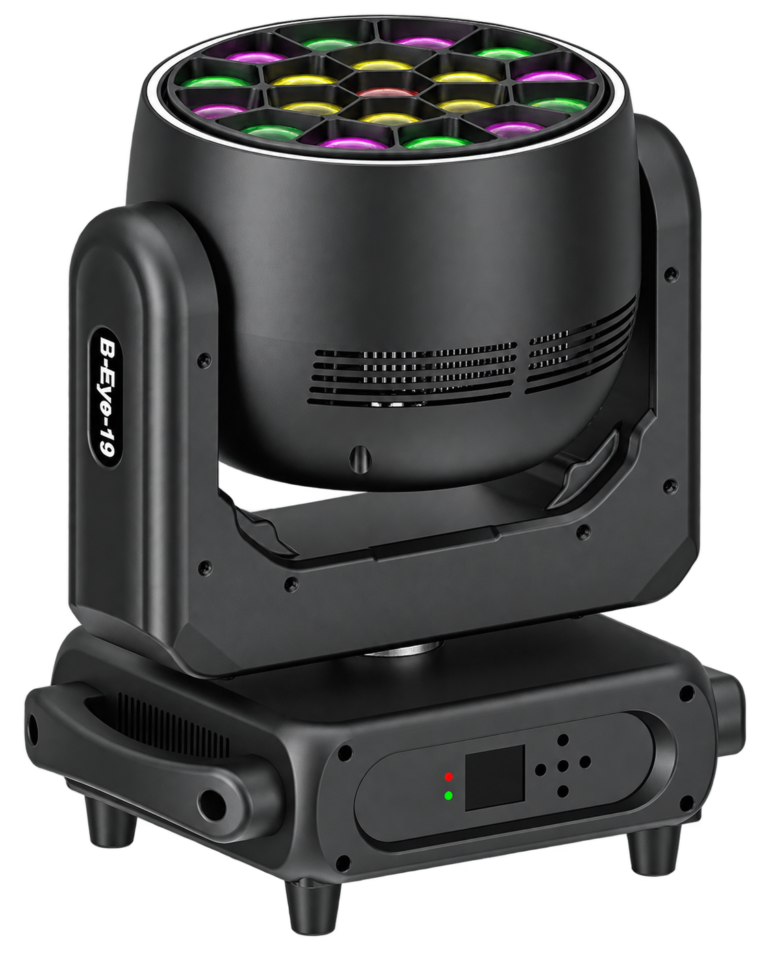
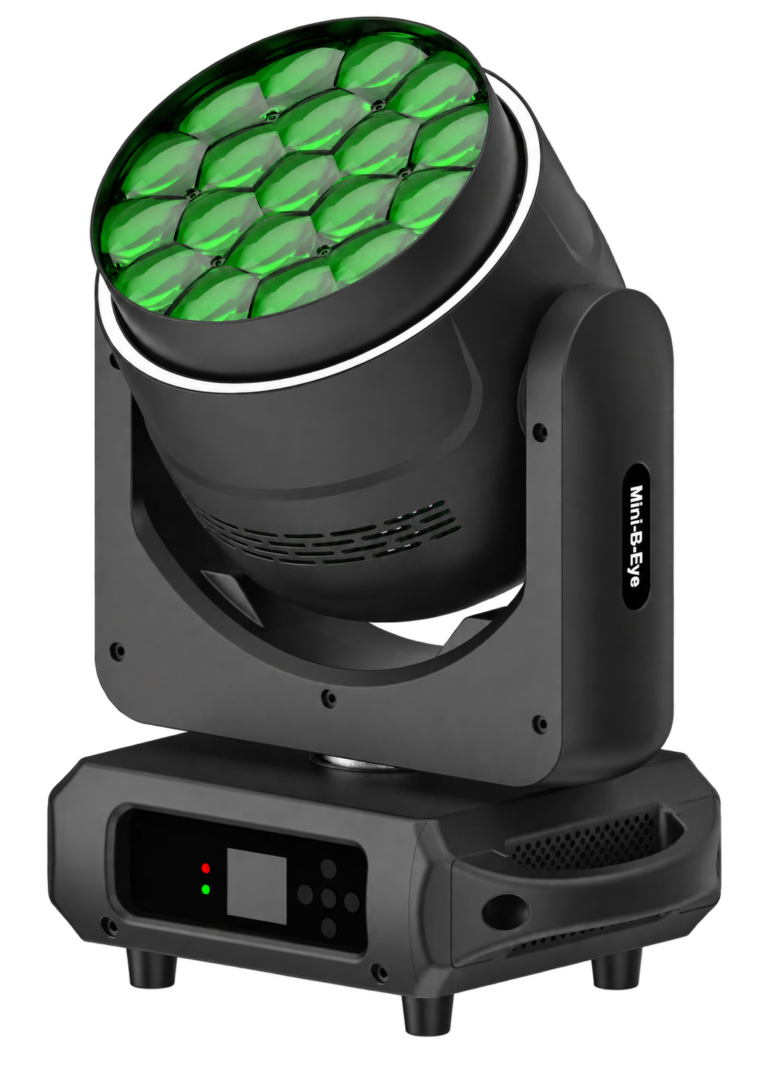
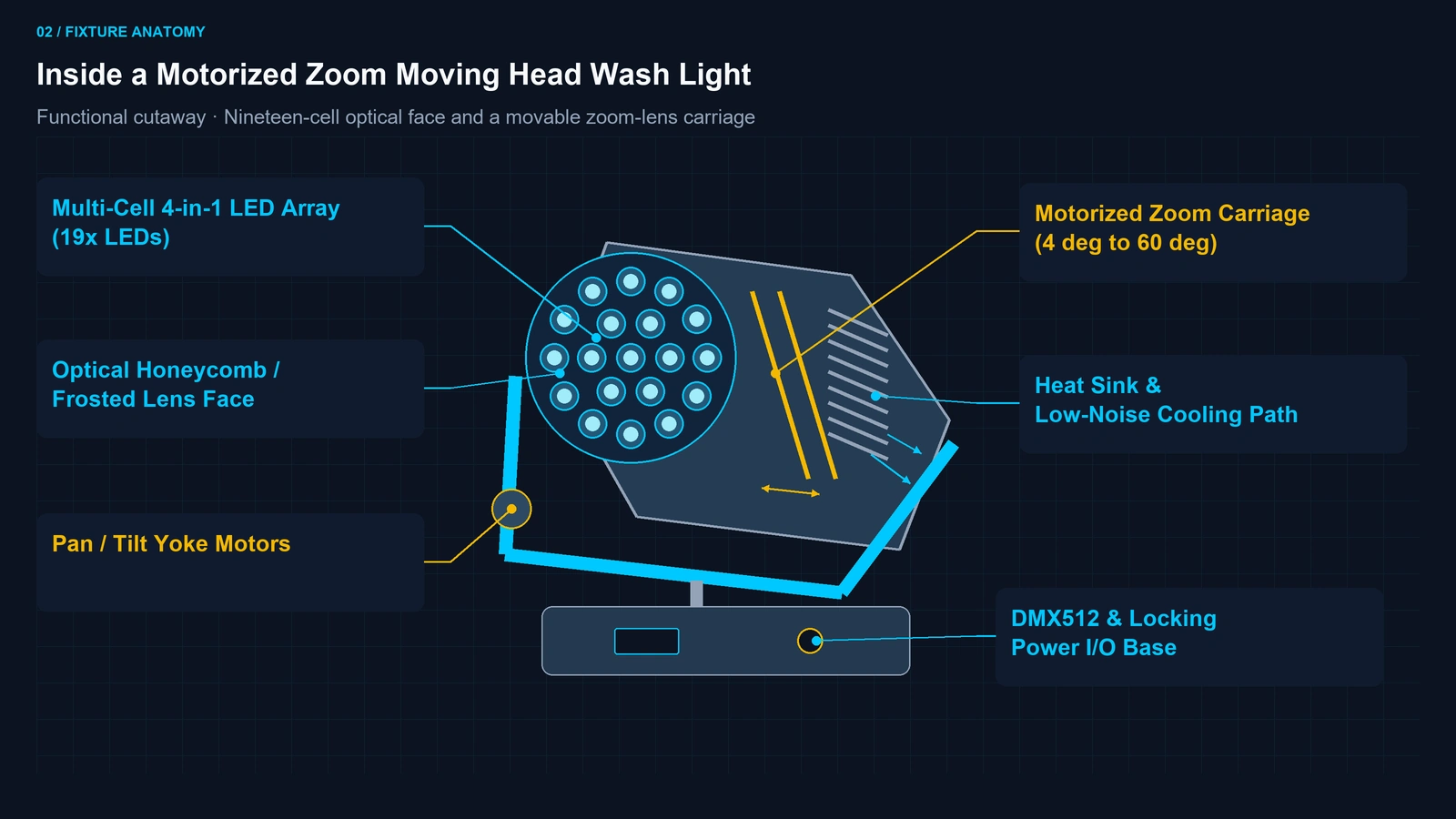
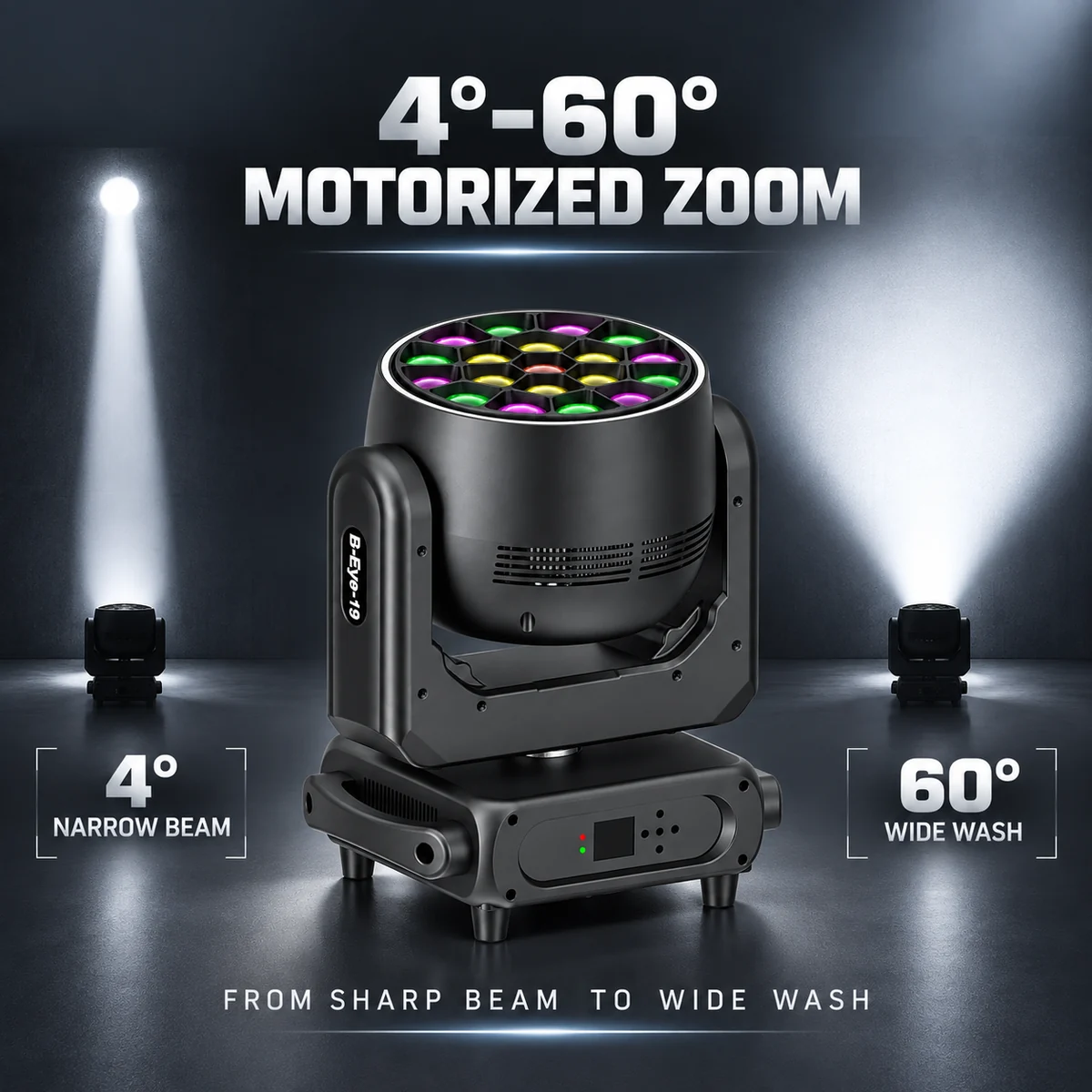
For touring rental fleets, live concerts, and multi-purpose venues where trusses stay fixed while stage layouts change daily, a motorized moving head wash light eliminates ladder focus calls. Multi-cell zoom washes—such as our 19×40W Rotating Bee Eye Moving Head and 19×15W Focusing Bee Eye Moving Head—offer a 4°–60° zoom range, 2800–8500K color temperature control, 24 / 26 / 38 / 81 / 95 / 100 / 102 CH DMX modes, and continuous rotating front lenses. Tightened to 4°–10°, they act as chunky aerial beam clusters; zoomed out to 45°–60°, they wash an entire band deck evenly. For a deep engineering breakdown of multi-cell bee-eye vs. classic wash optics, read Bee Eye vs. Wash Moving Head.
4. IP65 Outdoor Moving Head Washes & Linear Wash Bars
Open-air music festivals cannot rely on IP20 indoor washes when rain or coastal dew rolls in overnight. Weatherproof moving washes such as our 19×40W IP65 Bee Eye Moving Head seal optics, PCBs, and locking AC connectors against rain jets without bulky rain domes that trap heat and distort wash optics. See Best Wash Lights for Festivals for outdoor touring selection checks.
| Wash Fixture Tier | Typical Angle | Color Engine | Best Applications | DMX Footprint |
|---|---|---|---|---|
| Fixed LED PAR Wash | 25° fixed | RGBW / RGBWA / RGBWA+UV | Uplighting, truss warmers, club & wedding wash | 6–9 CH |
| Dual-White COB Face Light | 45° (or 15°–60° zoom) | 3200K–5600K Warm/Cool COB | Front wash stage lighting for churches, theaters, cameras | 2–8 CH |
| 19×40W / 19×15W Zoom Bee-Eye Wash | 4°–60° motorized zoom | 4-in-1 OSRAM LEDs + RGB strip | Touring concerts, festivals, multi-role rental fleets | 24–102 CH |
| IP65 Outdoor Wash | 4°–60° or 25° | Weather-sealed RGBW / COB | Open-air festivals, outdoor corporate stages, amphitheaters | 9–102 CH |
5. How to Space and Aim Stage Wash Lighting Without Dark Spots
Buying bright wash fixtures will not fix poor placement geometry. Follow these four practical field rules to achieve seamless coverage across any stage:
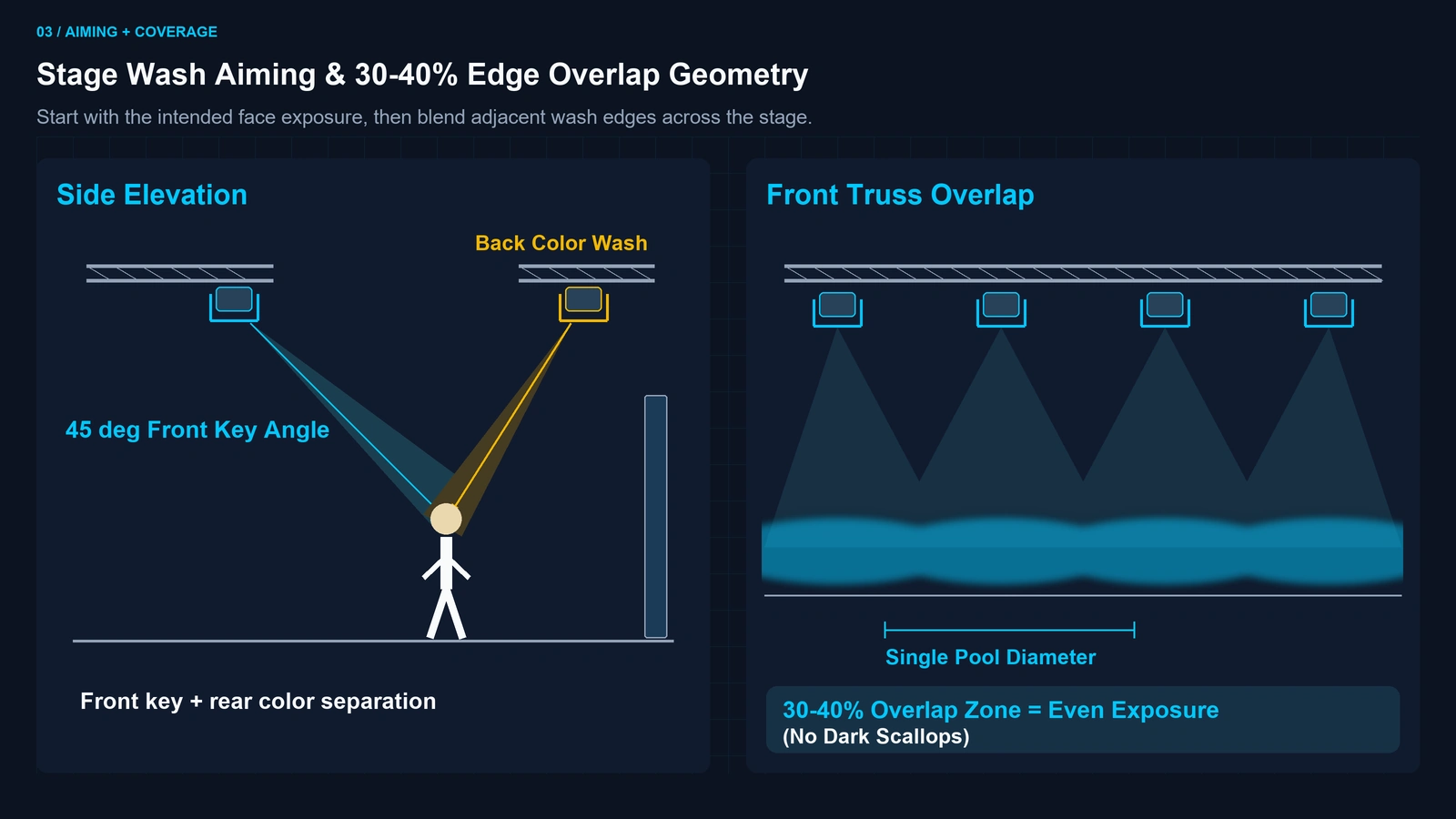
- Aim Front Wash at 45° Elevation and 45° Off-Axis: Following classic theatrical front-light principles documented by ETC's stage lighting engineering resources, hanging front wash stage lighting straight overhead creates raccoon eyes under performers' eyebrows, while shining flat from eye level blinds speakers and throws huge shadows onto the backdrop. A 45° vertical drop from FOH truss balances facial modeling with natural shadow falloff behind the performer.
- Overlap Adjacent Wash Pools by 30%–40%: Because soft-edge wash beams drop smoothly toward their outer perimeter, placing edges barely touching leaves a 50% intensity dip halfway between fixtures. Set center-to-center spacing to roughly 60%–70% of your single-fixture pool diameter (30%–40% overlap) so performers maintain constant exposure as they walk stage left to stage right.
- Separate Warm Front Wash from Saturated Back/Top Wash: Keep your front key wash clean (3200K–5000K white) so faces look natural on livestream cameras, and put deep blues, magentas, ambers, and cyans on your overhead and upstage moving head wash light zones. That color contrast creates immediate visual depth without turning presenters' skin purple.
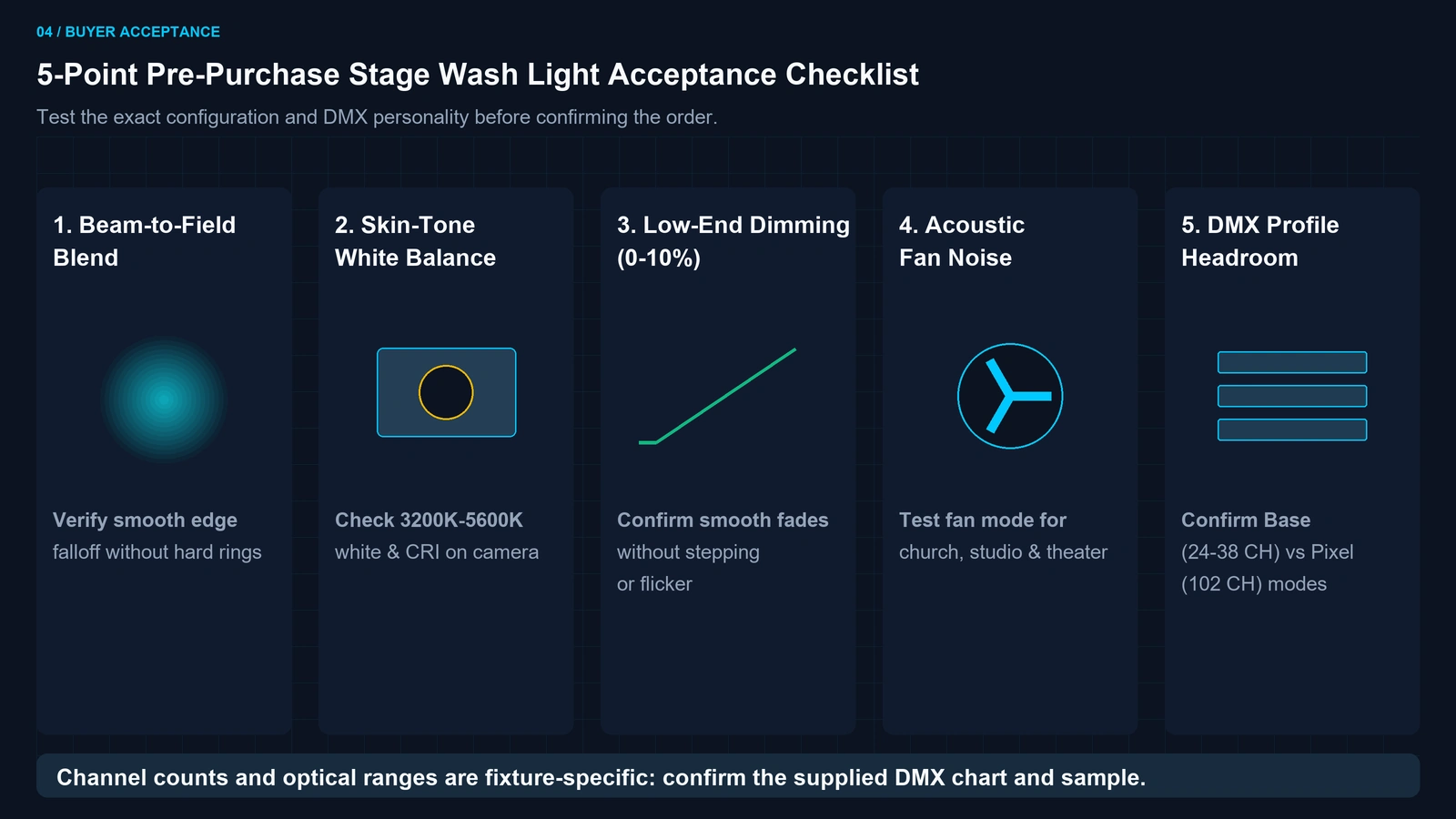
- Match Camera PWM Refresh & Dimming Smoothness: Cheap LED washes flicker on 24/30/60 fps video cameras and step visibly at the bottom 5% of a slow blackout fade. Always test slow 0%–10% dimmer fades on a camera monitor before committing to a bulk rental order—see our LED Stage Light Dimming Guide.
6. DMX Channel, Power & Rental Fleet Planning for Wash Rigs
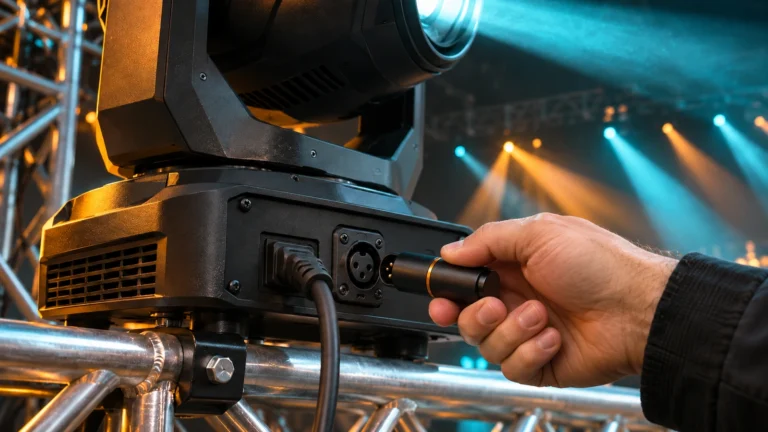
One common mistake when upgrading from fixed PAR cans to multi-cell moving head wash light fixtures is underestimating DMX universe consumption. Eight fixed 8 CH PAR cans occupy just 64 DMX channels (12.5% of one universe). Replace those eight fixtures with eight 19-cell rotating bee-eye washes patched in full 102 CH pixel-mapping mode and you suddenly consume 816 channels—immediately overflowing a single 512-channel DMX universe before you patch a single beam or strobe!
- Standard Touring Mode (24–38 CH): Patch your 19×40W or 19×15W zoom washes in 24 CH or 38 CH mode for everyday corporate events, churches, and festivals where smooth zoom, dimmer, and built-in macros matter more than individual LED ring pixels. Eight units take 192–304 channels, fitting comfortably on one universe alongside beams.
- Full Pixel-Mapping Mode (81–102 CH): Reserve extended pixel modes for multi-universe Art-Net or sACN consoles running pixel-mapped concert shows. Plan exact universe breaks using our DMX Addressing Guide, DMX Channels Guide, and Art-Net vs. sACN Guide.
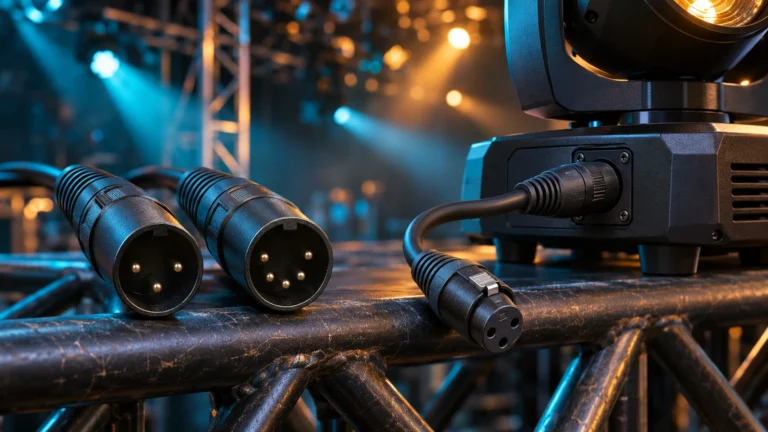
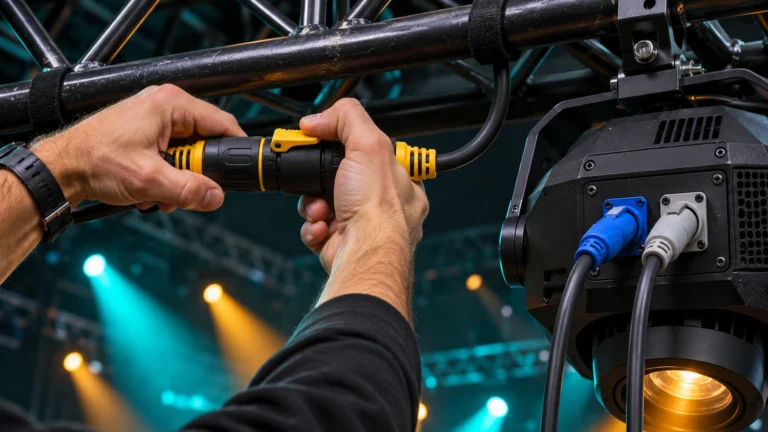
- Verify Whole-Fixture Power Before Daisy-Chaining: Never multiply raw LED chip ratings (such as 19 × 40W = 760W) as an automatic substitute for rated AC input power—driver efficiency, power factor, and firmware thermal limiting change actual wall draw. Always confirm the exact factory nameplate wattage and power-thru amp cap before linking AC jumpers across a truss.
7. What Drives Stage Wash Light Price? Comparing Three Real Buying Tiers
Once you know what a wash light does, the next buyer question is why two fixtures both labeled "LED wash light" can differ several-fold in quotation price. Rather than chasing wattage labels alone, compare the exact optical, cooling, and weather-sealing engineering tiers below before requesting a factory quote.
| Stage Wash Tier | Typical Optical & Hardware Build | Primary Cost Drivers | Best-Fit Buyer Use Case |
|---|---|---|---|
| Static LED PAR / COB Wash | Fixed beam angle (or manual zoom), no pan/tilt motors, compact aluminum housing | LED bin quality, high-CRI dual-white COB emitters, and silent convection vs. fan cooling | Fixed church front key, theater wash zones, wedding uplighting, and budget-sensitive stages |
| Motorized Zoom Moving Head Wash (e.g., 19x40W Class) | 4-60 degree motorized zoom, RGBW multi-cell color mixing, pan/tilt motors, multiple DMX modes | High-output 40W RGBW LEDs, precision zoom rail optics, high-frequency camera-safe dimming, and individual cell control | Touring rental fleets, concerts, multi-purpose venues needing both tight beams and wide soft stage washes |
| IP65 Outdoor Weather-Sealed Wash | Fully gasketed die-cast housing, sealed optics, outdoor locking power & DMX connectors | IP65 pressure-tested seals, thermal management without open dust intake, and corrosion-resistant exterior finishes | Outdoor music festivals, open-air crusades, stadiums, and coastal/rain-exposed rental stages |
8. Frequently Asked Questions: What Is a Wash Light?
What is a wash light used for on a stage?
A stage wash light provides wide, soft-edged illumination that evenly covers performers, bands, choirs, and backdrops without sharp borders or harsh dark gaps. It serves as the primary base lighting layer for concerts, theaters, worship stages, and live video broadcasts.
What is the difference between a wash light and a spotlight?
A wash light produces a wide (typically 25 to 60 degree) soft-edged beam designed to blend smoothly across large stage areas, whereas a spotlight or profile fixture produces a tighter, focusable hard-edged beam used for gobos, framing shutters, and isolated performer specials.
What is the difference between a wash light and a flood light?
Both illuminate broad areas, but a stage wash light uses precision lenses or zoom optics (25 to 60 degrees) to direct even light strictly onto the stage deck. A flood light has an ultra-wide (90 to 120 degree) uncontrolled beam that spills onto LED screens, curtains, and audience areas.
What beam angle is best for stage wash lighting?
For fixed LED PARs and COB face lights, 25 to 45 degrees works best for most 4 to 8 meter trim heights. For touring rental fleets, a motorized zoom moving head wash light with a 4 to 60 degree range adapts to low ceilings, tall festival roofs, and narrow aerial beam looks in one fixture.
How far apart should stage wash lights be spaced on a truss?
Space stage wash lights so adjacent light pools overlap by 30 percent for general live events or 40 percent for broadcast video cameras. In practice, that places center-to-center spacing at 60 to 70 percent of each fixture's single-pool diameter at your throw distance.
Do I need moving head wash lights or fixed LED PARs?
Use fixed LED PARs and dual-white COB face lights for permanent front wash, uplighting, and budget rigs where focus positions stay fixed. Choose motorized zoom moving head wash lights when you need fast cue repositioning across changing stage plots, touring shows, and dynamic color sweeps.
Why do churches and theaters use COB wash lights for front lighting?
Dual-white COB wash lights emit smooth 3200K to 5600K white light from a single optical aperture, eliminating the multi-colored RGB shadow fringes created by discrete multi-lens LED PARs and delivering cleaner skin tones on livestream cameras.
How many DMX channels does a moving head wash light use?
Compact fixed LED wash PARs typically use 6 to 9 DMX channels per unit, while motorized zoom bee-eye moving head washes (such as 19x40W or 19x15W models) offer selectable modes ranging from 24 CH basic operation up to 102 CH for individual LED ring pixel control.
9. Building a Stage Wash Package for Your Venue or Rental Fleet?
Whether you need smooth dual-white front wash stage lighting for a church sanctuary, weather-sealed IP65 PARs for outdoor stages, or motorized 4°–60° zoom moving head wash light fleets paired with beams and strobes, our engineering team can build a complete fixture count and DMX patch recommendation directly from your stage dimensions.
Send your stage width, truss trim height, indoor/outdoor requirement, and camera livestream needs via our Contact Page, or explore our LED Wash Light, LED PAR Light, and Stage Lighting categories to review factory specifications and request sample testing.