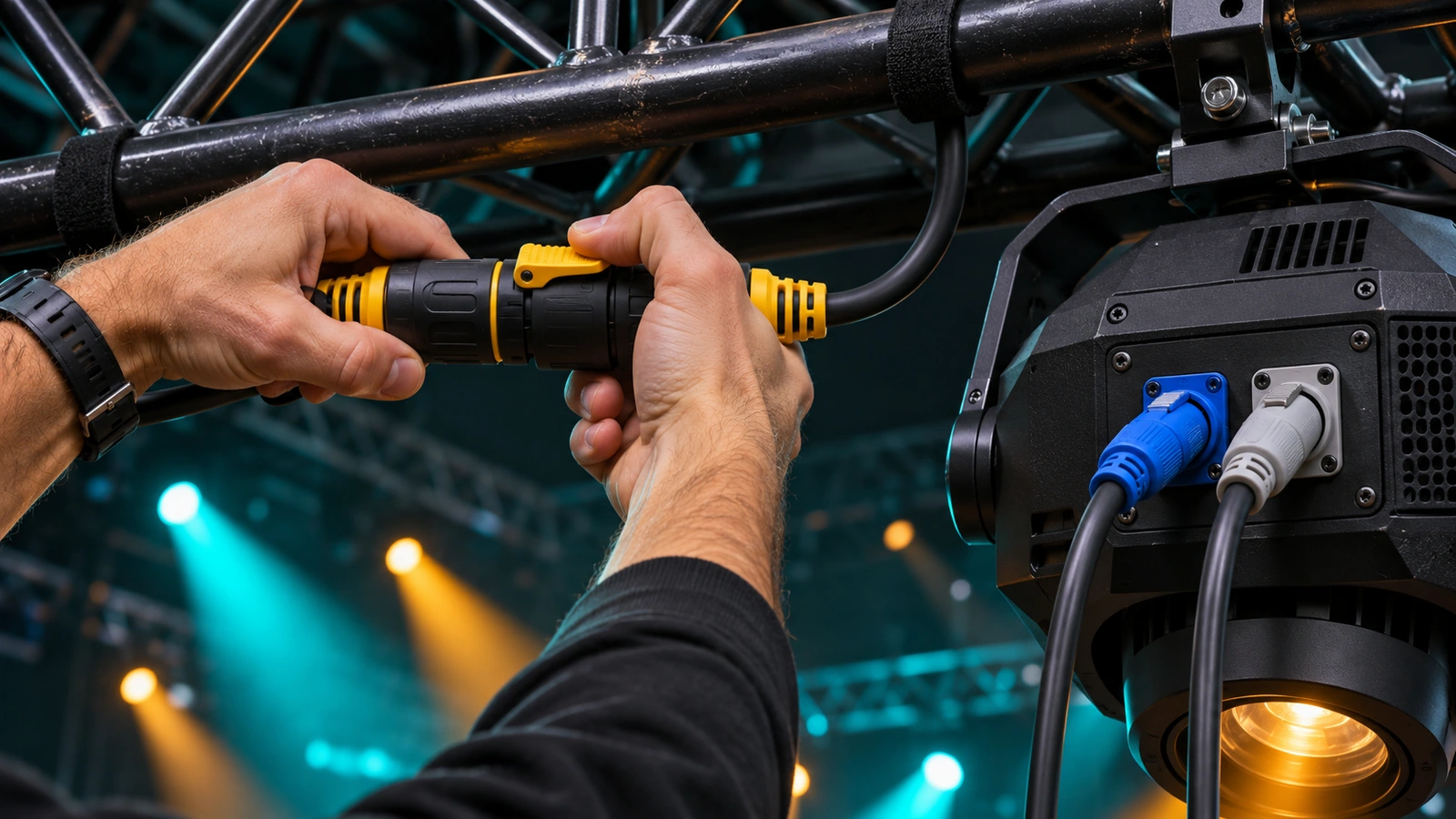
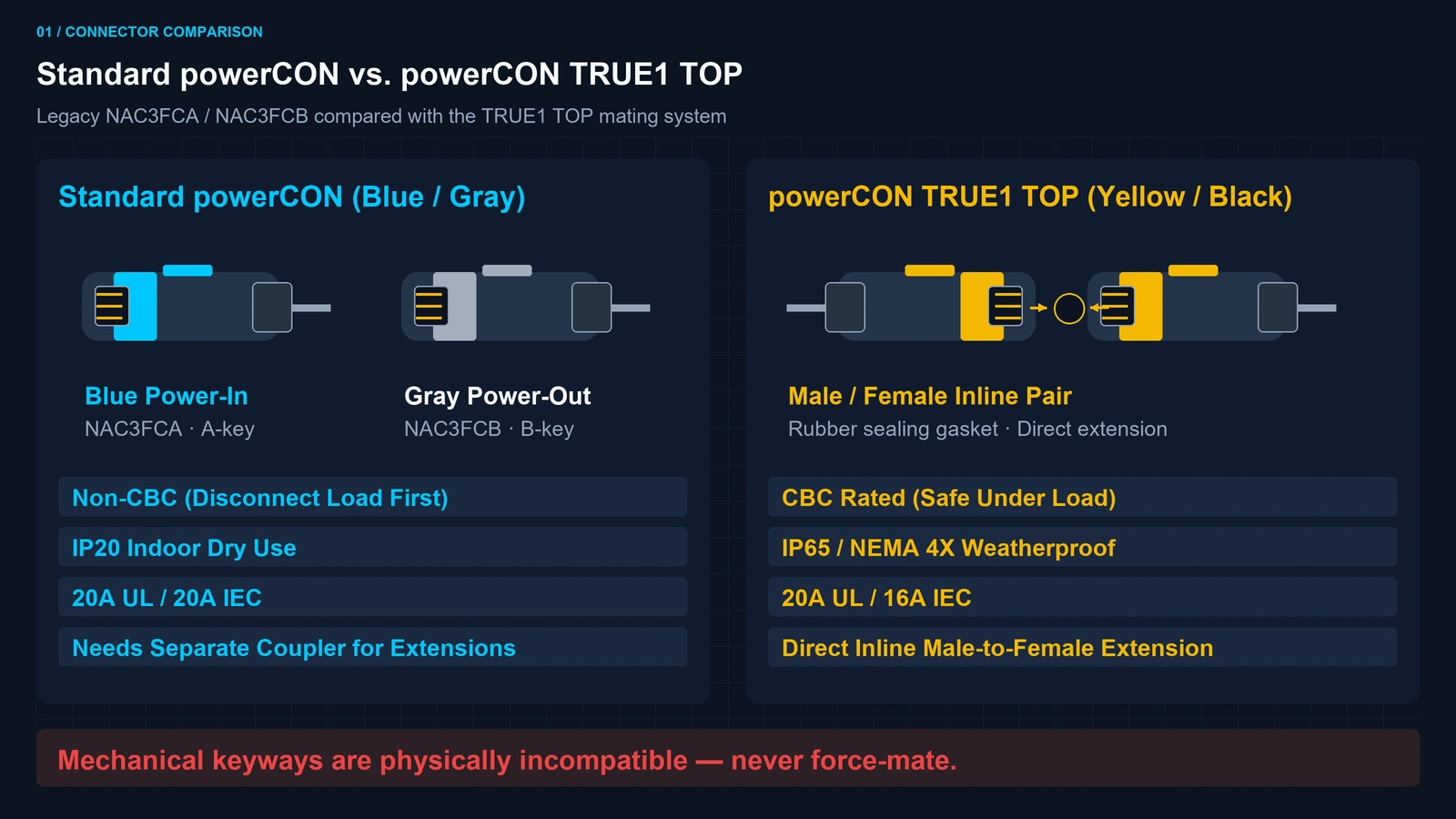
When comparing powerCON vs TRUE1, the core engineering difference is simple: powerCON TRUE1 (and TRUE1 TOP) is a true mains appliance coupler certified with Circuit Breaking Capability (CBC) so it can be safely plugged and unplugged under live load, sealed to IP65 when mated for outdoor shows, and built with interlocking male/female ends that extend cables inline. By contrast, original blue/gray powerCON (NAC3FCA power-in / NAC3FCB power-out) is an IP20 indoor-only locking connector without breaking capacity—meaning you must cut power before connecting or disconnecting it, and you need a separate barrel coupler to join two cables end-to-end.
Walk onto a stage deck after a rainy festival load-in or a rushed hotel ballroom changeover and you will see the same two power headaches over and over: crews unplugging blue powerCON jumpers under load until the brass contacts pit and arc, or technicians daisy-chaining eight high-draw moving heads or P3.91 LED cabinets through a skinny 16 AWG jumper cable simply because the connector shell says “20A”.
This field engineering guide answers what is powerCON, breaks down powerCON TRUE1 vs powerCON (plus TRUE1 TOP and widely used Seetronic Powerkon IP65 connectors on rental fixtures and outdoor LED walls), gives you an interactive powerCON vs TRUE1 Max Daisy-Chain Amp & Circuit Safety Calculator that exports a 1600×900 Rig Power-Link Card PNG, explains how to wire powerCON safely, settles powerCON vs speakON confusion once and for all, and maps safe power-linking numbers for real stage lighting and outdoor rental LED display fleets.
1. Interactive Tool: powerCON vs TRUE1 Max Daisy-Chain Amp & Circuit Safety Calculator
Before running power jumpers across a moving-head truss or an outdoor P3.91 LED video wall, remember the rule veteran touring electricians repeat on every call: the connector rating is almost never the weakest link in your daisy chain. Use this calculator to find the true bottleneck across your breaker’s 80% continuous load rule, connector rating (16A IEC / 20A UL), jumper wire gauge (12 / 14 / 16 AWG), and fixture power-out pass-through limit—then export a 1600×900 Rig Power-Link Sheet PNG for your cable trunk or crew chat.
powerCON vs TRUE1 Max Daisy-Chain Amp & Circuit Safety Calculator
Find the real limiting bottleneck across breaker 80% load, connector rating, jumper cable AWG, and fixture power-thru limits—then export a 1600×900 crew sheet PNG.
Field Electrician Action Checklist
Calculations assume conservative 0.90 power factor and 80% continuous breaker rule (NEC/IEC best practice). Always verify each fixture or LED cabinet manual for its exact Power-Out Thru current fuse rating and cable spec before energizing.
2. What Is powerCON? Locking AC Mains Connectors Explained
If you are transitioning from consumer IEC C13 computer cords to professional stage production, understanding what is powerCON saves shows from accidental blackouts. Neutrik powerCON is a rugged, 3-conductor (Live, Neutral, Protective Ground) twist-lock AC mains connector engineered specifically for live sound, stage moving head lights, and rental LED video walls.
Unlike friction-fit IEC plugs that vibrate loose on subwoofers or pull straight out when a stagehand trips over a truss feeder, a powerCON connector inserts straight in and twists clockwise until an internal mechanical latch clicks shut. It cannot pull free until a technician presses the release tab and twists counterclockwise.
What Is a powerCON Cable Used For on Stage?
A powerCON cable performs two critical jobs in modern AV rigs:
- Home-run power feeders: Connecting an Edison (NEMA 5-15), Schuko, CEEform, or stage distro box directly to the first moving head light or LED cabinet in a run.
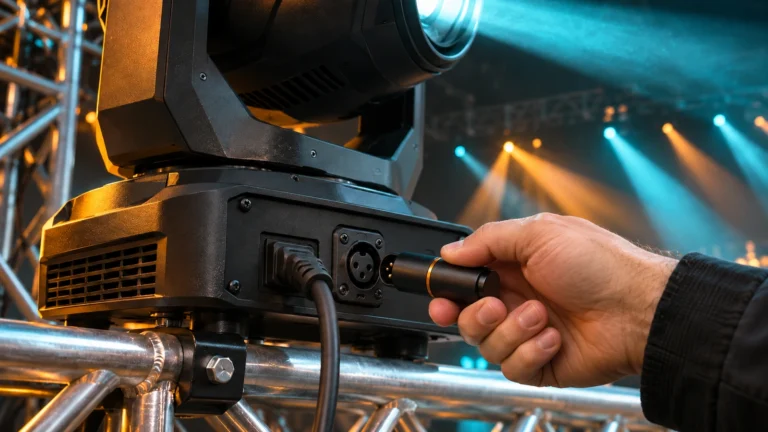
- Short power-linking jumpers (powercon daisy chain): Linking the AC Power OUT socket of Fixture #1 to the AC Power IN socket of Fixture #2 across a truss or vertical LED wall column, dramatically cutting cable weight and rigging time.
3. powerCON vs TRUE1 vs TRUE1 TOP: Official Engineering Comparison
Many rental buyers comparing powerCON vs powerCON TRUE1 assume powerCON TRUE1 vs powerCON is just a color change from blue/gray to yellow/black. In reality, they are completely different electrical certifications—and they do not physically mate with each other.
| Technical Specification | Standard powerCON (Blue NAC3FCA / Gray NAC3FCB) | powerCON TRUE1 (NAC3FX-W / NAC3MX-W) | powerCON TRUE1 TOP (NAC3FX-W-TOP / NAC3MX-W-TOP) |
|---|---|---|---|
| Color Coding & Keying | Blue = Power-In (Type A) / Gray = Power-Out (Type B); distinct mechanical keys prevent shorting | Yellow/Black locking coupler; single unified keyed mating pair (male + female) | Black/Yellow heavy-duty UV-stabilized housing; backward-compatible with original TRUE1 |
| Circuit Breaking Capability (CBC) | No (Non-CBC) — strictly dead-mate only; must not plug or unplug under live load | Yes (CBC) — certified appliance coupler; safe to connect/disconnect under live load | Yes (CBC) — certified appliance coupler under load (IEC/EN 60320-1 & UL 60320-1) |
| IEC Current Rating (Europe/Global) | 20 A rms @ 250 V AC (EN 61984) | 16 A rms @ 250 V AC (IEC/EN 60320-1) | 16 A rms @ 250 V AC (IEC/EN 60320-1) |
| UL Current Rating (North America) | 20 A @ 250 V AC (UL 1977) | 20 A @ 250 V AC (UL 60320-1) | 20 A @ 250 V AC (UL 60320-1 / UL 498) |
| Ingress Protection (IP Rating) | IP20 (indoor dry venues only; zero rain seal) | IP65 when mated | IP65 when mated (+ UL50E Enclosure Type 4 & UV outdoor weather resistance) |
| Inline Cable Extension | No — both ends of a jumper are female-style cable connectors; requires an external NAC3MM-1 barrel coupler | Yes — male and female cable ends lock directly together to extend runs cleanly | Yes — direct weather-sealed inline extension without extra barrels |
| Best Stage Application | Indoor ballrooms, clubs, permanent church/theater rigs, legacy moving head inventory | General touring, mixed indoor/outdoor events, fast stage changeovers | Outdoor festivals, IP65 outdoor rental LED displays, rain-exposed truss rigs |
(Note: Neutrik later introduced the updated powerCON XX blue/gray generation with CBC breaking capacity, but millions of existing stage lights and rental cables still use legacy non-CBC blue/gray shells—so unless every single plug and chassis socket in your warehouse is verified XX-series, treat all blue/gray powerCON as strictly cut-power-first!)
4. Why TRUE1 Won Outdoor Touring (and the Seetronic Powerkon Reality Check)
If you buy or rent professional outdoor stage lights or P3.91 500×1000 outdoor rental LED display cabinets, you will quickly notice two real-world patterns that most generic connector guides gloss over:
4.1 powerCON vs TRUE1 Outdoors: Why IP65 LED Walls and Stage Lights Demand TRUE1
- True Weather Sealing When Mated (and Capped): Standard blue/gray powerCON leaves exposed gaps around the latch (IP20). On an outdoor stage wall, wind-driven rain runs right down the power jumper straight into the rear power box—one of the six primary water-entry failures we documented in our LED Screen Water Damage & IP65 Recovery Guide. By contrast, powerCON TRUE1 TOP seals to IP65 when mated (see our IP65 vs IP67 protection breakdown) and includes UV-resistant shells that do not turn brittle under summer festival sunlight.
- No More Lost Barrel Couplers: With legacy blue/gray cables, extending a 5 m feeder into a 10 m feeder requires hunting for a separate double-sided coupler barrel (NAC3MM-1). TRUE1 cables use male-to-female ends just like regular extension cords—you snap two jumpers together in two seconds and drop a drip loop under the cabinet.
- Safe Hot-Swapping Under Live Load: When a single LED cabinet power supply or moving head faults mid-show, technicians often have to isolate one unit without killing an entire truss circuit. TRUE1's certified Circuit Breaking Capability (CBC) handles live disconnect without welding or pitting internal contacts.
4.2 Neutrik powerCON vs TRUE1 vs. Seetronic Powerkon (IP65 / SAC3 Series)
Across global rental production warehouses and export fixture fleets, you will frequently encounter Seetronic Powerkon (often nicknamed "TruCon" or "Tru1", such as the SAC3 IP65 series) installed on export stage lighting fixtures and outdoor LED cabinets. Here is what B2B buyers and rental crews should actually verify:
- Physical Intermatability: Seetronic's TRUE1-style IP65 Powerkon connectors are engineered to mate with Neutrik powerCON TRUE1 cables, making them widely used across cost-effective touring fleets.
- The D-Series Cutout Retrofit Advantage: Experienced touring technicians specifically note that legacy Neutrik TRUE1 chassis-out receptacles originally required larger non-D-series panel cutouts, whereas Seetronic introduced D-series-compatible female chassis-out variants (like the SAC3FPX-20) that drop cleanly into standard rack panels and fixture bases without custom metalwork.
- What Buyers Must Check Before Ordering: Never confuse genuine certified Neutrik or genuine certified Seetronic connectors with unbranded generic knockoffs. Uncertified clones often have loose spring tension, weak rubber O-rings that fail IP65 rain tests, or under-spec brass contacts that overheat at 12–15 A. Always verify connector certification and real cable copper gauge during pre-shipment inspection.
5. powerCON vs TRUE1 Daisy-Chain Amp Rule: How Many Lights or LED Cabinets Can You Link?
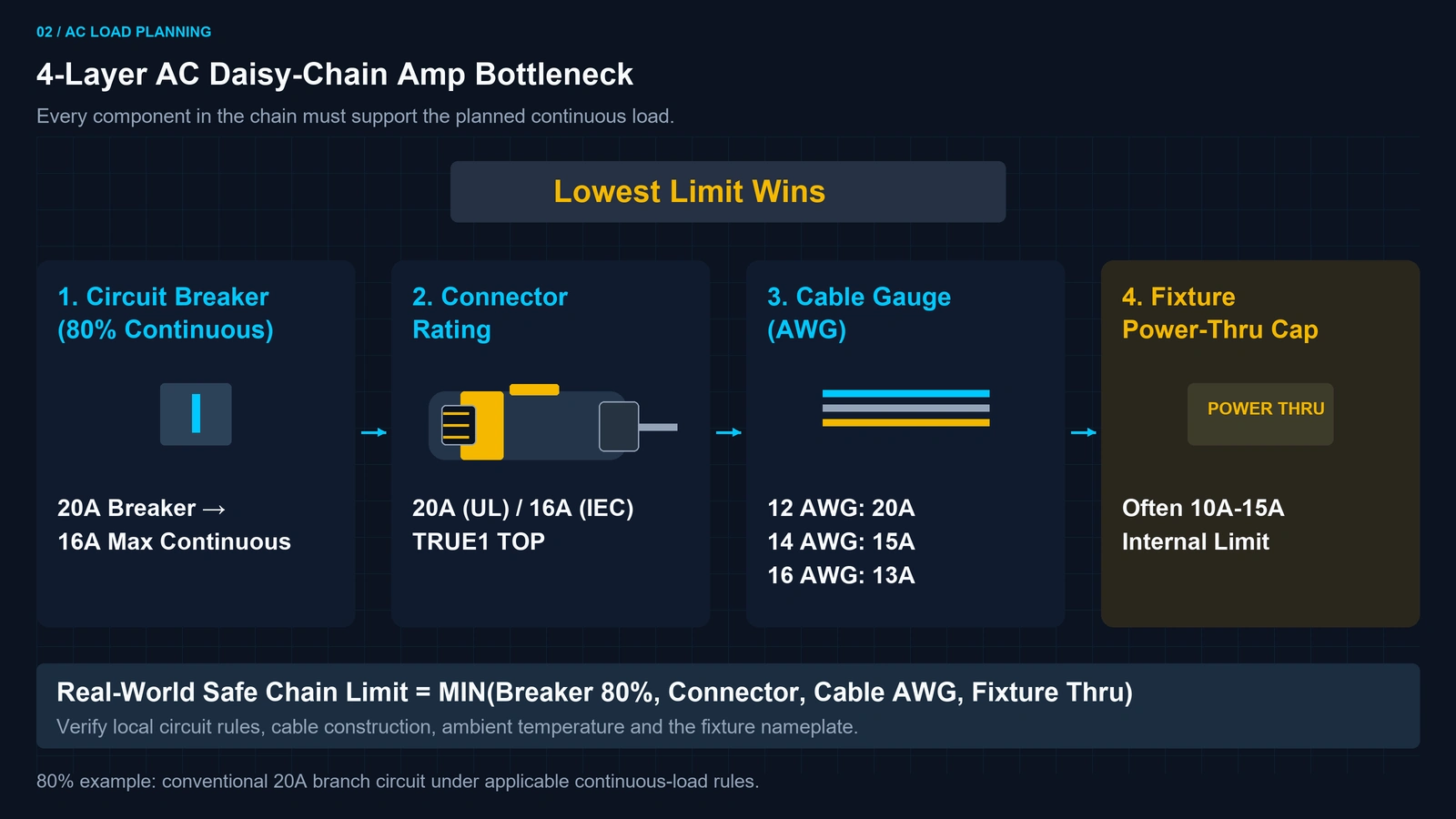
One of the deadliest myths on show sites is reading "20A" stamped on a blue or TRUE1 connector shell and assuming you can load 20 A continuously through a daisy chain. In commercial touring and rental production, master electricians follow a strict four-layer rule: your chain limit is the LOWEST number among these four layers:
- Circuit Breaker 80% Continuous Load Rule:
- US / North America (120V / 20A circuit): 20 A × 80% = 16 A continuous (~1,920 W max, or ~1,728 W at 0.90 power factor). On a 15 A hotel outlet: 12 A continuous (~1,440 W max).
- Europe / Global (230V / 16A circuit): 16 A × 80% = 12.8 A continuous (~2,944 W max, or ~2,650 W at 0.90 PF).
- Connector Rating (IEC vs UL):
- TRUE1 / TRUE1 TOP: 16 A IEC (230V) / 20 A UL (120V).
- Standard Blue/Gray powerCON: 20 A IEC & UL.
- Jumper Cable Copper Gauge (AWG / mm²):
- Cheap factory or third-party jumpers frequently use 16 AWG (1.0 mm²), which safely handles only ~13 A!
- Use 14 AWG (1.5 mm²) for standard 15 A–16 A runs and 12 AWG (2.5 mm²) whenever running full 20 A North American circuits.
- Fixture Power-Out (Thru) Internal Bus Limit:
- Many moving head lights cap their internal Power OUT pass-through bus or fuse at 10 A—even if the socket on the back is a 20 A powerCON! Always check the printed rating next to the POWER OUT socket on the fixture chassis.
Practical Daisy-Chain Reference Table (Verified WUYESTAGE Hardware Examples)
The table below uses verified rated power values (0.90 power factor, conservative 10 A fixture thru cap for moving heads / 16 A thru bus for outdoor P3.91 LED cabinets; always confirm exact connector and pass-through specs in your order documentation—see our Moving Head Power Consumption Guide and LED Display Power Consumption Guide for full breaker math):
| Equipment Example (Verified Rated Power) | Single-Unit Draw (120V / 230V @ 0.90 PF) | Safe Max Chain @ 120V / 20A (10A Thru Cap) | Safe Max Chain @ 230V / 16A (10A–16A Cap) | Recommended Jumper & Connector |
|---|---|---|---|---|
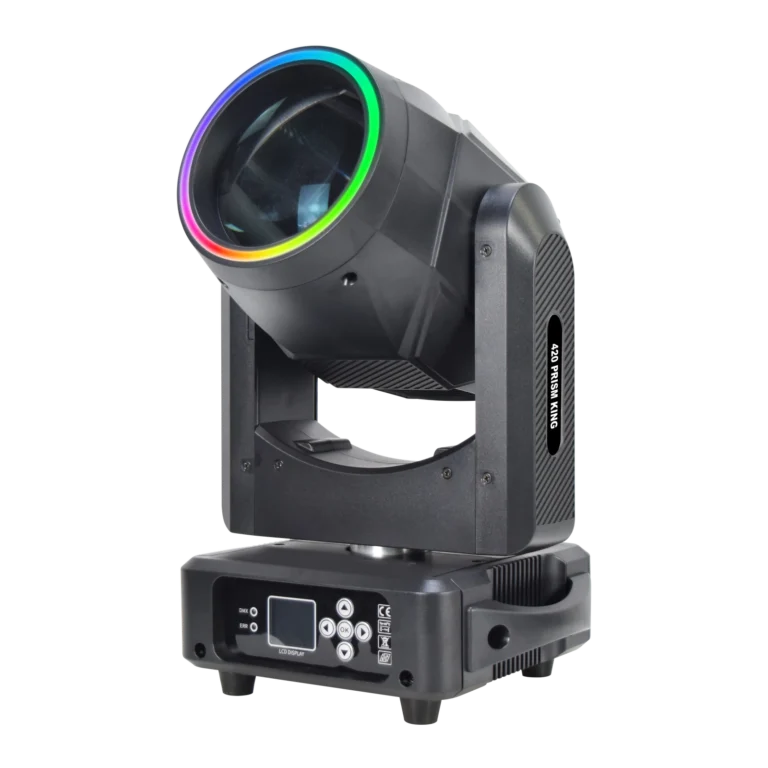
| 420 Prism King Beam (300W Lamp, 450 W rated) | 4.17 A / 2.17 A | 2 units (8.3 A) (3 units if thru ≥ 13A) | 4 units (8.7 A) (5 units if thru ≥ 11A) | 14 AWG (1.5 mm²), stagger lamp strikes |
| 295W Beam Moving Head (380 W rated) | 3.52 A / 1.84 A | 2 units (7.0 A) (4 units if thru ≥ 15A) | 5 units (9.2 A) | 14 AWG (1.5 mm²), stagger lamp strikes |
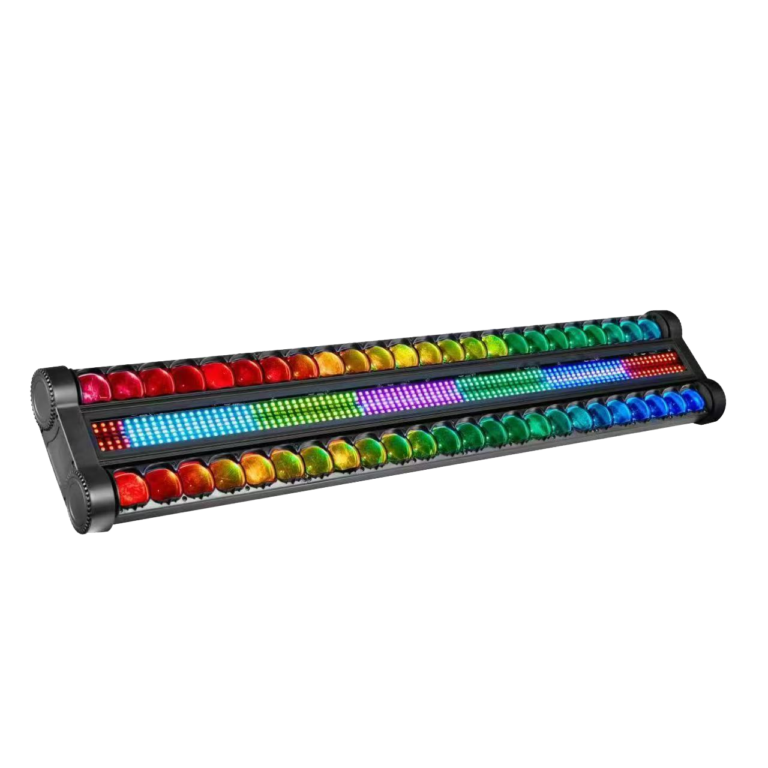
| 253W Double-Row Swing Strobe (253 W rated) | 2.34 A / 1.22 A | 4 units (9.4 A) | 8 units (9.8 A) | 14 AWG (1.5 mm²), clean DMX/power separation |
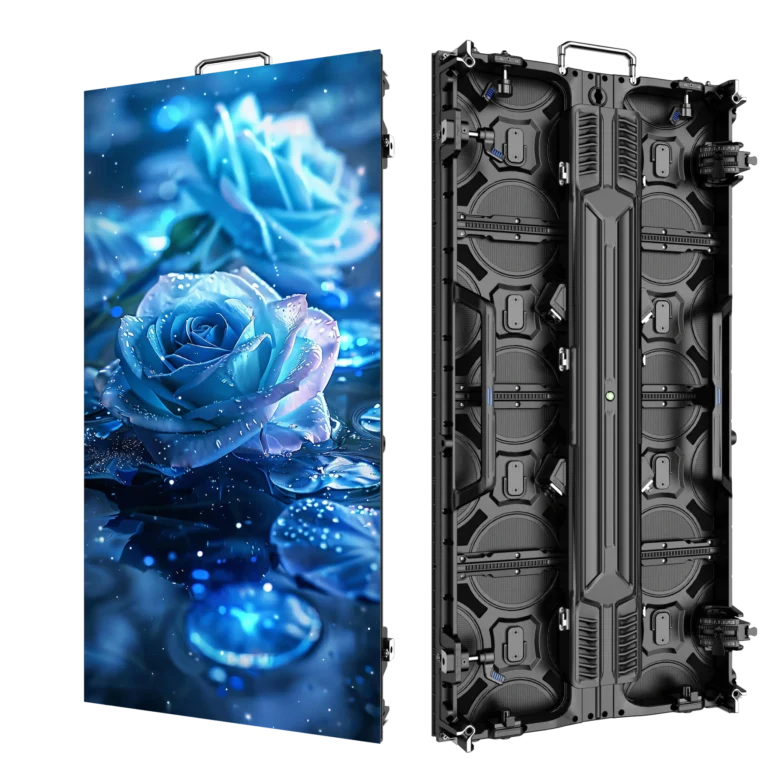
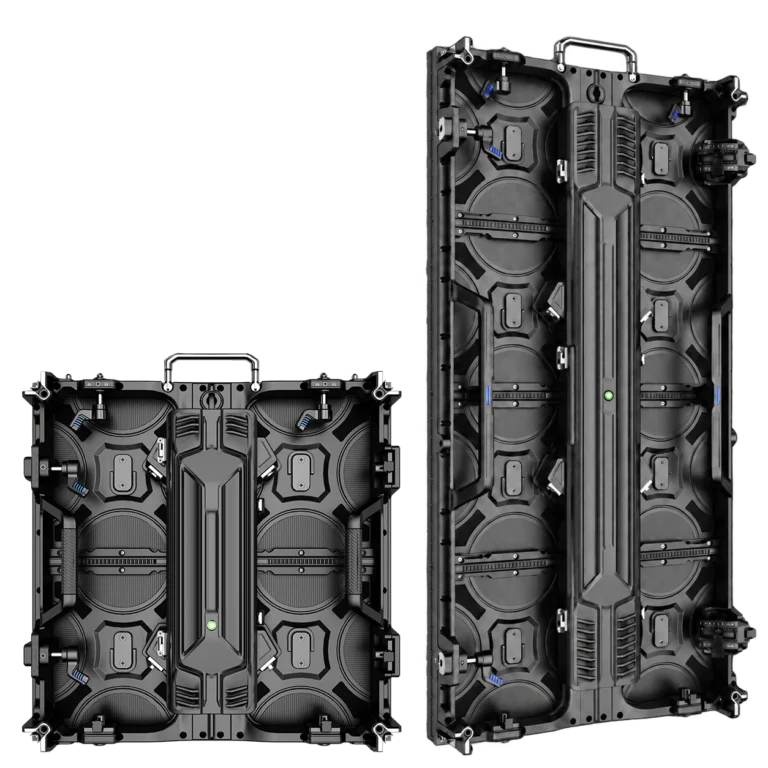
| P3.91 500×1000 Outdoor Cabinet (400 W max / 120 W avg per 0.5 m² cab) | 3.70 A max / 1.93 A max | 4 cabs @ max white (14.8 A w/ 16A thru) | 6 cabs @ max white (11.6 A w/ 16A thru) | IP65 TRUE1 + 14 AWG (1.5 mm²) or 12 AWG (2.5 mm²) |
6. powerCON vs speakON: Why Crews Confuse Them (and Why They Never Mix)
One of the highest-frequency beginner questions on Google is Are powerCON and speakON the same? The short answer is no—never confuse them, and never try to force one into the other.
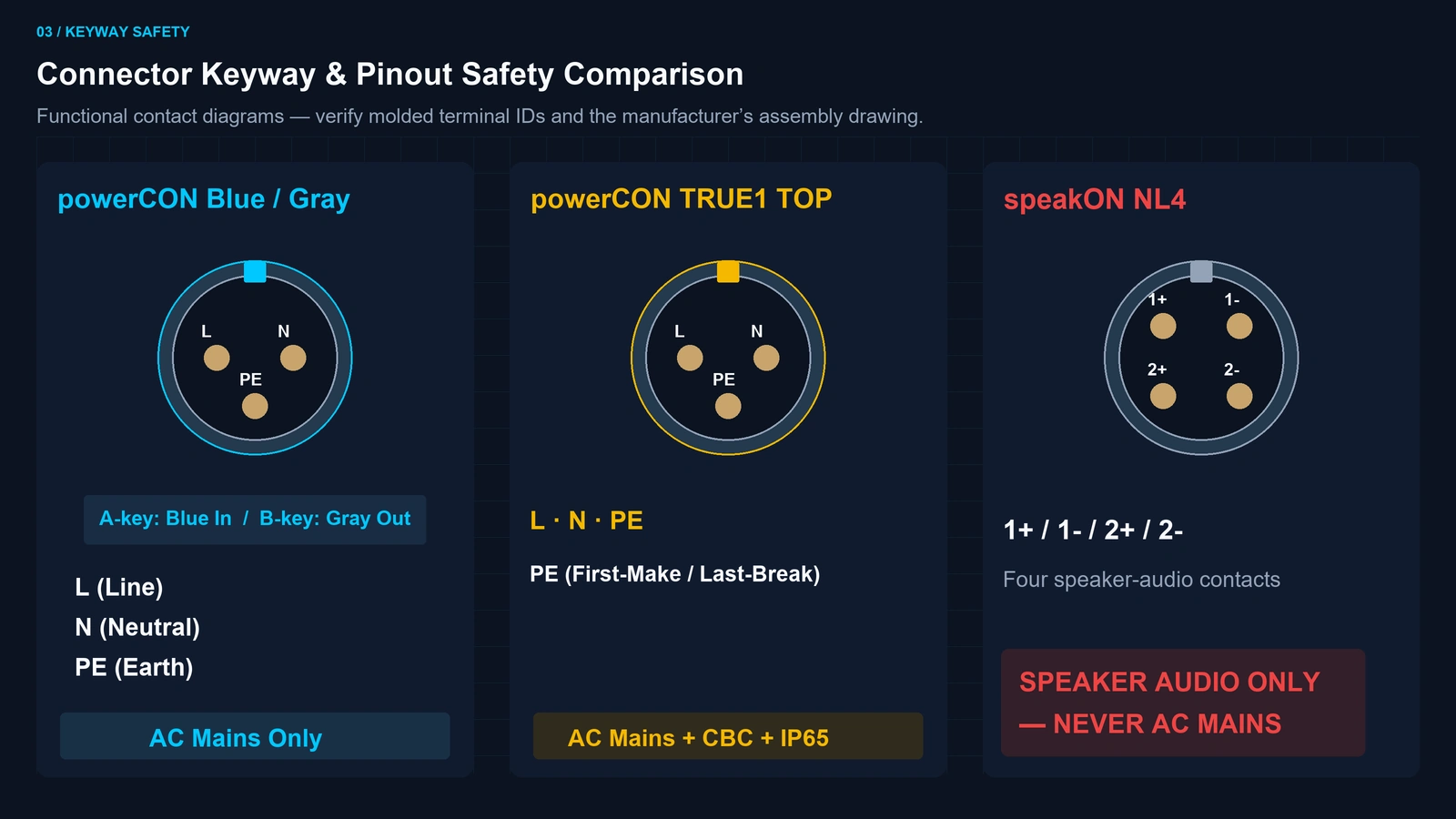
- Visual Similarity: Both were invented by Neutrik with nearly identical round twist-lock shells and release latches, which is why new stagehands grab the wrong cable trunk in dim backstage light.
- Opposite Electrical Jobs:
- speakON (NL2 / NL4 / NL8): Carries low-voltage amplified loudspeaker audio signals from power amplifiers to PA cabinets.
- powerCON (NAC3 Blue/Gray & TRUE1 Yellow/Black): Carries live 120V–250V AC mains electricity to stage lighting fixtures, powered speakers, and LED video walls.
- Built-In Mechanical Keyways: Neutrik engineered completely different internal keyways so a blue/gray powerCON plug physically cannot lock into a speakON speaker socket (preventing a catastrophic 230V AC injection into a loudspeaker voice coil). Still, labeling your trunks clearly (AC POWER — TRUE1 vs AUDIO — NL4 SPEAKON) eliminates show-day cable mix-ups.
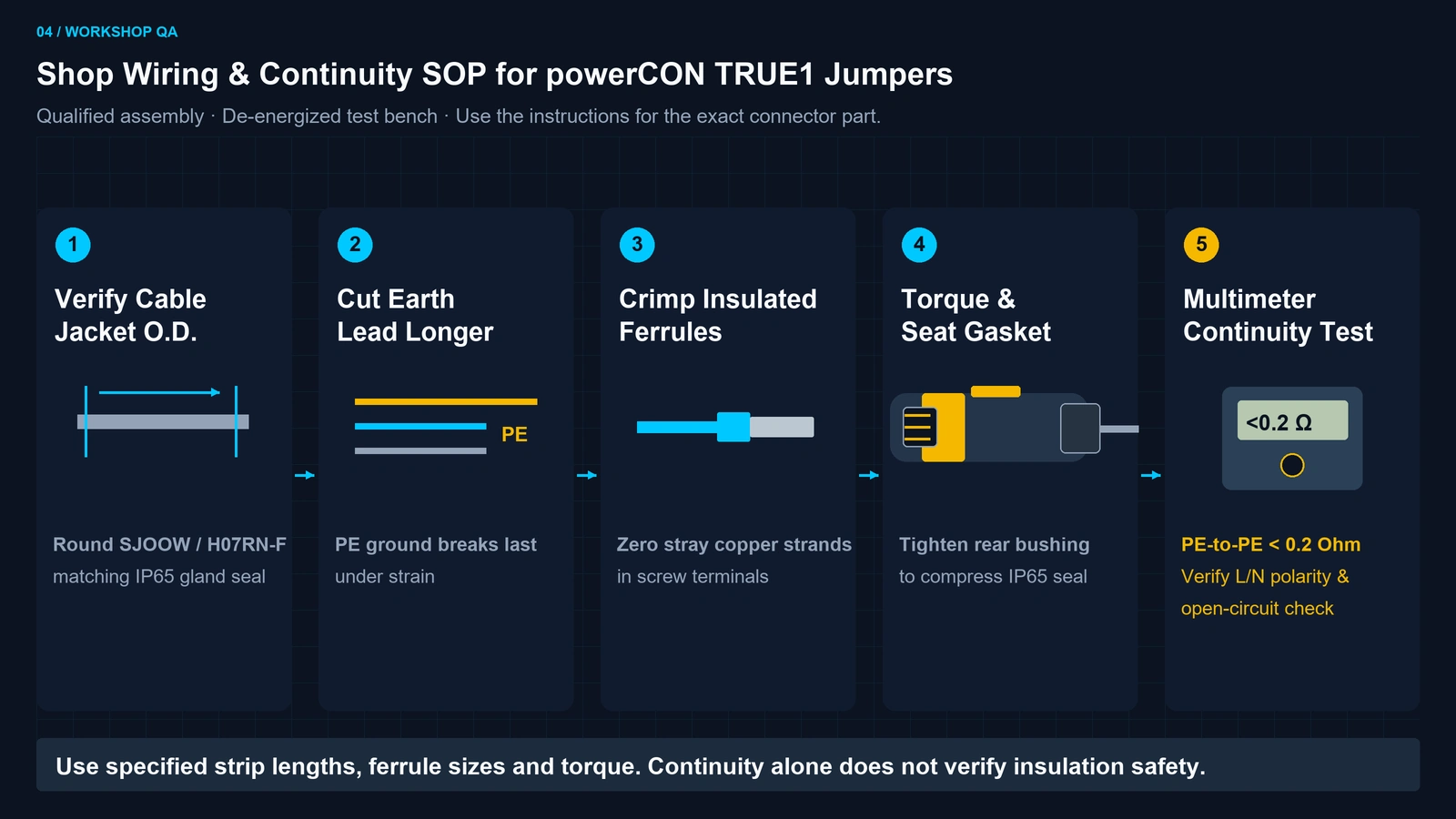
7. How to Wire powerCON & TRUE1 Connectors Safely (Shop Reference)
If your rental warehouse builds custom-length jumper cables, following exact terminal markings for how to wire powerCON prevents reversed polarity and lethal floating grounds. (All mains AC cable assembly must be performed by qualified personnel and tested with a continuity/insulation tester before live use.)
Standard 3-Terminal Wiring Pinout (Blue/Gray powerCON & TRUE1)
| Terminal Marking on Connector Insert | Electrical Function | North America (NEC) Wire Color | Europe / IEC Wire Color | Critical Shop Rule |
|---|---|---|---|---|
| L | Live / Line / Hot | Black | Brown | Strip length exact per datasheet (8–10 mm); zero stray copper strands |
| N | Neutral | White | Blue | Torque screw terminals firmly (or use insulated ferrules on stranded wire) |
| ⏚ (Ground Symbol) | Protective Earth / Ground | Green (or Green/Yellow) | Green/Yellow | Leave ground conductor ~3–5 mm longer so if cable pulls loose, ground disconnects LAST |
5 Mandatory Shop Assembly & Pre-Show Inspection Checks
- Verify Outer Jacket Diameter (O.D.) Fits the Chuck: Neutrik blue/gray NAC3FCA/FCB accepts 6–15 mm cable O.D. (using the correct white or black bushing), while TRUE1 TOP NAC3FX-W-TOP seals to IP65 only when the round cable jacket matches 6–12 mm—never put flat lamp cord inside a round IP65 gland!
- Use Ferrules or Proper Stranded Insertion: Avoid soldering tin onto wire tips clamped under screw terminals (solder cold-flows over time, causing loose high-resistance hot spots that melt plugs!). Use properly crimped bootlace ferrules or clean bare copper per the connector spec.
- Never Omit the Ground Wire: Stage trusses and aluminum LED cabinets are conductive metal structures. Every powerCON and TRUE1 jumper must pass <0.2 Ω end-to-end ground continuity.
- Test Polarity & Insulation Before Tagging: Verify L→L, N→N, G→G continuity and open-circuit (OL) between L–N, L–G, and N–G with a multimeter.
- Inspect Blue/Gray Contacts for Arc Pitting: If any legacy blue/gray plug shows black carbon burn marks on the brass blades from someone unplugging it hot, replace both the cable plug and the damaged fixture socket immediately.
8. powerCON vs TRUE1 Fleet Decision: When Should Rental Companies Upgrade?
Use this practical B2B procurement decision matrix when ordering new beam moving head lights, LED PAR fixtures, or outdoor rental LED display systems:
- Stay on Blue/Gray powerCON (with strict dead-mate SOP) when:
- Your gear lives strictly inside dry indoor ballrooms, churches, nightclubs, or fixed theaters;
- You already own hundreds of tested 14 AWG / 12 AWG blue/gray jumpers and want 100% spare-cable interchangeability across existing indoor stock.
- Standardize on powerCON TRUE1 / TRUE1 TOP (or verified IP65 Powerkon) when:
- You deploy gear outdoors (festivals, concerts, outdoor corporate tents, rain-exposed LED walls);
- Fast crew changeovers require safe live disconnect (CBC) and direct male-to-female cable extensions without barrel couplers;
- You are building a new 2026–2027 rental fleet and want one future-proof weather-sealed power standard across both lighting and LED displays.
9. Frequently Asked Questions: powerCON vs TRUE1
What is the main difference between powerCON and powerCON TRUE1?
powerCON TRUE1 is a true appliance coupler with Circuit Breaking Capability (CBC), meaning it can be safely plugged and unplugged under live load, seals to IP65 for outdoor use when mated, and extends inline via male/female ends. Legacy blue/gray powerCON is IP20 indoor-only, has no breaking capacity (cut power before disconnecting), and requires a separate barrel coupler to extend cables.
What are the differences between powerCON TRUE1 and powerCON TRUE1 TOP?
TRUE1 TOP (True Outdoor Protection) upgrades the original TRUE1 with UV-resistant, high-impact weatherproof housing materials certified to IP65 when mated and UL50E Enclosure Type 4, making it better suited for prolonged outdoor sun, rain, and heavy touring abuse while remaining mechanically compatible with original TRUE1.
How many amps can a powerCON or TRUE1 connector handle?
Standard blue/gray powerCON (NAC3FCA/FCB) is rated 20 A at 250 V AC (IEC and UL). powerCON TRUE1 and TRUE1 TOP are rated 16 A at 250 V AC under IEC/EN 60320-1 (Europe/Global) and 20 A at 250 V AC under UL 60320-1 (North America). In real daisy chains, always limit load to the lowest bottleneck among your breaker 80% rule, jumper AWG, and fixture Power-Out pass-through cap.
Are powerCON and speakON connectors the same?
No. Although both are Neutrik twist-lock connectors that look similar in dim backstage areas, speakON (NL2/NL4/NL8) is strictly for amplified loudspeaker audio signals while powerCON carries 120V–250V AC mains power. Different mechanical keyways prevent accidentally plugging mains AC power into a speaker cabinet.
Can you plug standard blue/gray powerCON into a TRUE1 socket?
No. Standard blue/gray powerCON and yellow/black powerCON TRUE1 have completely different mechanical dimensions and keyways and are not cross-compatible. To transition between fleets, use a purpose-built adapter whip made with properly rated 14 AWG or 12 AWG cable.
How do Seetronic Powerkon IP65 connectors compare to Neutrik powerCON TRUE1?
Seetronic's IP65 Powerkon (SAC3) line is widely used on export stage lights and outdoor LED display cabinets as a TRUE1-intermatable alternative, including D-series chassis-out options that simplify panel retrofits. Always verify genuine certified connectors, intact IP65 sealing rings, and true copper jumper AWG rather than using uncertified knockoffs.
When should you use powerCON instead of standard IEC power cords?
Use locking powerCON or TRUE1 whenever equipment is hung overhead on truss, stacked near subwoofers, or deployed on live stages where vibration or stagehand foot traffic could pull a friction-fit IEC plug loose mid-show. Choose TRUE1 specifically for any outdoor or moisture-exposed event.
How many moving head lights or P3.91 LED cabinets can you daisy-chain on one powerCON circuit?
Divide your lowest bottleneck amperage (commonly 10 A for fixture Thru ports, 12.8 A on a 230V/16A EU breaker, or 16 A on a 120V/20A US breaker) by each unit's operating current (Watts divided by Voltage × 0.90 PF). For example, on 230V/16A with a 10 A thru cap, link up to 4 × 450W beam moving heads; for outdoor P3.91 500×1000 cabinets (400 W max each) with a 16 A thru bus, cap runs at 6 cabinets per 230V/16A circuit at full white.
10. Need Matched Power Jumpers, Moving Heads, or Outdoor P3.91 Cabinets?
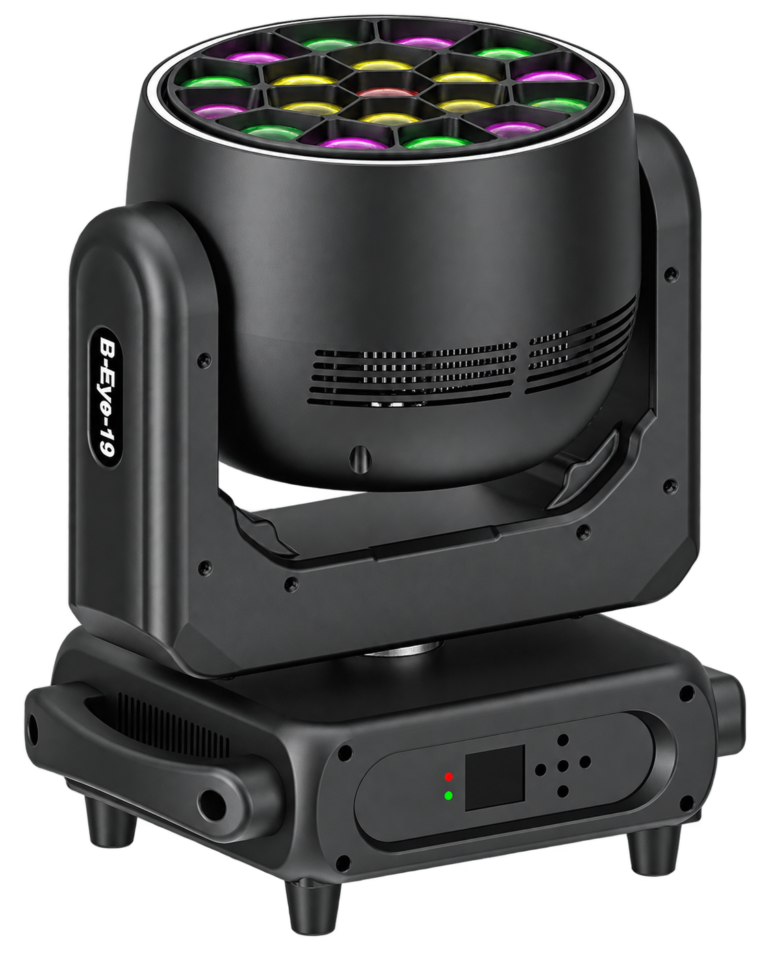
When deciding on powerCON vs TRUE1 for your rental fleet across stage lighting and outdoor LED video walls, send the WUYESTAGE engineering team your regional mains voltage (120V / 230V), preferred connector standard (blue/gray powerCON or IP65 TRUE1-style), fixture list (such as 420 Prism King Beam, 19×40W Rotating Bee Eye, or 253W Swing Strobe), and target LED screen dimensions (P3.91 500×1000 Outdoor Rental Display). We will return verified per-unit power specs, recommended jumper configurations, and a factory-direct B2B quotation via our Contact & Engineering Quote page.