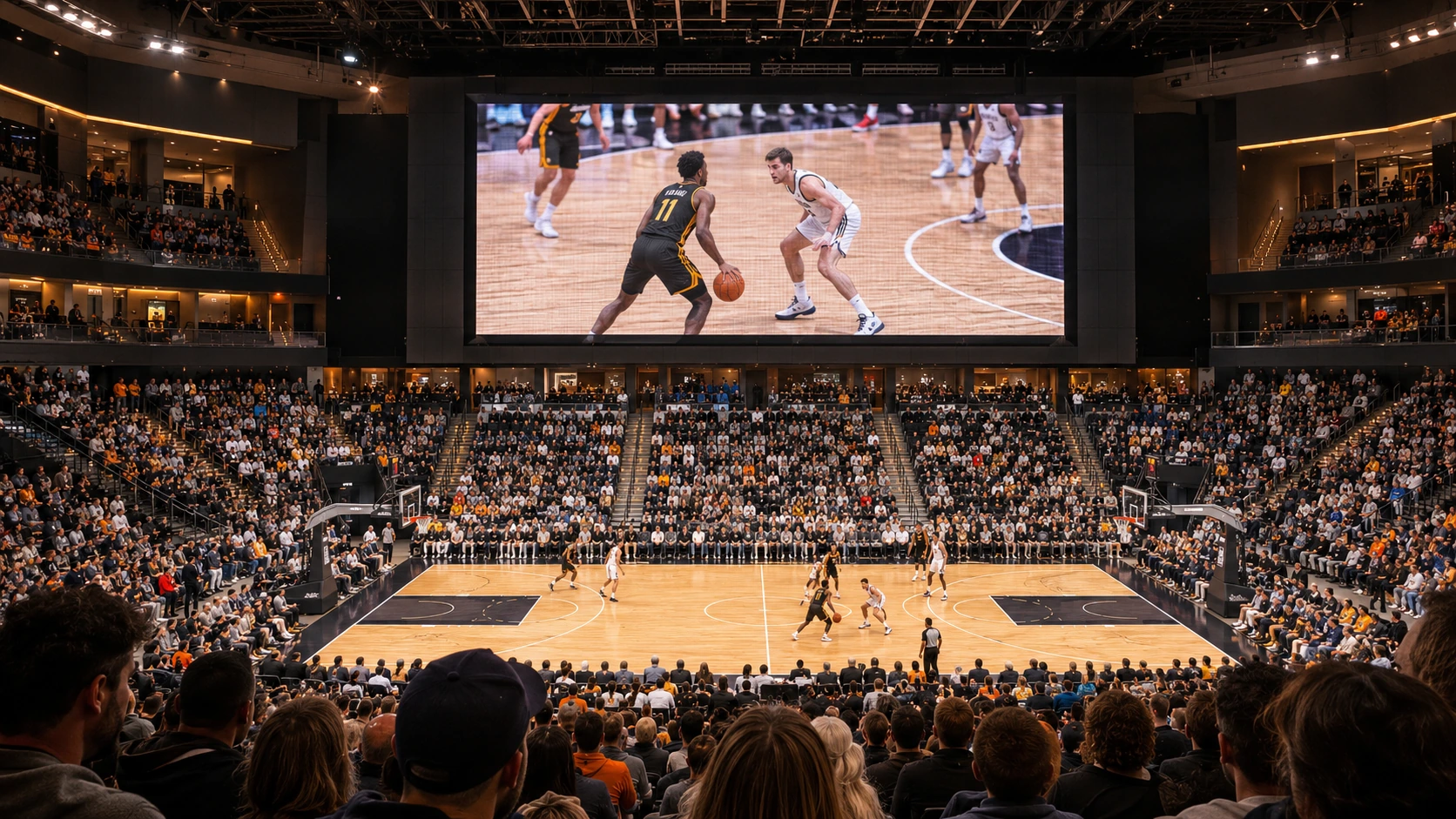
A jumbotron is a large video display used to give an audience a shared view of live action, replays, graphics, or event information. You will often see one at a stadium, arena, concert, or public viewing event. Modern versions commonly use direct-view LED video walls assembled from modular cabinets.
For an event coordinator, the useful distinction is between the screen's common name, the technology that produces its image, and the functions supplied by the wider system. A jumbotron can show a scoreboard, but the screen alone does not generate game scores or camera coverage.
Where Did the Word “Jumbotron” Come From?
The name comes from Sony's JumboTron, shown at Expo 1985 in Tsukuba, Japan. The original used cathode-ray-tube technology; later versions used LEDs, as described in the Bureau International des Expositions history of JumboTron.
Today, people also use “jumbotron” as a common name for a large event video display made by other manufacturers. The word alone does not specify its size, shape, pixel pitch, or resolution. A four-sided display over an arena floor is one familiar format; a single large video board can also be called a jumbotron.
How Does a Jumbotron Differ from an LED Video Wall or Scoreboard?
The three terms describe different aspects of a display system and can apply to the same installation.
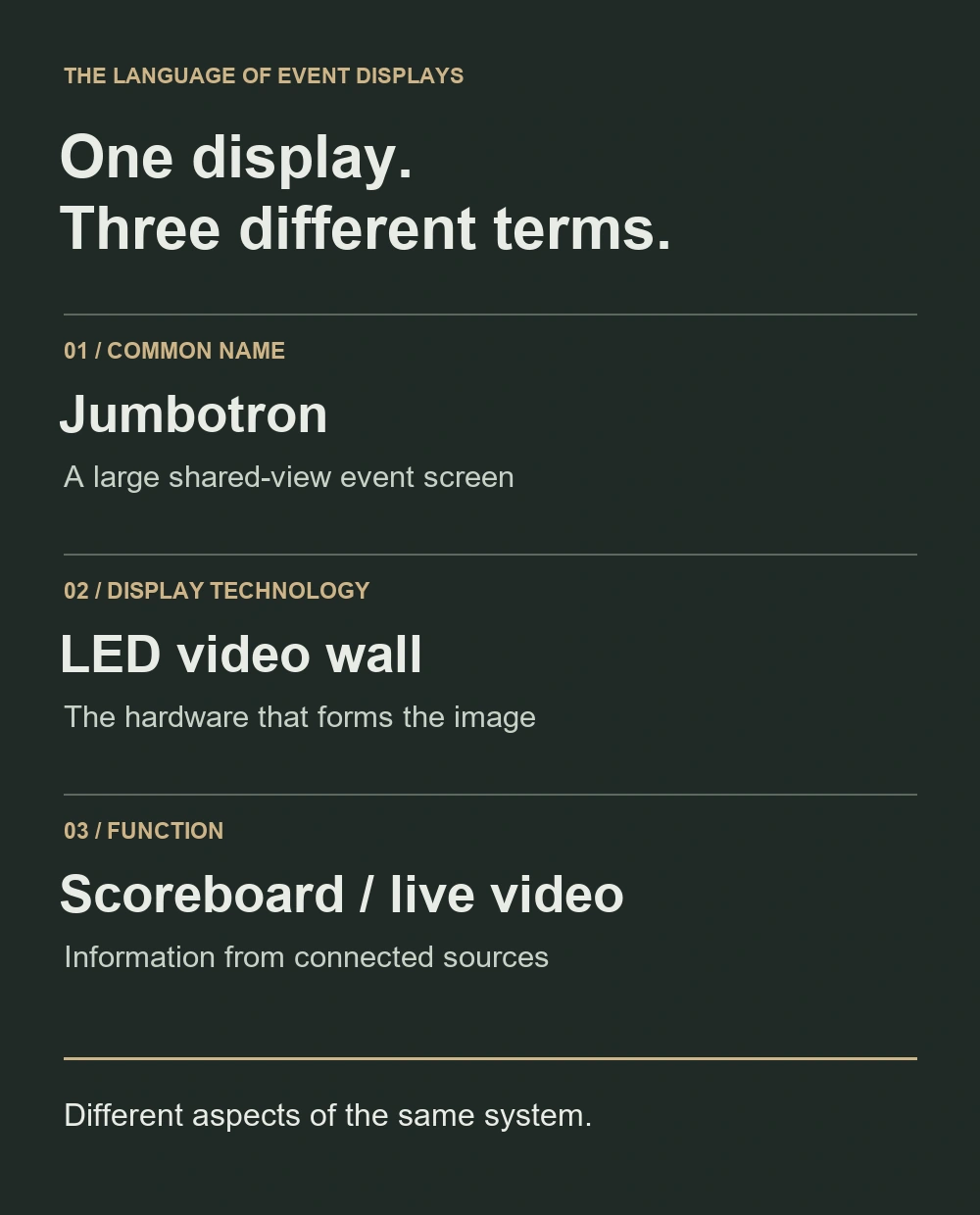
| Term | What it describes | What to clarify |
|---|---|---|
| Jumbotron | A common name for a large shared-view event video display | What the audience needs to see and where the screen will be used |
| LED video wall | A display technology: LED modules and cabinets form a video surface | Cabinet layout, pixel resolution, processing and installation requirements |
| Scoreboard | A scoring and timing function, or a dedicated device that presents that information | Where game data comes from and how it reaches the display |
A dedicated numeric scoreboard can show scores and a clock without displaying full-motion video. A video wall can show scoring graphics alongside camera images and replays when the appropriate sources and control systems are connected. It can also operate as a concert screen with no scoring function at all.
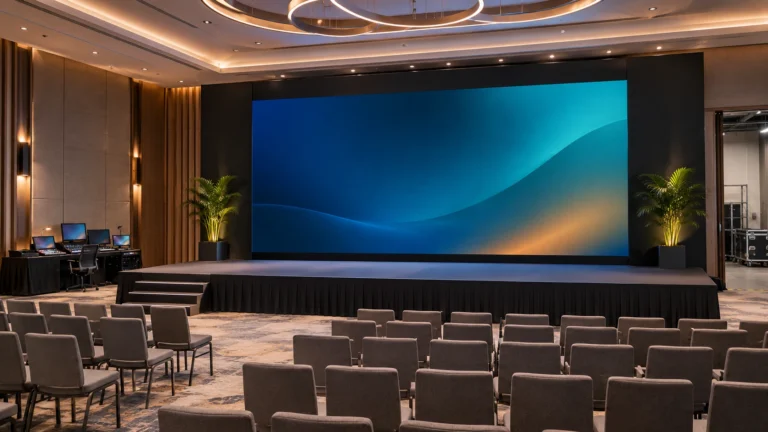
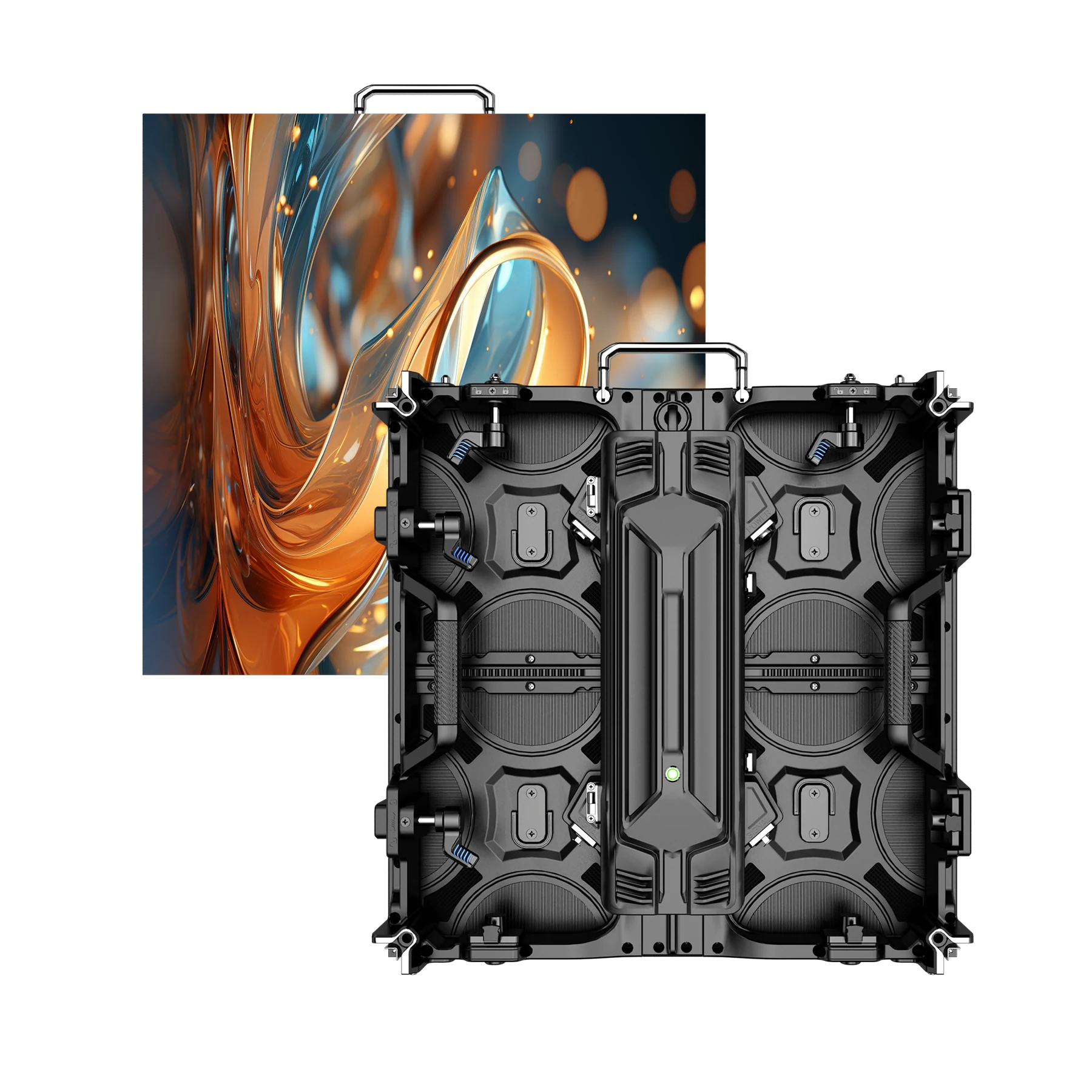
An LED video wall consists of cabinets containing LED modules. With compatible control equipment and correct mapping, those cabinets display one coordinated image. LED walls also serve many other purposes, so the technology name does not automatically mean a stadium jumbotron.
How Are Jumbotron Screens Used at Live Events?
Three familiar uses make the term easier to recognize:
- Sports-venue video board: shows camera coverage, replays or game graphics to spectators around a playing area.
- Concert side screen: shows live camera close-ups of performers, often called image magnification or IMAG, to help audiences follow the performance.
- Public viewing screen: carries a program feed for a fan zone, community event or other gathering.
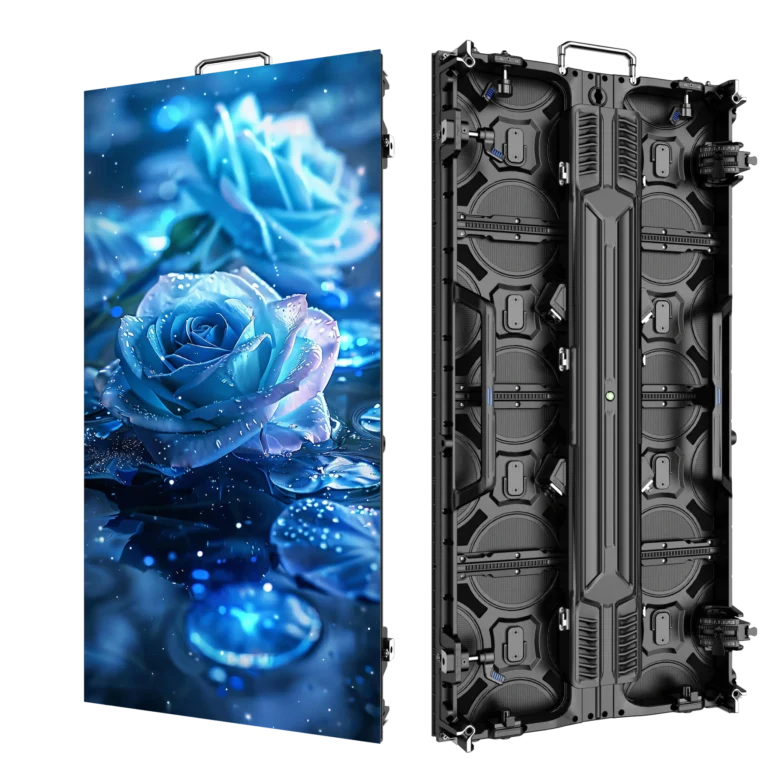
For screens assembled and moved between events, modular rental LED display cabinets provide a reusable building format. “Rental” here describes equipment designed for repeated deployment; a local event-rental package is a separate service scope.
Is a Large Jumbotron Automatically Native 4K UHD?
No. Physical size tells you how much space the screen occupies. Native resolution tells you how many physical pixels form its image. Pixel pitch—the distance between adjacent pixel centers—helps explain why two equally large LED walls can have different pixel counts.
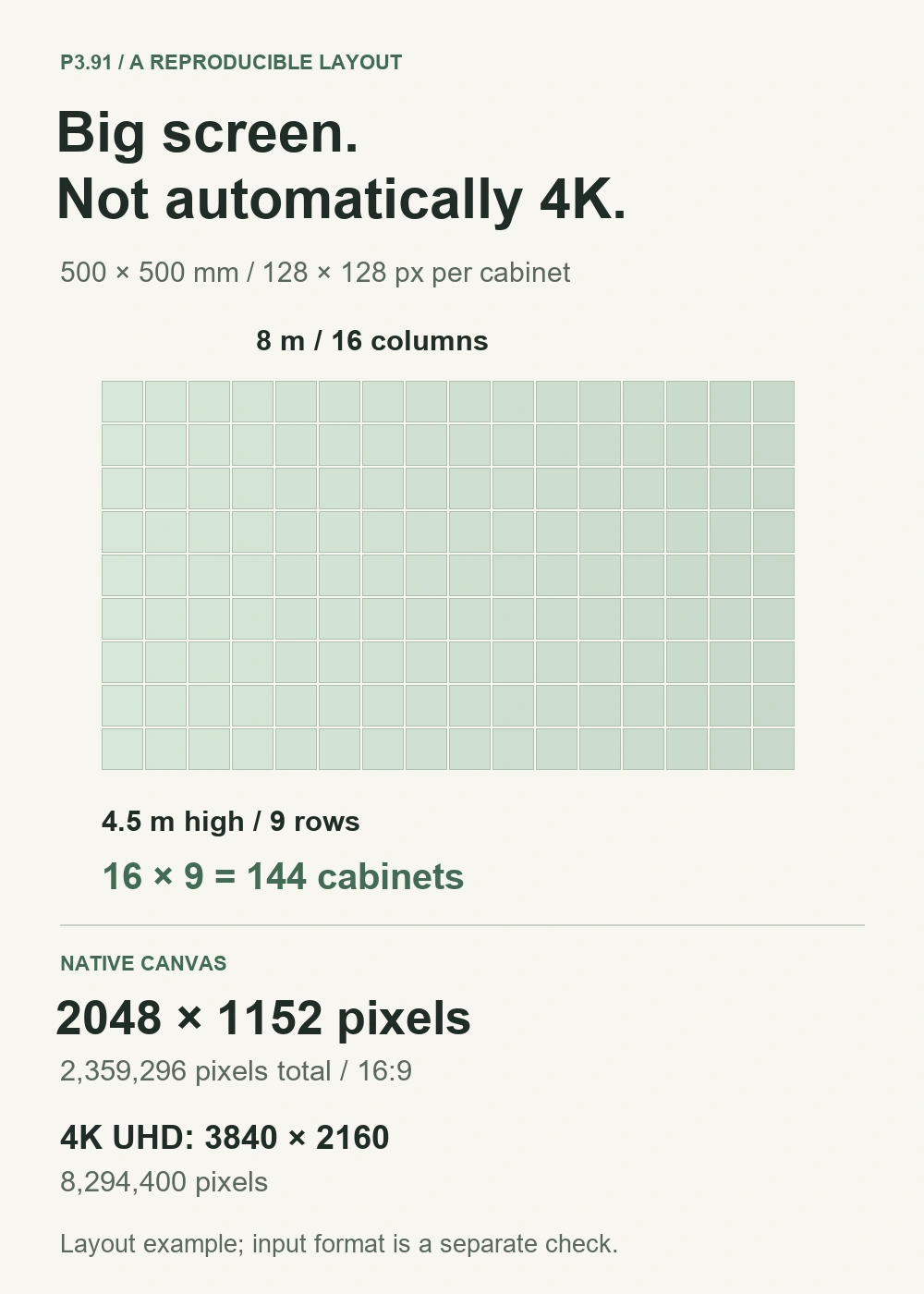
The ITU's explanation of television resolution identifies 4K UHD as 3840 × 2160 pixels, or 8,294,400 pixels in total. A large cabinet layout does not automatically reach that matrix.
Example: an 8 m × 4.5 m P3.91 Wall
Our P3.91 outdoor rental LED display has a 500 × 1000 mm cabinet format and a 500 × 500 mm alternative. For this example, use only the square 500 × 500 mm cabinets, each with 128 × 128 pixels.
| Calculation | Result |
|---|---|
| Width: 8 m ÷ 0.5 m | 16 cabinet columns |
| Height: 4.5 m ÷ 0.5 m | 9 cabinet rows |
| Cabinet count: 16 × 9 | 144 cabinets |
| Horizontal pixels: 16 × 128 | 2048 pixels |
| Vertical pixels: 9 × 128 | 1152 pixels |
| Native canvas: 2048 × 1152 | 2,359,296 pixels |
This 8 m × 4.5 m screen has a 16:9 shape and a native resolution of 2048 × 1152 pixels, so it is not native 4K UHD. The calculation uses the cabinet's exact pixel matrix rather than rounding from the nominal P3.91 pitch. It is a layout example; structure, power and control compatibility still require project-specific checks.
Accepting a 4K input is a separate question. A compatible processor may receive and scale a 4K source to fit this smaller pixel canvas. Confirm the selected processor, interface and input format; accepting that source does not add physical pixels to the wall.
Use the LED wall size and resolution calculator to explore preliminary cabinet layouts for your intended dimensions.
What Equipment Provides the Video, Scores and Sound?
The LED screen displays the image it receives. Other equipment supplies the program and its functions:
- Live camera images: need a camera source and a compatible signal path. Multi-camera shows commonly use a production switcher.
- Replays and recorded content: need a replay or playback source appropriate to the production. The display does not create instant replays itself.
- Scores and game clocks: need a scoring/data source and a compatible way to present that information on the screen. The exact console, software and interfaces depend on the system.
- Sound: comes from an audio system; the LED cabinet surface does not serve as a PA loudspeaker system.
For an equipment quotation, confirm the cabinets, receiving/control equipment, processing, cables and spares included in the proposed package. Separately agree who supplies the content sources, audio and installation engineering. The name “jumbotron” does not define those responsibilities.
How Much Does a Jumbotron Cost?
There is no single price attached to the name. Screen dimensions, pixel pitch, indoor or outdoor configuration, processing and the agreed supply scope all affect a quotation. Buying display equipment and hiring a local event-production package involve different costs.
For equipment purchasing, our LED wall cost guide for rental companies explains how to compare quotation scope. It is a hardware-purchasing guide, rather than a local event-rental rate card.
What Should You Send a Screen Supplier?
If your team calls the planned screen a jumbotron, describe the project in concrete terms: its use, intended width and height, closest and farthest audience positions, indoor or outdoor exposure, and the content or signal source you want to display.
WUYESTAGE supplies modular rental LED display cabinets and project-selected control hardware. Share those project details and the equipment you need included so we can discuss a suitable cabinet layout and control configuration. If cameras, scoring, replay or audio must connect to the screen, identify those systems early so their interfaces and responsibilities can be confirmed.