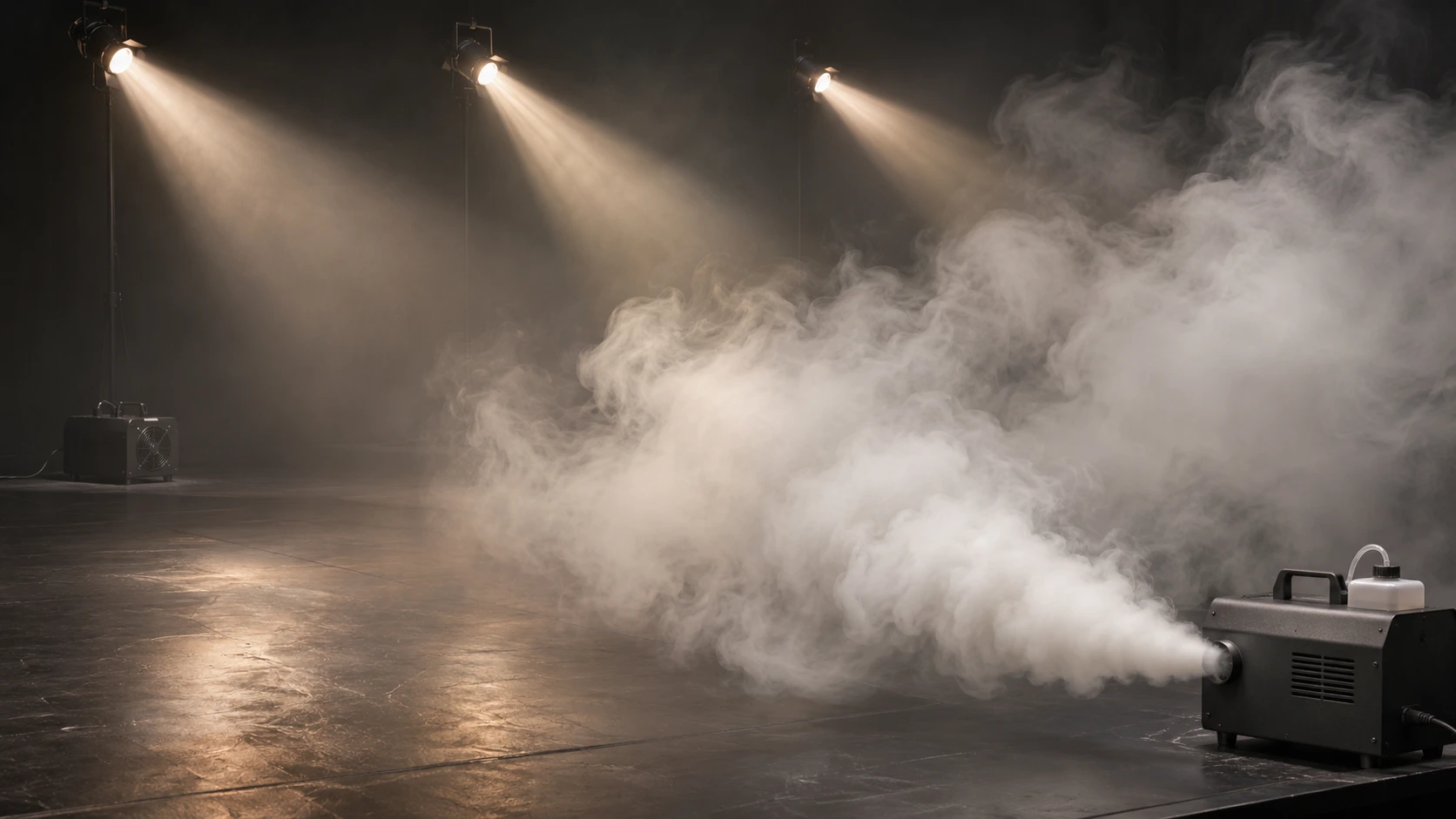
A haze machine vs fog machine comparison starts with the effect you want to sustain. A hazer is usually the better starting point for a thin, even atmosphere that reveals lighting beams. A fogger is usually the better starting point for a visible cloud or a timed burst. A floor-hugging effect needs a suitable low-fog system; an ordinary fogger does not automatically provide it.
Choose the visual task first, then confirm the exact machine, approved fluid and venue conditions. Neither the machine name nor its electrical wattage predicts the result in your room.
Hazer vs fogger: the practical comparison
“Smoke machine” commonly means a theatrical fog machine in equipment listings. When comparing a hazer vs smoke machine, check the actual product description: the label alone does not tell you its mechanism, fluid or duty cycle. Theatrical atmospheric effects should not be confused with smoke from burning material.
| Decision | Haze machine / hazer | Fog machine / fogger |
|---|---|---|
| Main visual goal | A relatively even atmosphere supporting visible light paths | A visible cloud, plume or timed atmospheric moment |
| Typical appearance | Thin veil, with scenic detail remaining readable at a suitable density | More concentrated and uneven clouds that can become part of the scene |
| Cue behavior to check | Maintaining the required atmosphere across the cue or show | Starting, shaping and clearing the cloud at the required moment |
| Output control | Check haze output, fan control and supported continuous operation | Check output adjustment, burst behavior and recovery between cues |
| Machine and fluid | Match the exact hazer to its specified fluid | Match the exact fogger to its specified fluid |
| Floor-level effect | Not the usual purpose of an even room haze | Requires an appropriate low-fog configuration rather than an assumed ordinary fog output |
| Venue acceptance | Requires approval for the proposed effect and conditions | Requires approval for the proposed effect and conditions |
These are selection tendencies, not guaranteed hang times or output measurements. Products overlap: some machines can produce a range of effects, but a low setting on a fogger is not proof that it maintains the same uniform atmosphere as a particular hazer.
Choose between three effect targets
1. You want the audience to see the beam in the air
Start by evaluating a hazer with the lighting cue. Light traveling through a room becomes visible from the side when enough light is scattered toward the viewer. The International Laser Display Association’s explanation of haze and fog describes this principle and the different visual textures of thin haze and denser fog. Its laser examples explain the mechanism; they do not measure the output of a conventional stage fixture.
An even atmosphere can make a moving light’s path read across a cue. A dense moving cloud can instead reveal bright patches, hide scenery or change the look as it passes through the beam. More atmosphere is not automatically a better lighting result.
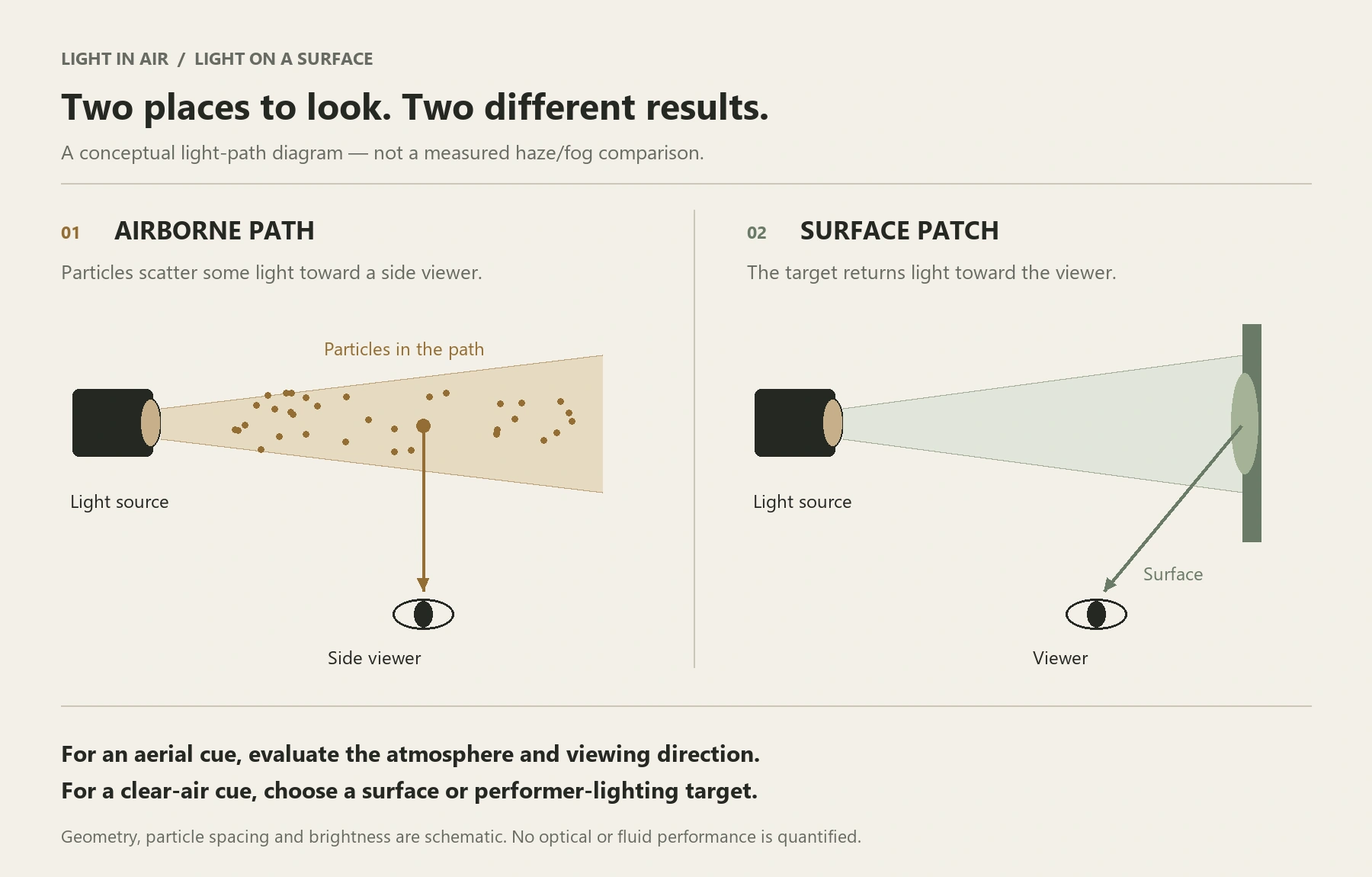
The airborne path and the illuminated surface are different visual targets. Diagram is conceptual; particle spacing, beam size and brightness are not to scale.
2. You want a cloud to arrive on a cue
Start by evaluating a fog machine. Write the cue in observable terms: where the cloud should appear, which sightlines must remain clear and when the following scene needs visibility again.
Test the complete cue sequence. A machine that produces an attractive first burst may need different preparation or recovery before the next one. Check the manufacturer’s operating cycle and rehearse at the intended interval instead of judging a single demonstration.
A hazer and fogger can serve separate roles in one production: a maintained atmosphere for lighting and a cloud for a specific moment. Using both adds fluid, control, placement and venue requirements; it is not an automatic upgrade.
3. You want fog to stay near the floor
Specify a low-lying fog effect as its own task. Confirm the equipment and operating conditions needed to obtain it. Cooling systems and purpose-built low-fog machines differ; an ordinary fogger’s cloud may rise or follow air currents instead of staying at floor level.
Rosco’s fog FAQ explains chilled fog in its own system and distinguishes fluids with different effect behavior. That is a useful reason to evaluate the complete machine/fluid/effect combination, rather than treating every fog machine as a low-fog machine.
For a musical or entrance cue, include the desired coverage and clearance in the demonstration brief. Keep any gas, cooling, handling and ventilation requirements with the specific system documentation. This comparison does not supply a universal low-fog operating procedure.
Water-based or oil-based does not identify the mechanism
Hazers can use different methods to create and disperse their output. “Water-based” does not mean every machine uses ultrasonic atomization or operates without heat. For example, the JEM Hazer Pro manual describes a water-based haze system with a heating stage and a specified fluid. Its operation is a model example, not a rule for all hazers.
Use the fluid approved for the exact machine. Do not interchange fluids simply because both containers say “water-based,” and do not mix a substitute to make a fogger behave like a hazer. The machine documentation determines fluid compatibility, preparation, cleaning and shutdown requirements.
Similarly, neither “haze” nor “water-based” establishes zero residue, zero odor or an acceptable result around sensitive scenery and equipment. Agree what must remain clean and inspect it under the intended demonstration conditions. Avoid choosing from claims that omit the machine, fluid and conditions behind them.
Check the venue before choosing either machine
Both haze and fog introduce airborne material. Confirm whether the venue permits the proposed equipment and fluid, and which approval process and operating conditions apply. A hazer is not a workaround for a no-atmospherics rule, and neither category guarantees that detectors will remain unaffected. Keep detection-system decisions with the responsible venue personnel.
If atmospheric effects are not permitted, change the lighting target. Our moving head lights without haze guide explains how to evaluate surface color, projected patterns and performer visibility in clear air. An attractive haze-filled demonstration cannot establish that clear-air result.
For a permitted effect, compare these practical conditions:
- Air movement: record HVAC, open doors, fans and outdoor wind. A rehearsal in still air does not establish the show’s distribution or clearance behavior.
- Ambient light and sightlines: inspect the cue from the actual audience and camera positions. Check whether the effect supports the beam while keeping faces, scenery and required routes readable.
- Noise: listen to the fan, pump or compressor at the output setting used for the cue, including quiet dialogue and recording conditions.
- Readiness and endurance: check warm-up, recovery, permitted continuous operation, refill and shutdown against the actual show sequence.
- Operating cost: compare approved-fluid use for the intended duty, consumables, cleaning and service. Purchase price and heater wattage alone do not establish running cost or useful coverage.
Do not compensate for disappearing haze simply by increasing output without reviewing the permitted conditions. Reconsider distribution, the visual target and whether the chosen effect is practical in that venue.
Match the lighting cue to a real fixture
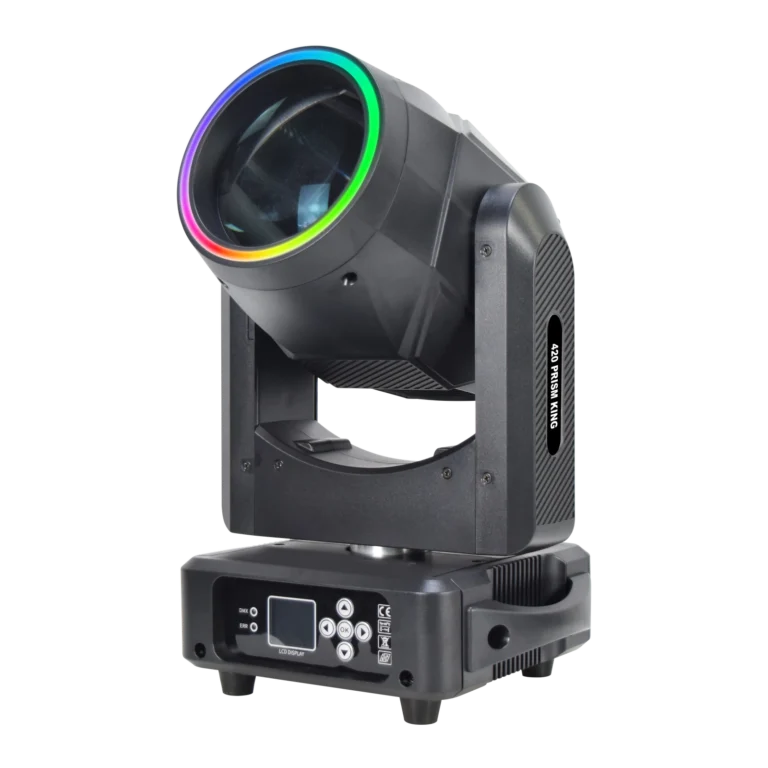
Atmosphere and fixture optics contribute different parts of the result. The 420 PRISM KING BEAM is a relevant narrow-beam reference: the current RG-132 configuration specifies a 2° beam and prism options. Evaluate the chosen optical setting with the actual throw, atmosphere, ambient light and viewing position.
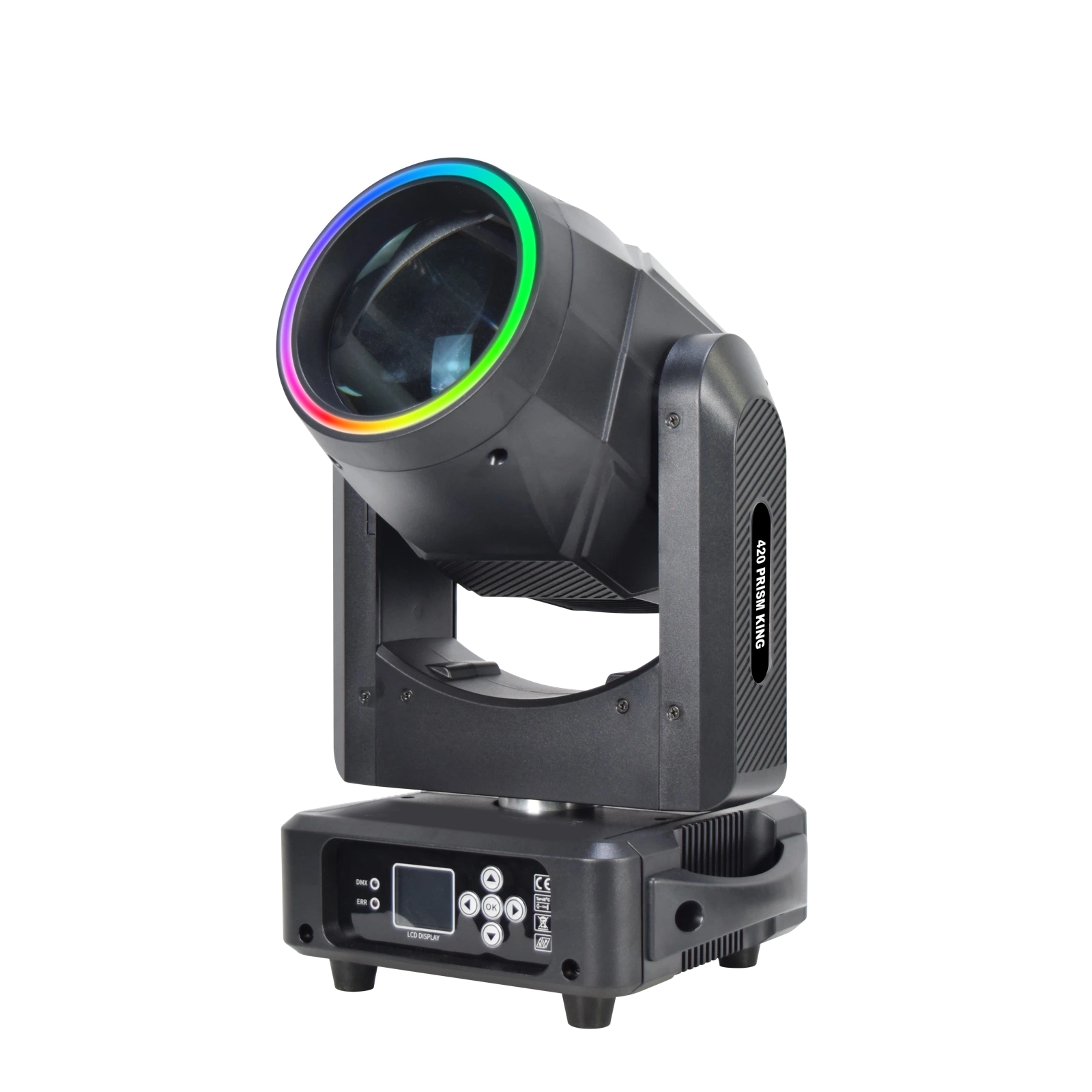
Use the same fixture position and optical setting when comparing atmosphere. The colored front ring and the airborne beam are separate visible features.
A product photo identifies the fixture being discussed. It does not establish a haze-machine pairing, measured aerial visibility or low-fog performance. Keep the fixture cue fixed while testing the atmospheric system, then evaluate any proposed lighting change in a separate run.
Compare the same cue and keep a usable record
A haze vs fog machine demonstration is useful when the conditions are recorded and the acceptance target is clear. Start with a baseline under the venue’s normal lighting and ventilation. Then test each permitted machine/fluid combination against the same fixture cue. Allow the room to return to a comparable baseline before attributing a later result to a different machine.
The following is a filled planning example, not a completed test. CUE-01 asks for an aerial beam with readable scenic detail. The machine identities, operating settings and outcomes must be filled from the actual demonstration.
| Record field | CUE-01 planning example | Fill from the demonstration |
|---|---|---|
| Visual goal | See the airborne beam from the center and rear audience positions; retain scenic detail | Agreed acceptance wording and views |
| Fixture and cue | Same RG-132 unit; open white, prism out, static cue | Exact unit/configuration, console cue and settings |
| Geometry | Do not move the fixture or viewing positions between runs | Position, throw, aim and observation/camera locations |
| Venue condition | Use the intended show HVAC and house-light settings | Room/door/fan conditions, light settings and permission reference |
| Atmospheric equipment | Baseline without added effect; then permitted hazer and fogger runs | Model, approved fluid, preparation, output/fan setting and run ID |
| Capture | Keep camera settings fixed for the comparison | Camera, lens, exposure, white balance and original clip ID |
| Behavior to check | Beam continuity, scenic readability, noise, buildup and clearance through the cue sequence | Observations and elapsed times actually measured |
| Decision | Pending demonstration | Accepted conditions, unresolved issue and retest required |
For a cloud or floor effect, create a different goal record instead of marking a hazer as unsuccessful for a task it was not selected to do. If several variables change together, the footage shows the combined setup; it cannot isolate the contribution of one machine.
Retain the original clips and operating record with the proposed configuration. A later change in fluid, machine, HVAC or room calls for a review of the affected result. Do not carry one venue’s accepted settings into every future booking without checking the conditions.
What to include in a stage-lighting inquiry
Tell WUYESTAGE whether the task is an aerial beam, a projected pattern, surface coverage or a combination. Include the venue environment, atmospheric permission, mounting positions, throw, audience/camera views, quantity and control requirements. If the venue prohibits haze or fog, state that at the start.
These inputs help match lighting fixtures and demonstration conditions to the project. Specify atmospheric equipment separately with the responsible supplier; a lighting-fixture quotation should not silently imply that an unconfirmed fog or haze system is included.
Frequently asked questions
Is a hazer better than a fog machine for moving-head beams?
A hazer is usually the better starting point for a relatively even atmosphere that supports visible beam paths. Confirm the exact fixture cue, machine/fluid and venue conditions; a denser cloud is not automatically an improvement.
Can a fog machine replace a haze machine?
It may create a useful atmospheric look, but it is not automatically equivalent. Check whether the exact fogger can maintain the required distribution and duty cycle without unwanted visible clouds, noise or interruptions.
Will an ordinary fog machine make low-lying fog?
Not reliably by category name alone. Specify a suitable low-fog system and test the intended coverage and clearance under the actual room and airflow conditions.
Can I use a hazer when a venue bans smoke machines?
Clarify the venue’s restriction before selecting equipment. If it bans atmospheric effects, do not substitute a hazer to bypass it. Plan clear-air surface and performer-lighting effects instead.