Moving head lights without haze can still illuminate surfaces, create projected effects and provide moving color coverage without haze. The choice changes when a venue prohibits atmospheric effects: judge the result on the wall, floor, scenery, performers or visible fixture, rather than relying on a showroom photograph of airborne beams.
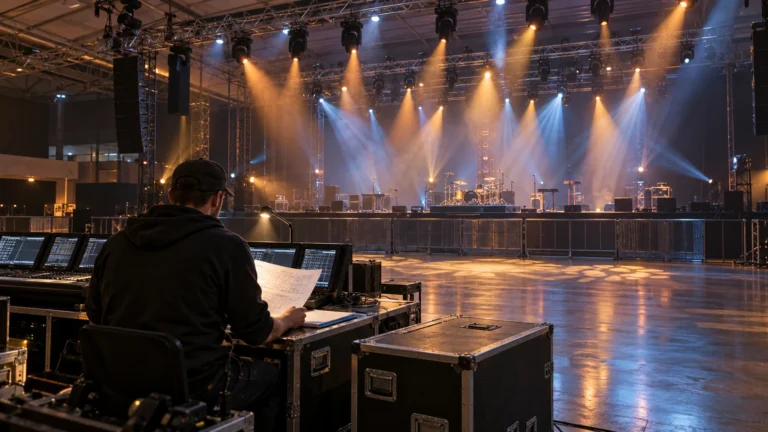
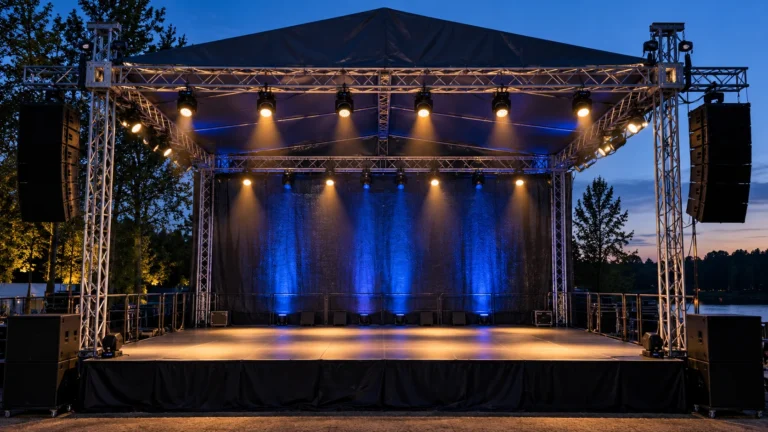
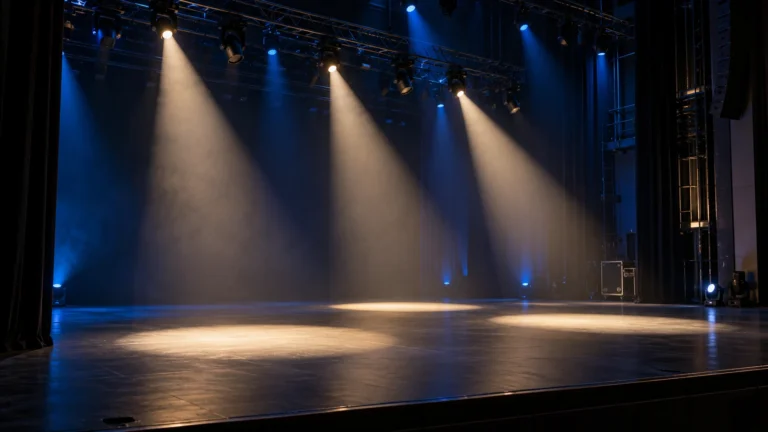
A beam moving head still emits light in clear air. What may disappear is the strong visible path through the room. ETC’s atmospheric-effects explanation describes fog and haze as media that make light beams more visible. Their contribution should be part of the purchasing conditions, not an unnoticed difference between a supplier demo and your venue.
Check 1: define the venue restriction
Record whether the venue prohibits fog, haze or all added atmospheric media, and whether that restriction applies throughout rehearsal and performance. Use the venue’s actual requirement. Calling an effect subtle, water-based or almost invisible does not establish permission.
If the project must run without haze, ask for a clear-air demonstration. A video filmed with atmospheric effects answers a different question. Do not build a purchase around obtaining an exception later or around an unapproved change to venue systems.
Also record the room’s normal ambient light. A dark demonstration room cannot predict how a projected pattern will read beside house lighting, daylight or illuminated displays. If the event changes from daylight to evening, evaluate both relevant conditions.
Check 2: choose a visible target
Start by deciding what the audience must see. These are different visual jobs, even when every shortlisted fixture has a moving head.
| Required result in clear air | Start with | Verify in the venue |
|---|---|---|
| Readable patterns or texture on scenery | Suitable Spot or Profile configuration | Focus, useful pattern size and edges at the real throw |
| Broad color on a stage or scenic area | Suitable Wash configuration | Coverage, blending and dimming across the required area |
| Faces visible to the audience and camera | Appropriate performer-lighting fixtures and positions | Skin appearance, shadows, glare and camera exposure |
| Moving accents on a wall or floor | Projection-capable fixture matched to the cue | Where the effect lands, transitions and audience sightlines |
| A visible aperture or front-ring accent | Fixture with the documented visible feature | Appearance from audience positions without expecting room-wide illumination |
| Strong suspended shafts through the room | Reconsider the cue if the venue is no-haze | Do not approve from a haze-heavy demonstration |
The Beam, Spot and Wash comparison explains how to test the optical roles separately. For a no-haze purchase, the extra step is to test them in the atmosphere you are actually allowed to use.
Check 3: match the optics to the target
A fixture may include gobos, color wheels and prisms while remaining a narrow-beam effect product. The existence of a pattern wheel does not prove readable projection at your distance or useful coverage on your target.
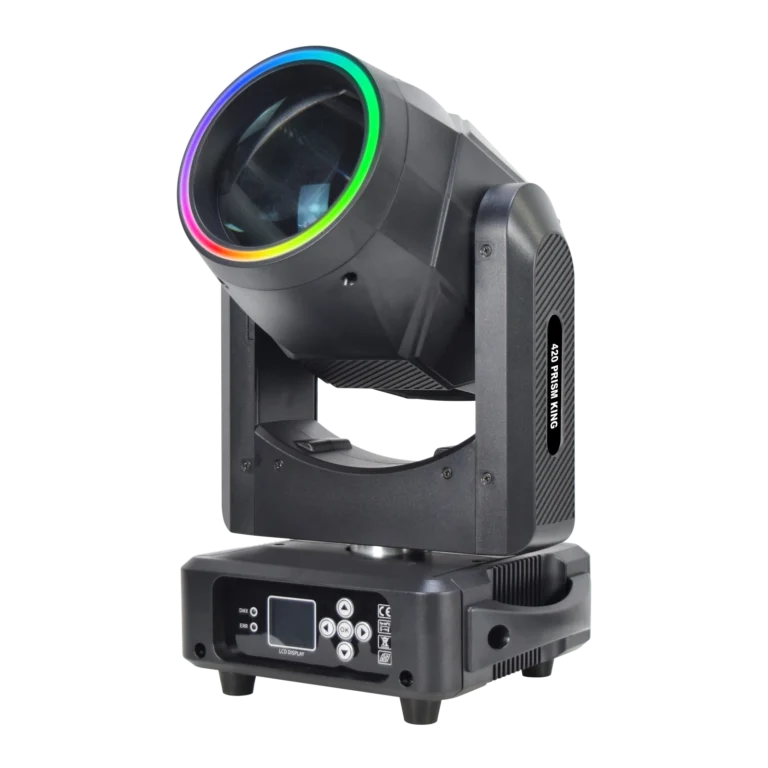
For example, the RG-132 420 Prism King has a documented 2° beam, four prism structures, fixed gobos and an RGB front ring. Those features provide effect options, but do not establish that it is a substitute for a dedicated wash, face light or framing fixture.
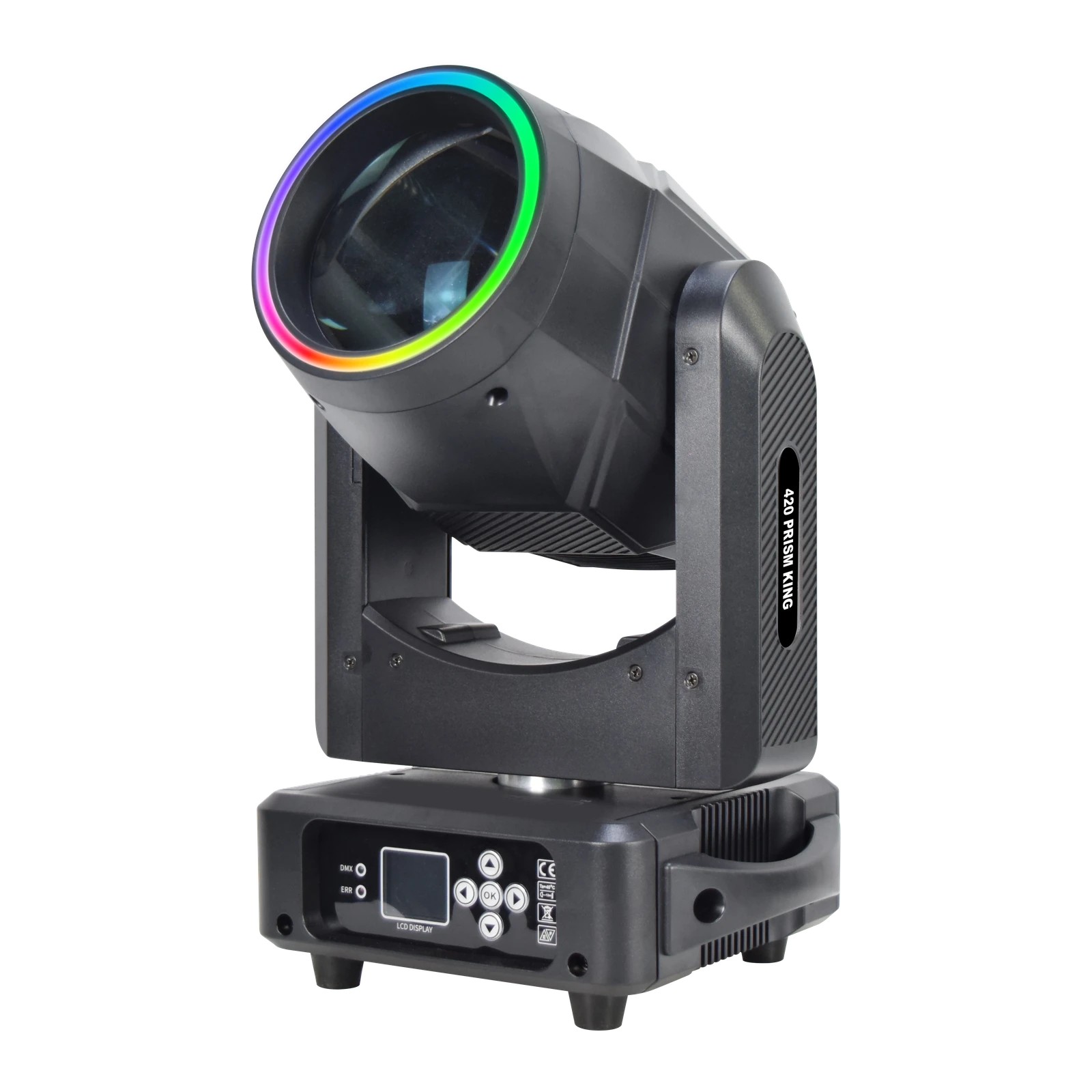
In a no-haze venue, test any proposed surface cue directly. Record the target material, working distance, required pattern size, ambient light and viewing positions. If the required result is readable projection, begin with the Profile and Spot range; confirm the exact model’s focus, gobos and any framing functions instead of treating the whole category as one specification.
Check 4: test coverage and performer lighting
For a stage wash, identify the area that needs color and examine its useful edges, centre and overlaps. Run the colors and dimming transitions required by the event. A striking circular spot in the centre is not proof of even coverage across the stage.
Use the LED Wash range to explore that role. A zoom range or bee-eye effect may be relevant to a particular configuration, but the actual coverage still needs to be tested at the planned position and distance.
Keep performer lighting as its own task. Decorative projection and visible front-ring accents may add interest while leaving faces poorly lit. Evaluate the needed light on a person or a suitable test target under the intended camera and viewing conditions; do not infer it from an empty-stage effect photo.
Check 5: test moving head lights without haze in the venue
Approve cues rather than an attractive general demo. A simple record can follow this sequence:
- Identify the exact model, optical configuration, firmware and control mode.
- Record the no-haze condition and actual room lighting.
- Establish the target, mounting position and working distance.
- Run each required cue on that target, including transitions and repeat positions.
- View it from relevant audience positions and the camera when recording matters.
- Save a photo or clip with the conditions and the accept/reject decision.
For each cue, write the required result before testing. “Gobo remains readable on the rear wall under normal house lighting” is more useful than “looks bright.” A wash record should name its coverage area; a decorative-ring record should name the viewing positions.
If a cue fails, change the target, fixture role or proposed look and test again. Merely buying more of the same fixture does not prove that the original target will be met. Adding atmospheric media is not a valid correction when the brief prohibits it.
Plan a clear-air conference cue
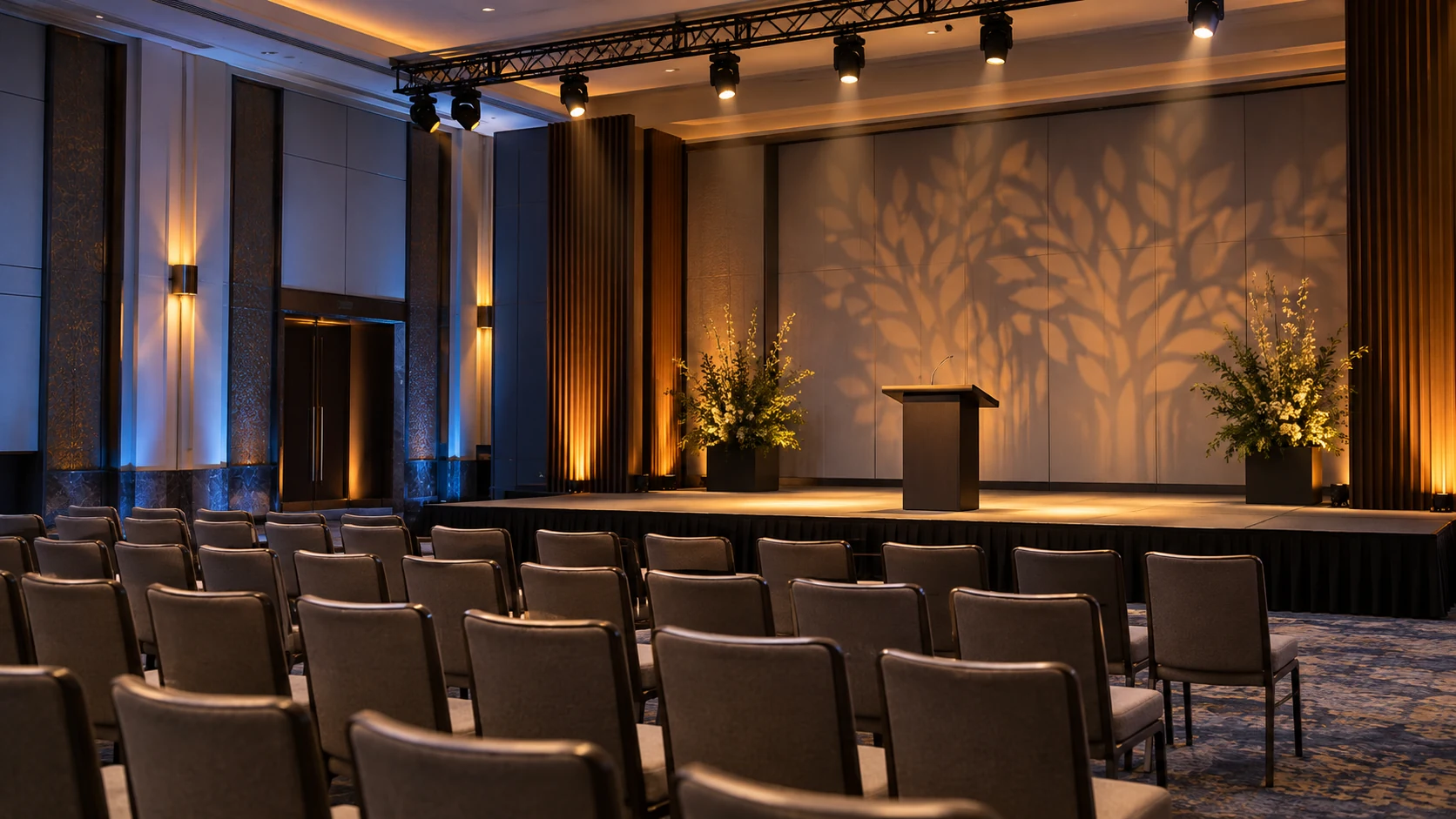
Consider a conference hall that prohibits haze and needs three results: readable speakers, color on the scenic wall and a projected pattern behind the podium. This is a planning example, not a completed WUYESTAGE project. It shows why one impressive beam demonstration cannot approve the whole lighting package.
Begin with the speaker position. View a person at the podium from the audience and the planned camera position. Check facial shadows, glare and exposure with the house lights at their normal setting. If the scenic pattern is attractive but the speaker remains hard to see, improve the performer-lighting role rather than increasing the decorative effect.
Next, evaluate color on the actual backdrop. A light-colored matte wall, a dark curtain and a glossy panel can produce different visible results. Keep the target and house-light conditions in the test record. If a projected pattern crosses the speaker or presentation screen, revise its position and size before approval.
Finally, run the transitions: walk-on, presentation, interval and closing. Observe from the nearest and farthest important seats, keeping the fixture positions consistent. Moving head lights without haze should be selected against those surface and visibility tasks. A distant airborne-beam photo does not answer them.
For a touring or rental package, retain the accepted cue record with the equipment configuration. When the next venue has a different wall, throw distance or ambient light, repeat the affected checks. Reusing a fixture list is useful; assuming every clear-air room will give the same outcome is not.
Match a portable rig to recurring venue conditions
Rental buyers should record how often their bookings permit haze. A rig that produces a successful aerial show in one room may need a different optical mix for clear-air halls.
Do not divide the budget equally between Beam, Spot and Wash just because three categories exist. Start with recurring paid jobs and the roles missing from the current stock. The rental fleet guide connects that booking mix to quantities, reserve units and handling decisions.
Beam fixtures can remain useful for bookings that allow their intended effects. The Beam category is the right place to compare those models once the visual task and operating environment fit. A no-haze question should not automatically send every buyer to the same product.
No-haze lighting FAQ
Can moving head lights without haze still create useful effects?
Yes. They can illuminate surfaces, create projected effects or provide moving color coverage supported by their optics. A strong visible airborne shaft cannot be assumed. Choose the required target and test the exact fixture in clear air.
Will a higher-wattage beam solve the no-haze problem?
Higher wattage alone does not establish the required visible result. Source type, optics, atmosphere, ambient light, target and viewing position all matter. A haze-heavy demo cannot prove clear-air performance.
Can I use a beam fixture’s gobos instead of buying a Spot?
Only if that exact configuration produces the required projection on the real target. A fixed-gobo list or a prism effect does not establish readable edges, useful size or a Spot-equivalent result.
What should I send a supplier for a no-haze project?
Send the venue’s atmospheric restriction, room lighting, target surfaces or coverage areas, mounting positions, working distances, audience/camera requirements, required cues and quantity. Ask for a sample demonstration under those same conditions.
Ask for a no-haze sample plan
Tell WUYESTAGE what must be visible in your venue. Include the restriction and the cues you need so the proposed fixture roles and sample conditions can be matched to your project before ordering.