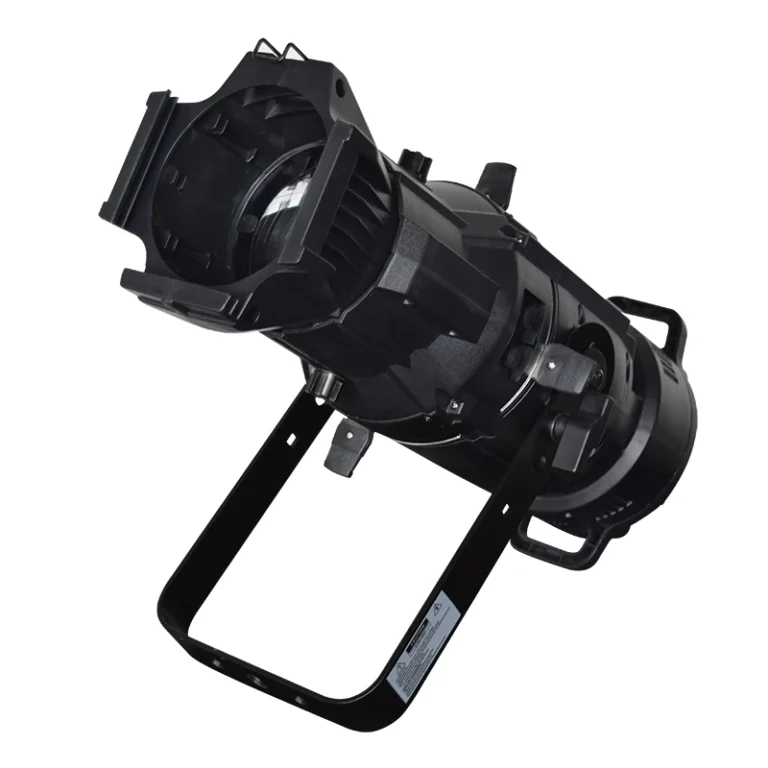
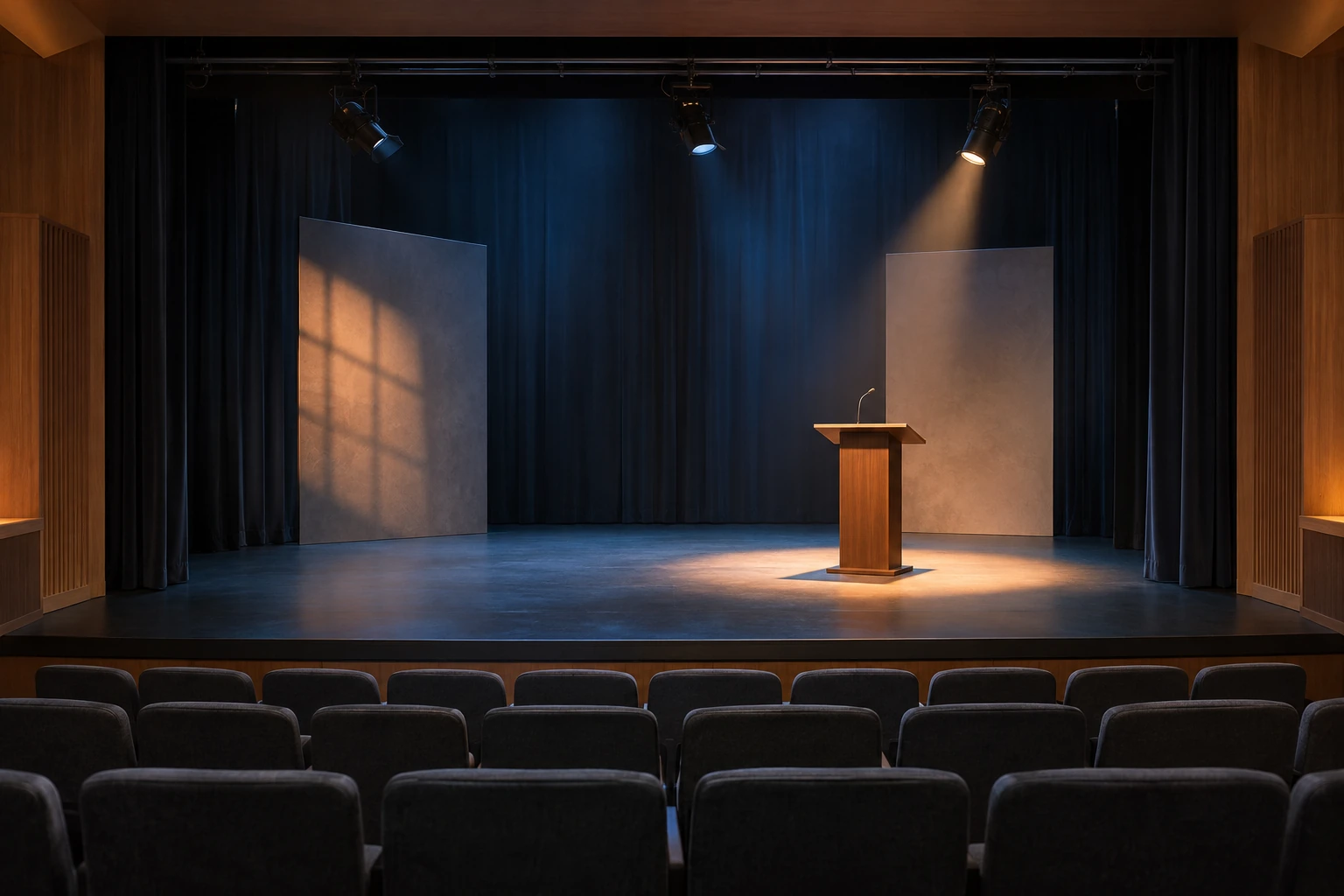
An ellipsoidal light, short for ellipsoidal reflector spotlight (ERS), is a stage-lighting fixture used for a focused pool of light, a shaped boundary or a projected pattern. Its useful distinction is control: with the appropriate optics and fittings, you can decide where the light falls and what its edge looks like.
The parts do different jobs. Framing shutters change the shape. Lens selection or zoom changes the spread. Focus changes edge sharpness. A gobo adds a pattern. An iris, where supported, reduces a circular opening. None of these functions should be inferred from LED wattage alone.
You will also hear ellipsoidal spotlight, ERS light and, especially in European theatre, profile spotlight. Leko is a historical trade name often used informally for this type of fixture. Those names help identify the family; the model's specification establishes its actual controls and accessories.
What are ellipsoidal lights used for?
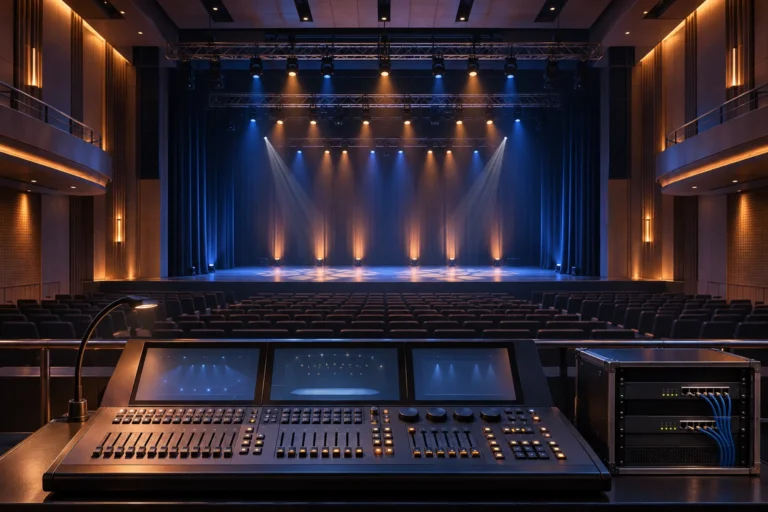
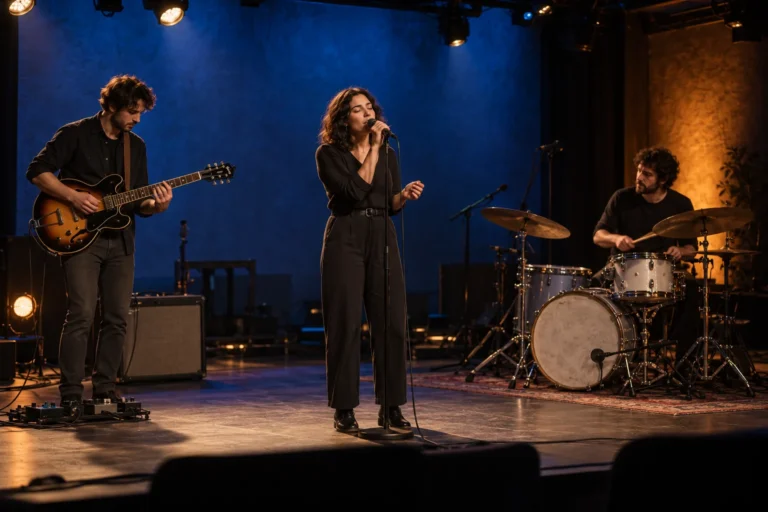
Ellipsoidal lights are useful when a stage needs a deliberate boundary or an image rather than general illumination alone.
For a speaker at a lectern, you may want light on the person while keeping the projection screen behind them darker. That requires an appropriate position, sufficient coverage and a way to control unwanted edges. A bright circular spot that also lights the screen does not solve the same problem.
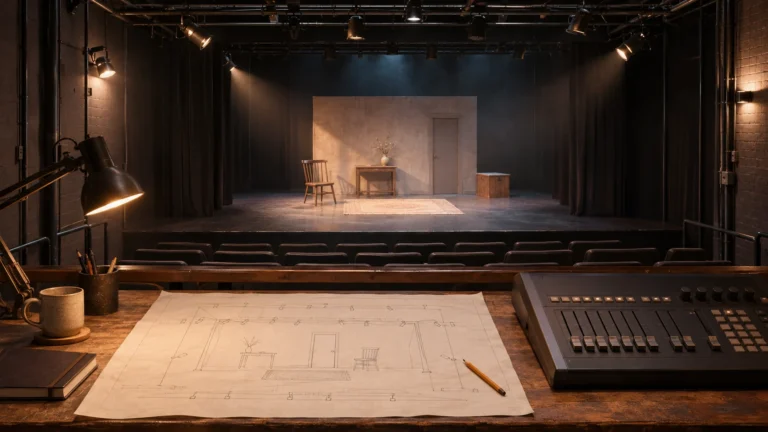
For a theatre set, a designer may frame light within a doorway or across a scenic panel. The required rectangle and mounting angle determine the shutter and focus checks. The result is more specific than simply asking for a “sharp spotlight.”
For a window texture or foliage pattern, the fixture needs a suitable gobo system and projection optics. Shutters can crop the outer boundary, but they do not create the details inside the picture.
Ellipsoidal lighting can also be softened for blending. However, using a defocused spot does not automatically make it the best tool for a broad, even stage wash. Choose the optical job first, then compare fixtures that can perform it.
Four functions inside an ellipsoidal reflector spotlight
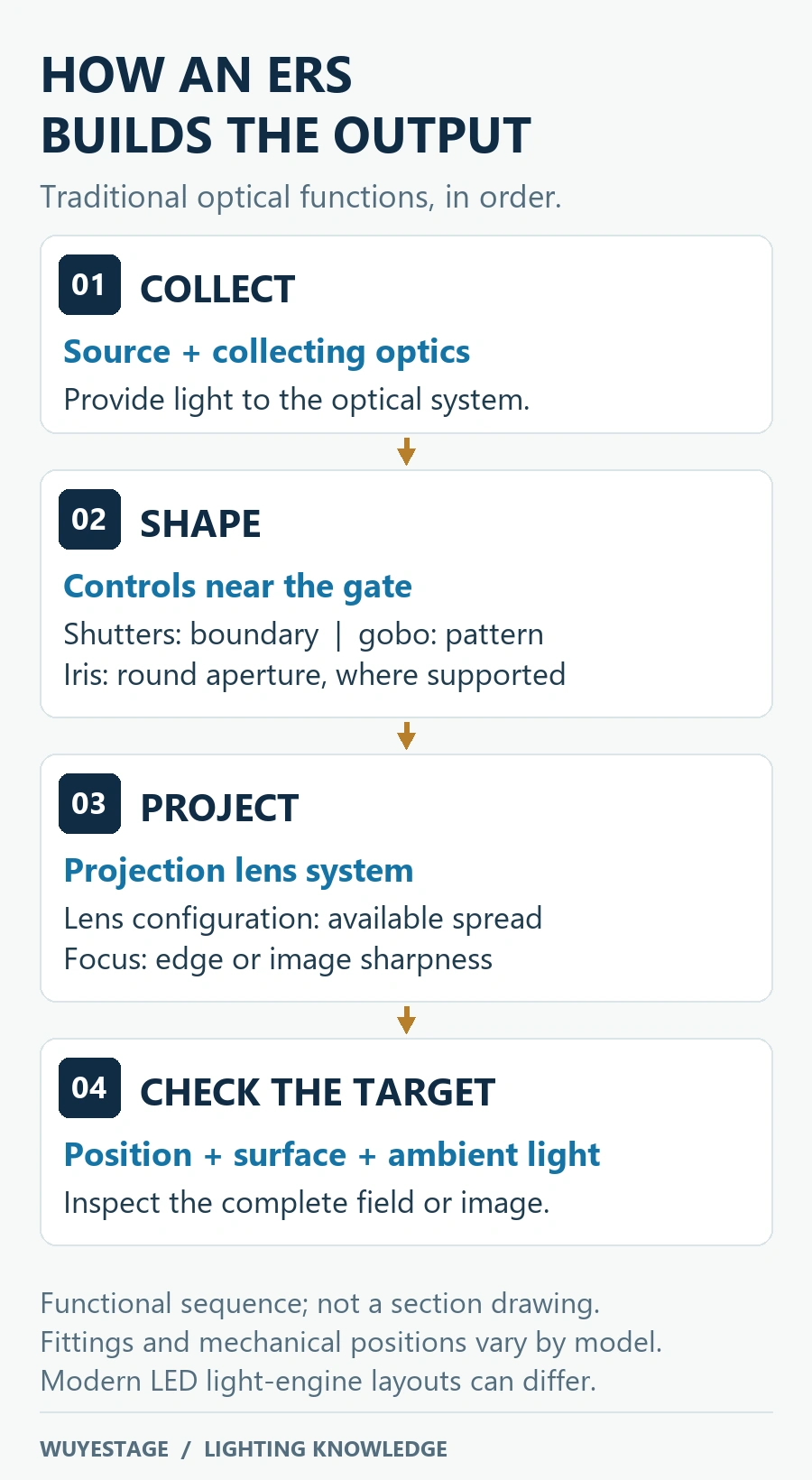
In a traditional ERS, an ellipsoidal reflector collects light from the lamp and directs it toward an internal gate region. Projection lenses then form the output toward the stage. Modern LED fixtures may use different light-engine arrangements, so the traditional optical description is a useful explanation, not a universal internal drawing.
1. The light engine supplies and collects light
The source and collecting optics provide light to the rest of the system. A source rating tells you something about the selected light engine; it does not specify the projected field size, shutter capability or brightness at a given distance.
An LED ellipsoidal light may have a fixed-white, tunable-white or color-mixing source. These are different configurations. “LED” by itself does not mean that a fixture can adjust its color temperature or mix colors.
2. The gate region provides shaping and pattern positions
Framing shutters enter the optical path to cut boundaries. A gobo places a pattern in a suitable imaging position. An iris provides a variable circular aperture when the fixture accepts one.
These are separate mechanisms, even when they are housed close together. Their slots, sizes, travel and compatibility depend on the fixture. A gobo holder is not an iris, and a lens tube is not a shutter assembly.
3. The lens system projects the result
The projection lenses form the shaped light or pattern on the target. The lens configuration determines the available spread, while the focus adjustment brings the relevant edge or image into focus at the working distance.
Some products accept interchangeable lens tubes; others provide a documented zoom range or a different integrated optical assembly. Check the exact configuration before treating a removable front section as an interchangeable lens system.
4. The target and working position complete the setup
The final result also depends on throw distance, mounting angle, surface and surrounding light. A pattern that looks clear on a nearby test wall may be too large, too dim or distorted from the intended stage position.
Read the functional sequence below from collection to the target; the individual fittings are model-specific.
Shape, size, edge and pattern are different adjustments
Consider one fixture position aimed at a scenic panel. Four requests can sound similar while requiring different controls.
“Keep the light inside this rectangle.” Use supported framing shutters to crop the field, then focus and aim the result at the actual position. Check all required edges together. The available cut, corner behavior and sharpness across the field matter more than a close-up photograph of one blade.
“Cover more of the panel from here.” Select a suitable lens configuration or adjust a supported zoom. This changes the available spread. Moving a focus control is not proof of a zoom function, and opening the shutters cannot create coverage outside the available optical field.
“Make this edge less obvious.” Adjust focus to soften the boundary. Check the surrounding falloff as well as the central patch: soft focus does not guarantee that light stops outside the intended area. It also does not promise unchanged size or brightness.
“Put a window pattern on the panel.” Use a supported gobo and holder, then focus the image. Verify image size and contrast from the planned position. If the cue requires rotation, confirm that separately; a static pattern slot does not establish a rotating-gobo function.
These four results call for different controls, even when they come from the same fixture family.
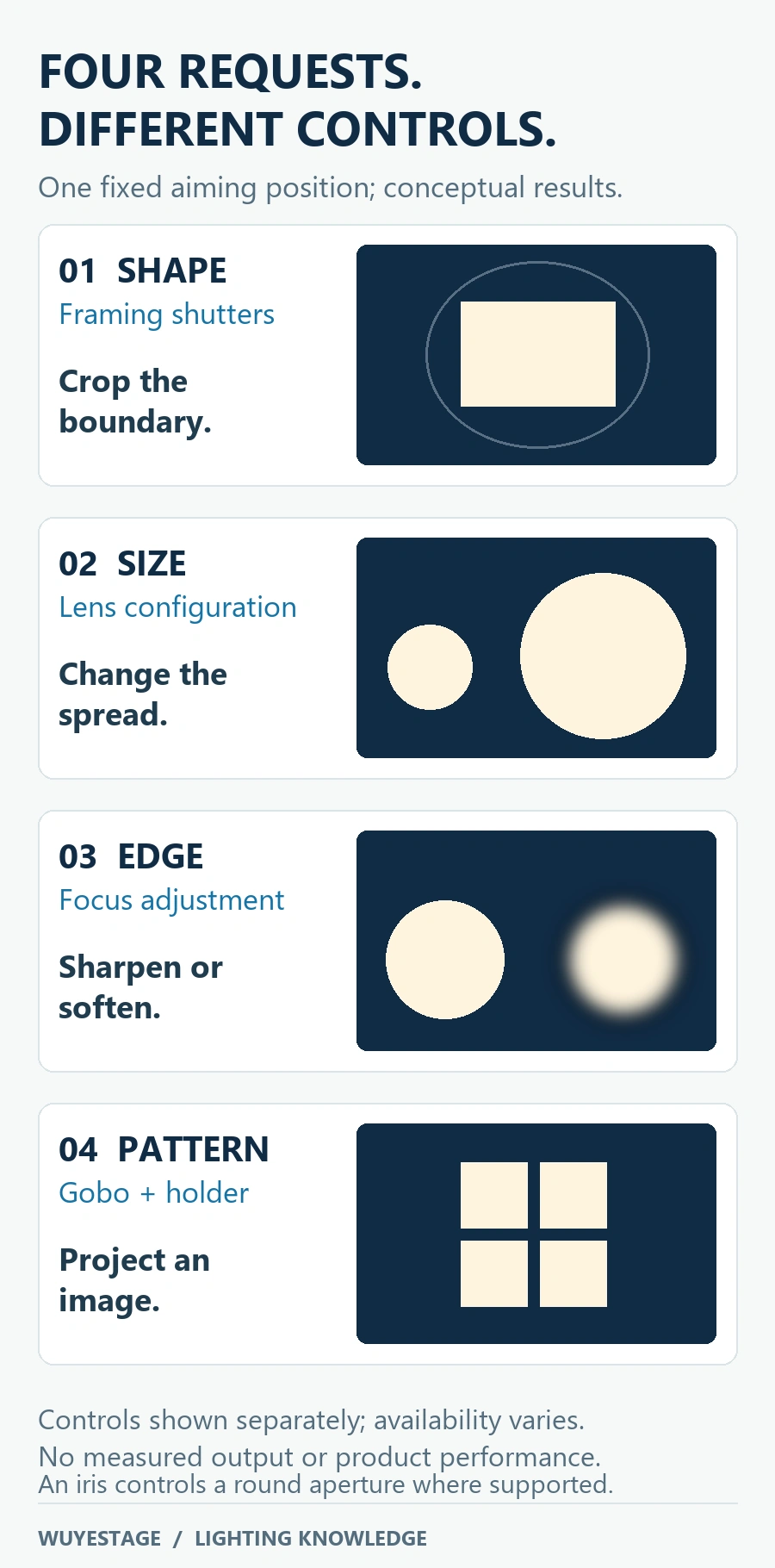
For a smaller round pool, an iris may be appropriate if the fixture supports it. It changes the aperture rather than creating a four-sided shutter cut. Confirm the resulting field, focus and output over the range you need.
For pattern-specific checks, our gobo lighting guide explains focus, surface, contrast and movement in more detail.
Choose a lens angle without confusing it with focus
A fixed-angle lens provides a particular spread; a compatible alternative lens tube can provide another. A zoom system offers an adjustable spread within its stated range. Focus addresses how clearly the selected edge or pattern forms at the target.
At the same distance, a smaller full spread angle gives a smaller geometric footprint. That does not, on its own, establish usable illuminance, uniformity or a clean cropped boundary. Ask whether the quoted angle is a beam angle, field angle or another documented convention, and compare like with like.
For example, a 3m-wide target at an 8m centerline distance requires an ideal full cone angle of about 21.2° when the target plane is perpendicular to the centerline. That is a geometry estimate for an uncropped circle, not a lens recommendation or a measured fixture result. A rectangular shutter cut must fit inside the available field; its width alone does not prove that the corners will fit.
Use our beam-angle calculation guide for the calculation and its assumptions. The beam angle versus field angle explanation helps you interpret the boundaries in a specification.
Once a lens configuration is shortlisted, check the actual sample at the planned throw and mounting angle. For a scenic rectangle, inspect the complete cut. For a gobo, inspect the complete image. Neither requirement is established by a nominal angle alone.
Framing shutters are not barn doors
Framing shutters work inside the fixture near its imaging region. With the appropriate projection optics and focus, their edges can form controlled boundaries on the target.
Barn doors are external flaps placed in front of a fixture to limit spill. They are useful, but they do not become an ERS shutter assembly merely because both devices block some light. Their position and the fixture's optics affect the boundary they produce.
Arizona State University's explanation of lighting accessories distinguishes shutters, irises, gobos and front-mounted barn doors by the jobs they perform.
When comparing an ellipsoidal versus a Fresnel, begin with the desired result. A soft-edged wash and a defined scenic cut are different tasks. If the specification asks for a sharp rectangle, request that result from the proposed fixture and configuration; an accessory named “barn door” is not sufficient evidence.
Turn the required result into an order scope
A useful order describes both the effect and the supplied configuration. “One LED profile” leaves important questions open if the lens, holder or accessory needed for the cue is excluded or incompatible.
| Required result | Configuration to identify | Check at the planned position | Make the supplied scope explicit |
|---|---|---|---|
| A controlled scenic or lectern boundary | Framing system, lens and focus arrangement | Required edges and corners together, including unwanted spill | Actual shutter mechanism and optical configuration |
| A particular coverage size | Fixed-angle lens, compatible lens tube or stated zoom | Target width and height, throw, angle convention and usable output | Selected lens or zoom version and whether it is included |
| A sharp or softened edge | Focus controls and appropriate optics | Edge quality and surrounding falloff | Focus capability for the selected configuration |
| A window, foliage or logo pattern | Supported gobo, holder and projection system | Complete image, focus, scale and contrast; motion if required | Gobo/holder sizes, supplied pattern and any rotation accessory |
| A smaller circular pool | Compatible iris, where supported | Aperture range, focus and output | Iris compatibility and inclusion |
Also identify the light engine or body, lens assembly, required accessories, mounting hardware and control documentation as separate order lines where relevant. They may be supplied as a complete package or as separate items. The quotation should make that clear; another brand's package or part number does not establish what is included.
For LED fixtures, verify the required power supply and control method from the product documentation. Do not connect one to a conventional dimmer circuit unless that use is explicitly supported. DMX control of an internal LED driver is a different arrangement from dimming a traditional lamp's supply.
A fixed-white product choice is a separate configuration decision
Our 200W / 300W LED Profile Spot Light, RG-309, provides a concrete example of specifying the source: select the 200W or 300W LED option and the 3200K or 6500K white-light version. The listed DMX profiles are 2CH and 4CH. These are order choices, not a claim that one fixture changes between both white-light versions.
When sending a requirement for a shaped area or projected pattern, include the exact lens, framing and accessory functions needed in the configuration request. The source rating and white-light choice do not establish those functions. If movement between positions is part of the cue, compare the documented options in our Profile and Spot moving-head range as a separate fixture-role decision.
Ellipsoidal light FAQ
Is a lens tube the same as framing shutters?
No. A lens tube carries projection optics; framing shutters cut the boundary of the light. Some designs combine parts into a larger assembly, but the functions remain different. Check the model’s parts and optical configuration rather than treating the names as interchangeable.
Does every ellipsoidal light have zoom?
No. A fixed-angle configuration and a zoom configuration are different. A focus adjustment may sharpen or soften the image without providing a documented zoom range. Confirm both controls separately.
Does an ellipsoidal light include a gobo and an iris?
Not necessarily. Support, dimensions, holders and package contents vary by fixture and version. List the required pattern, holder and iris in the quotation and confirm compatibility before ordering accessories.
Can existing lens tubes be reused with a new LED body?
Only where the manufacturer documents compatibility for the exact body, barrel and lens combination. Similar diameters or familiar product-family names do not establish mechanical fit, optical performance or accessory compatibility.
Send the optical requirement with the fixture request
Include the target width and height, throw distance, mounting angle and required edge or pattern. Add the intended white or color behavior, any camera use, control method, movement requirement, quantity and destination.
That gives the configuration discussion a useful starting point: what the light must do, which parts provide it, and what the supplied package includes.