To estimate moving head light power consumption, start with the electrical power specified for the complete ordered fixture, not the wattage in its product name or light-source description. Multiply the chosen input assumption by the number of fixtures and their operating time. Treat the result as a conditional budget until you have measurements for the actual configuration and show conditions.
For a rental purchase, three common mistakes can distort the budget: using light-source watts as the whole-fixture input, counting only the performance hours, and treating a dimmer percentage as measured energy savings. The examples below show how to keep each assumption visible before comparing quotations.
A useful budget answers two different questions: how much electrical power the equipment may require at a particular operating point, and how much energy it may use over a booking. Watts and kilowatts describe power. Kilowatt-hours describe energy used over time; the U.S. Department of Energy’s Electricity 101 identifies kWh as the unit used to measure a customer’s electricity use.
Mistake 1: using lamp watts as fixture power
Several numbers can appear on the same fixture page. They have different jobs.
| Figure | What it describes | How to use it |
|---|---|---|
| Lamp or LED-source watts | The stated light-source configuration | Identify the optical version; do not use it as the whole-fixture electrical input |
| Rated fixture power | The supplier’s declared electrical rating for that configuration | A documented budgeting input, with its meaning and conditions confirmed |
| Measured average input | Electrical input averaged over a defined operating period | Estimate energy for a comparable operating period |
| Startup or transient demand | Behaviour during startup or another short event | Obtain the relevant data for electrical planning; do not infer it from average watts |
| Energy in kWh | Power accumulated over time | Compare operating-energy budgets using consistent boundaries |
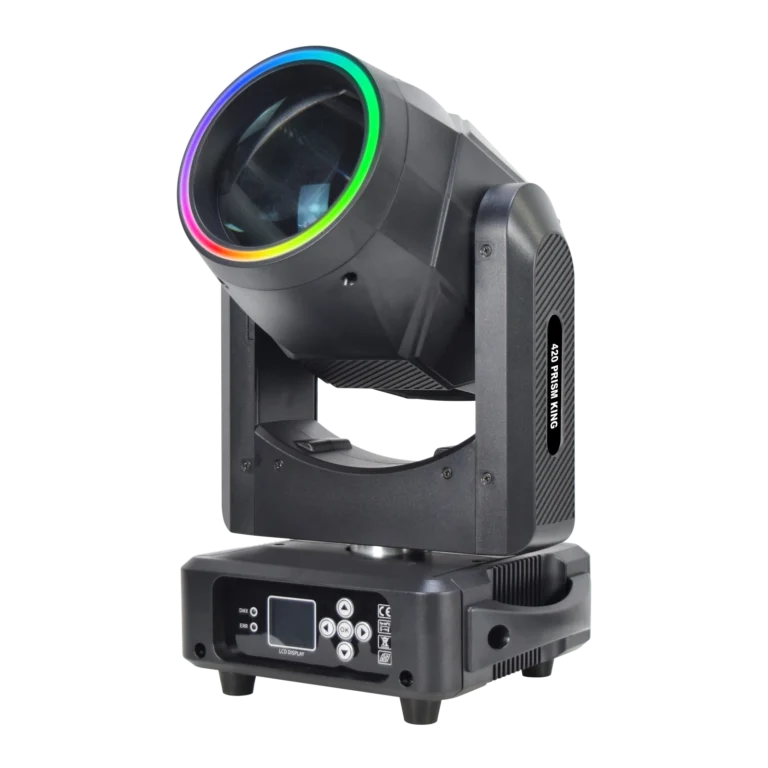
The RG-132 420 Prism King has a 300W lamp and a declared 450W rated fixture power. “420” is its product name, not a 420W lamp rating. The RGB front ring is another specified feature; adding source wattages is not a substitute for the complete-fixture rating.
For eight RG-132 fixtures, using the 300W lamp number would give 2.4kW. Using the declared 450W fixture figure gives 3.6kW. That 1.2kW difference shows why the input definition matters. It is not a measured efficiency loss or a comparison with another fixture.
Calculate moving head light power consumption for one booking
Use these equations when the chosen power level is assumed constant over the stated time:
Total assumed power (kW) = quantity × assumed input per fixture (W) ÷ 1,000.
Estimated energy (kWh) = total assumed power (kW) × operating hours.
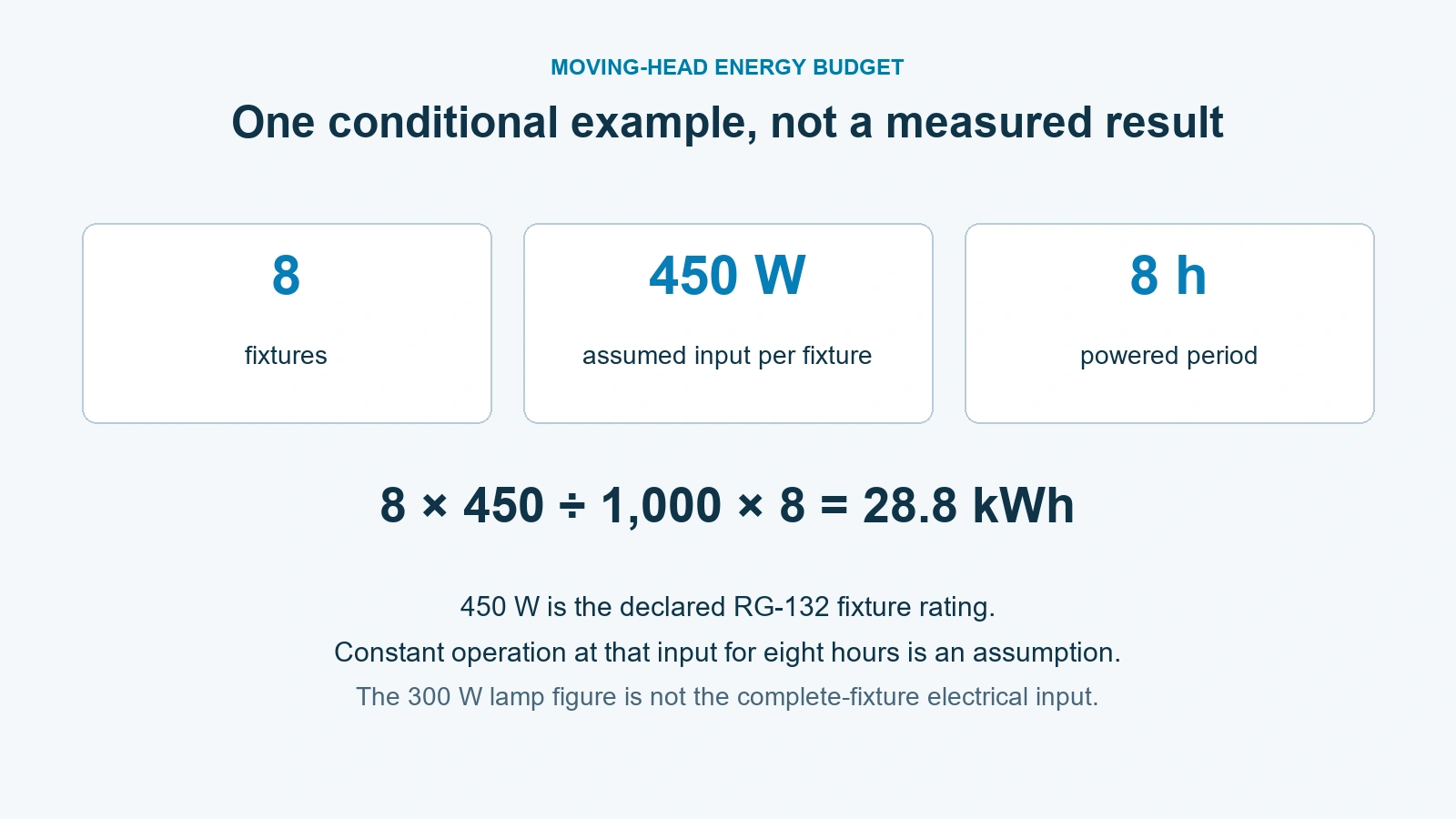
Assume eight RG-132 fixtures operate at an input level of 450W each for eight hours:
| Step | Calculation | Result |
|---|---|---|
| Combined assumed power | 8 × 450 ÷ 1,000 | 3.6kW |
| Assumed operating period | Eight fixtures, each powered for eight hours | 8h |
| Conditional energy budget | 3.6 × 8 | 28.8kWh |
The 450W value comes from this model’s declared fixture rating. Constant operation at that level is the example’s assumption. The result is not an actual show measurement, a guaranteed maximum or an approval of the venue’s power distribution.
Mistake 2: counting only the performance hours
Use the full powered period relevant to your budget. Setup, focusing, rehearsal and post-show operation may fall outside the ticketed performance. Record their durations and input assumptions rather than calling a two-hour show a two-hour equipment run.
For variable operation, calculate each documented period separately and add its energy. If measurements establish different average inputs during rehearsal and performance, keep those periods distinct. Do not invent a percentage reduction because the dimmer was set below full.
Add a mixed rig without mixing rating definitions
A mixed equipment schedule needs one row for each exact configuration. Here is a second rated-input illustration using currently specified WUYESTAGE models:
| Equipment in this example | Quantity | Declared fixture figure used | Row calculation |
|---|---|---|---|
| RG-132 420 Prism King | 8 | 450W | 3,600W |
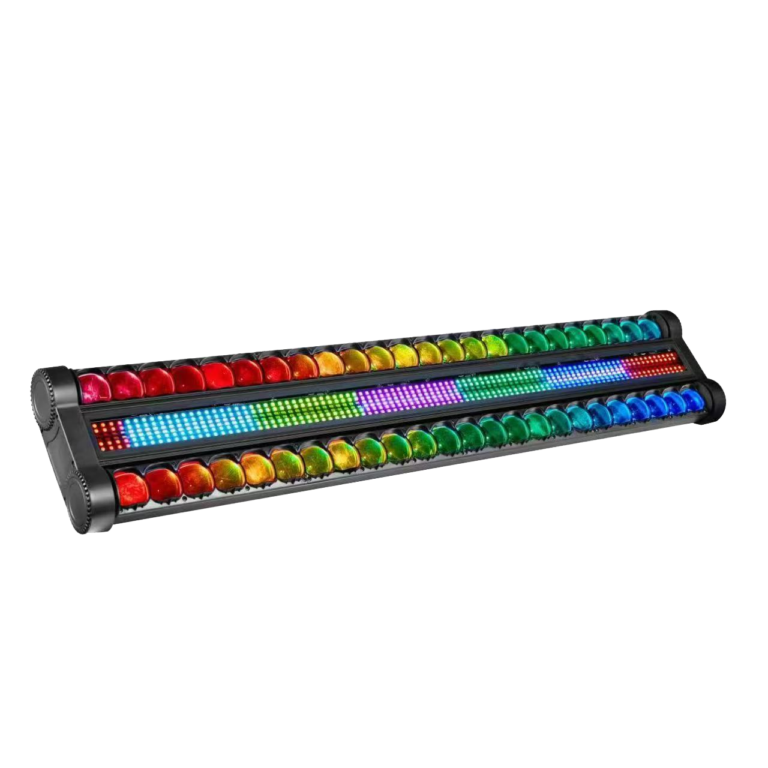
| RG-906 double-row beam swing strobe | 4 | 253W | 1,012W |
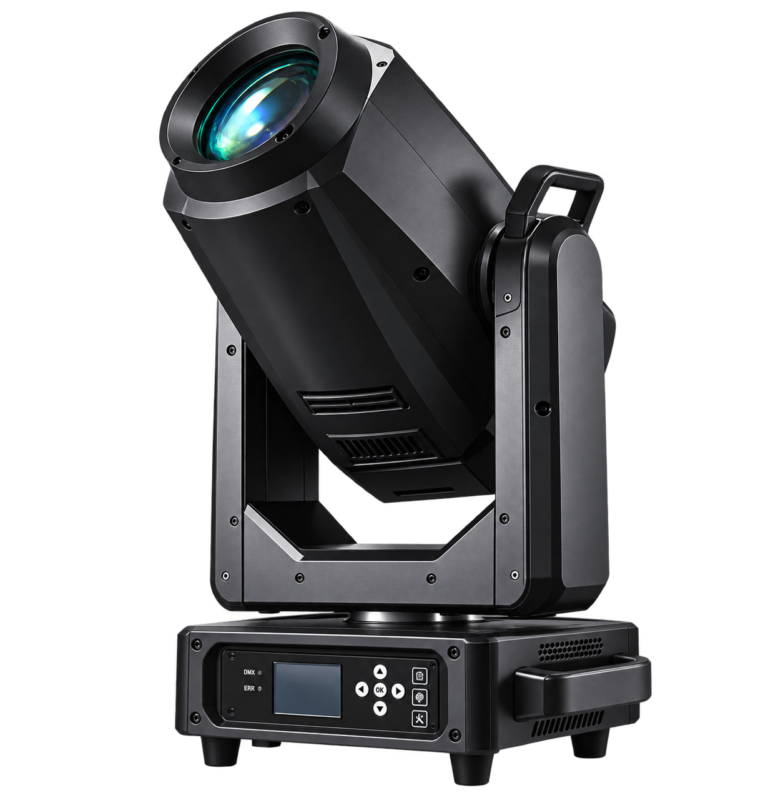
| RG-800, specifically the 1000W LED version | 2 | 1,050W | 2,100W |
| Total of these assumptions | 14 | Configuration-specific figures | 6,712W / 6.712kW |
If all fourteen fixtures were assumed to operate continuously at those figures for eight hours, the calculation would be 6.712 × 8 = 53.696kWh. This remains a conditional worksheet result, not a tested average for that rig.
The RG-800 page offers several LED-source configurations. The 1,050W fixture figure here belongs to the detailed 1000W LED version; it cannot be applied to every 500W–1200W option. Likewise, the RG-906 figure is the fixture’s stated power, not a sum of its LED package labels.
Add other powered equipment separately. Hazers, control equipment, displays and other loads are outside this example. An incomplete equipment list cannot become a complete event-energy budget by adding a generic allowance.
Mistake 3: treating dimmer settings as measured savings
An optical intensity setting is not a measured electrical-input percentage. The relationship depends on the fixture and how its source, electronics, cooling and other functions operate. A blackout cue also does not prove that the complete fixture draws zero power.
Ask for readings for the exact ordered version under relevant conditions. A useful record includes model and firmware, source configuration, supply conditions, DMX mode, cue or operating state, duration, measured average watts or energy, and the boundary of the measurement. Identify whether the reading covers one fixture, several fixtures or the entire rig.
When comparing two quotations, keep the required visual job and operating conditions consistent. A lower source wattage does not establish lower event energy or an equivalent beam, gobo or wash result. Use the Beam, Spot and Wash comparison to define the optical task before comparing electrical numbers.
Convert energy into cost with your own tariff
For a simple energy-only estimate, multiply estimated kWh by your applicable price per kWh. The eight-unit example is 28.8 × your energy tariff.
That does not automatically equal the event’s electricity bill. Venue charges, demand-related charges and other contractual items may use different rules. Keep them as separate budget lines rather than assuming that a flat kWh calculation covers every cost.
This article budgets energy; it does not size circuits, cables, protective devices or generators. Electrical planning needs the exact equipment data, supply arrangement and competent assessment. A kWh result cannot identify how many units may share a connection.
Keep an assumption and measurement record
A moving head light power consumption worksheet should show where each input came from. Keep supplier ratings separate from readings taken during a sample test. If you change the fixture version, quantity or powered period, update the row before comparing the total with an earlier quotation.
| Record | What to enter | Why it matters |
|---|---|---|
| Exact fixture version | Model, source option and any relevant hardware or firmware identifier | Keeps a reading tied to the supplied configuration |
| Input source | Declared complete-fixture rating or a documented measurement | Separates an assumption from measured evidence |
| Operating period | Powered hours and the defined operating state for each period | Includes setup and rehearsal when they belong in the budget |
| Measurement boundary | One fixture, a fixture group or the complete rig | Prevents counting the same load twice |
| Result and revision | Calculated or measured kWh, date and changes since the previous record | Supports a consistent sample-to-order comparison |
For example, a whole-rig reading that includes controllers and haze equipment cannot be compared directly with the fixture-only 28.8kWh illustration. Record those extra loads separately or use the same whole-rig boundary on both sides of the comparison. These are alternative accounting boundaries, not extra energy figures to add together.
If a supplier provides only a source wattage, leave the complete-fixture input unresolved in the worksheet. Request the relevant rating or measurement instead of filling the gap with a typical value from another model. This keeps the moving head light power consumption estimate traceable without implying that WUYESTAGE has measured the example rig.
Send a supplier a configuration-specific request
Request the complete-fixture rating and its definition, available measurements, startup information needed by your electrical planner, and the exact source/control version. Supply your intended fixture quantities, powered periods, operating conditions, destination, voltage and plug requirements.
Use the Beam moving-head range to shortlist an optical fit. For inventory quantities, reserve units and booking economics, continue with the rental fleet guide. Those decisions complement the energy worksheet rather than replacing it.
Power and energy FAQ
Is a 300W moving head necessarily a 300W electrical load?
No. The 300W figure may describe its lamp or LED source. Confirm the complete-fixture electrical rating for the exact version. RG-132 has a 300W lamp and a declared 450W fixture rating.
Does setting the dimmer to 50% halve electricity use?
Not necessarily. A dimmer setting describes an optical-control command, not a verified percentage of complete-fixture input. Use measurements for the relevant operating states.
How do I calculate moving head light power consumption in kWh?
Multiply the documented or assumed complete-fixture input in watts by quantity and powered hours, then divide by 1,000. Eight fixtures at 450W for eight hours give 28.8kWh. This is a conditional budget, not a measured show result or approval of the electrical supply.
Can I select a circuit or generator from this worksheet?
No. An energy worksheet cannot resolve startup behaviour, power factor, connection limits, distribution or protection requirements. Give the exact equipment schedule and manufacturer data to the person responsible for electrical planning.
Ask for the power data for your actual order
Send WUYESTAGE your fixture mix and operating schedule. Include the exact configuration, quantity, intended use, powered periods and destination so the quotation and available electrical information can be matched to your project.