To calculate beam angle from a circular target diameter, use θ = 2 × arctan(D ÷ 2L). To estimate the diameter from a known angle, use D = 2L × tan(θ ÷ 2). Here, θ is the full included angle, L is the distance along the beam’s centerline and D is the diameter on a flat target perpendicular to that centerline.
These equations describe an ideal cone. They help rental buyers and stage-project teams compare geometry before choosing a light, but they do not predict brightness, edge sharpness, uniformity or the readable size of a projected gobo. Treat the result as an estimate to check with the actual fixture and target.
Before entering numbers, make three checks: confirm the angle convention, measure the relevant distance, and identify the target plane. A correct calculator cannot compensate for the wrong inputs.
Check 1: use the full angle and matching units
The full angle runs from one side of the cone to the other. The half-angle runs from the centerline to one side. If a specification gives a full angle of 20°, the tangent in the diameter formula uses 10°, not 20°.
| Symbol | Meaning | Input rule |
|---|---|---|
| θ | Full included angle | Use degrees or radians consistently with the calculator |
| θ ÷ 2 | Half-angle | Divide the full angle before evaluating the tangent |
| L | Centerline distance to the target plane | Same length unit as D |
| D | Ideal circular diameter at that plane | Same length unit as L |
If L is in metres, the calculated D is in metres. Millimetres also work if both lengths use millimetres. Avoid combining a distance in metres with a target width entered in centimetres without conversion.
For the inverse equation, a calculator returning arctangent in radians needs conversion to degrees. In a degree-mode calculator, the returned half-angle can be doubled directly. Record the mode rather than relying on a value that merely looks plausible.
Also confirm what the manufacturer’s angle represents. Beam angle and field angle can identify different intensity boundaries; a zoom range or frost effect may describe another operating state. Compare like definitions and request the relevant photometric documentation when the boundary matters. The light does not necessarily end at a sharp circle matching the quoted angle.
Why the formula uses half the angle
Split the ideal cone through its centerline. One half makes a right triangle: the opposite side is the radius D ÷ 2, and the adjacent side is L. Therefore:
tan(θ ÷ 2) = (D ÷ 2) ÷ L
Rearranging gives the diameter equation. Applying arctangent gives the angle equation. The distance is measured along the centerline to a plane perpendicular to it; that condition is part of the calculation, not an optional detail.
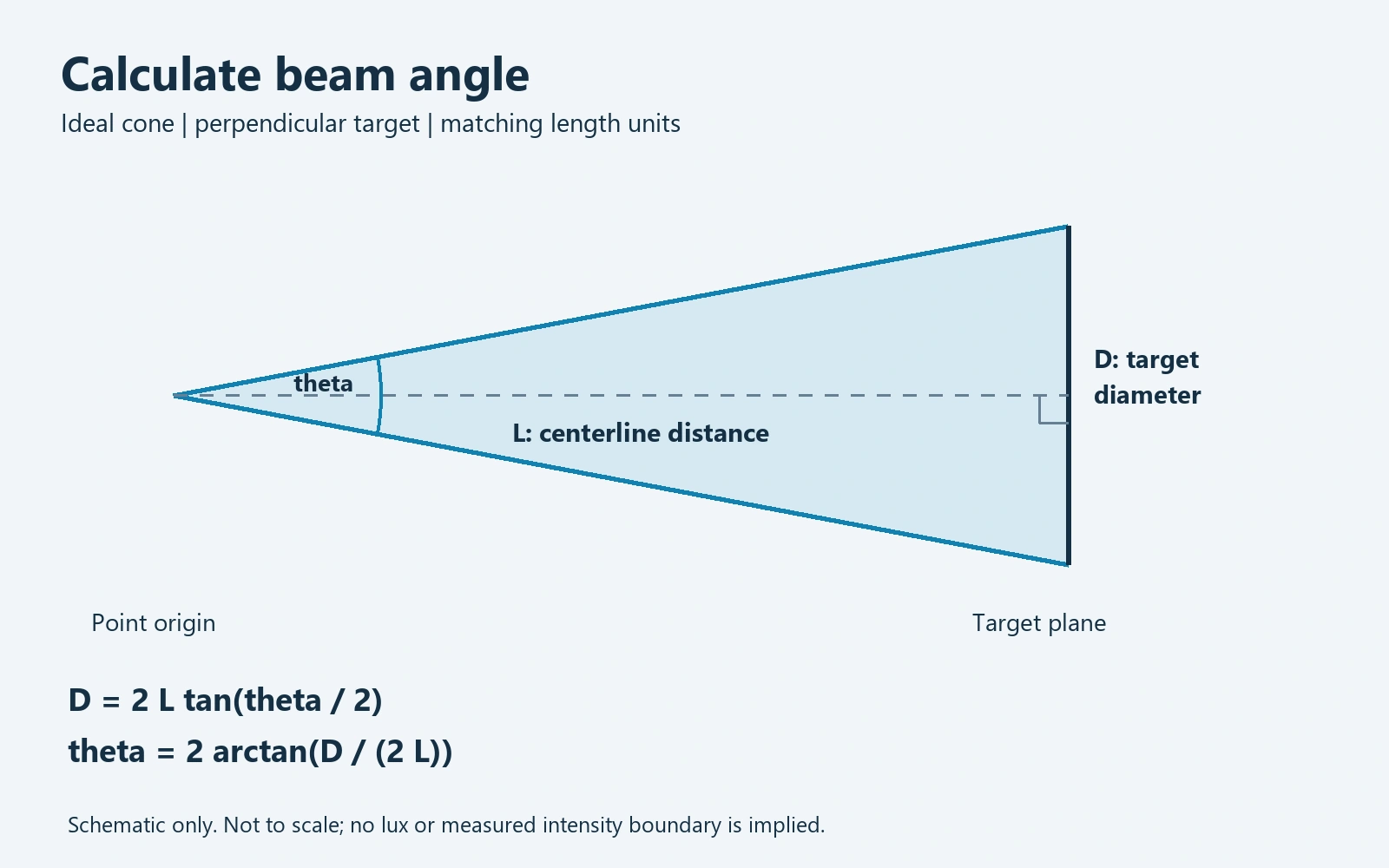
Ideal geometric cone with a point origin and a perpendicular target. The labelled boundary is a calculation model, not a measured fixture intensity contour.
Check 2: measure throw distance along the centerline
Throw distance in this calculation is the distance from the chosen optical reference to the target along the centerline. It is not automatically the truss height, the horizontal distance across the room or the distance to the nearest corner of a stage.
If the light is overhead and aimed vertically at a level floor, the vertical separation can represent that distance. If the light is aimed diagonally, using truss height alone usually describes a different triangle. Establish the centerline and target before choosing L.
The equation assumes a point origin. Real fixtures have a finite output aperture and optical design. At short distances, a zero-diameter starting point can be a poor approximation. Do not add the housing width or lens diameter as an automatic correction: the appropriate optical reference depends on the fixture and the available data.
For a practical comparison, write down the measuring reference, aiming position, selected optics and target. A recorded reference makes a later sample test more useful than an unexplained “10m throw” note.
ETC’s guidance on ColorSource Linear IES files explains why source size and test distance affect photometric predictions. Its model-specific recommendations are not operating limits for WUYESTAGE fixtures.
Three worked examples you can reproduce
The following values are mathematical planning examples, not measured WUYESTAGE output. Calculations use degrees and are rounded after evaluating the equation.
Example 1: estimate the diameter of a 20° cone at 6m
Use the half-angle of 10°:
D = 2 × 6 × tan(10°) = 2.116m, approximately 2.12m.
That is the ideal circular diameter on the perpendicular target. It does not establish that the entire circle has the required lux level or acceptable uniformity.
Example 2: calculate beam angle for a 3m target at 8m
Start with the required diameter and the centerline distance:
θ = 2 × arctan(3 ÷ 16) = 21.239°, approximately 21.24°.
A product with a nearby nominal angle is a candidate for evaluation, not proof that it evenly lights the complete target. Check the actual optical state, edge definition and photometric data before treating it as a match.
Example 3: calculate the distance for a 1.5m circle with a 10° angle
Rearrange the diameter formula:
L = D ÷ [2 × tan(θ ÷ 2)]
L = 1.5 ÷ [2 × tan(5°)] = 8.573m, approximately 8.57m.
This is an ideal geometric distance. It does not establish a safe mounting position, permitted operating distance, usable brightness or a final rigging design.
| Known inputs | Calculation result | What remains to check |
|---|---|---|
| 20° full angle; 6m centerline distance | Approximately 2.12m diameter | Actual intensity boundary and uniformity |
| 3m diameter; 8m centerline distance | Approximately 21.24° full angle | Available optics and target acceptance |
| 10° full angle; 1.5m diameter | Approximately 8.57m distance | Mounting feasibility and actual output |
Check 3: a tilted target is a different geometry
A circular diameter calculation assumes the target is perpendicular to the beam axis. A beam aimed obliquely onto a floor or scenic wall can produce an elongated footprint rather than the circle in the model.
Do not use the circular result as a promise of coverage across a tilted stage surface. Identify the aiming position and target orientation, then assess the actual footprint. Where precise coverage is required, use an appropriate geometry model or manufacturer design data and verify the result on the intended surface.
The same caution applies to a rectangular stage. Knowing the circle’s diameter does not establish how many fixtures will produce even coverage across a rectangle. Overlap, edge falloff, mounting positions, obstructions and the required illumination remain separate inputs.
Apply the estimate to a real beam fixture
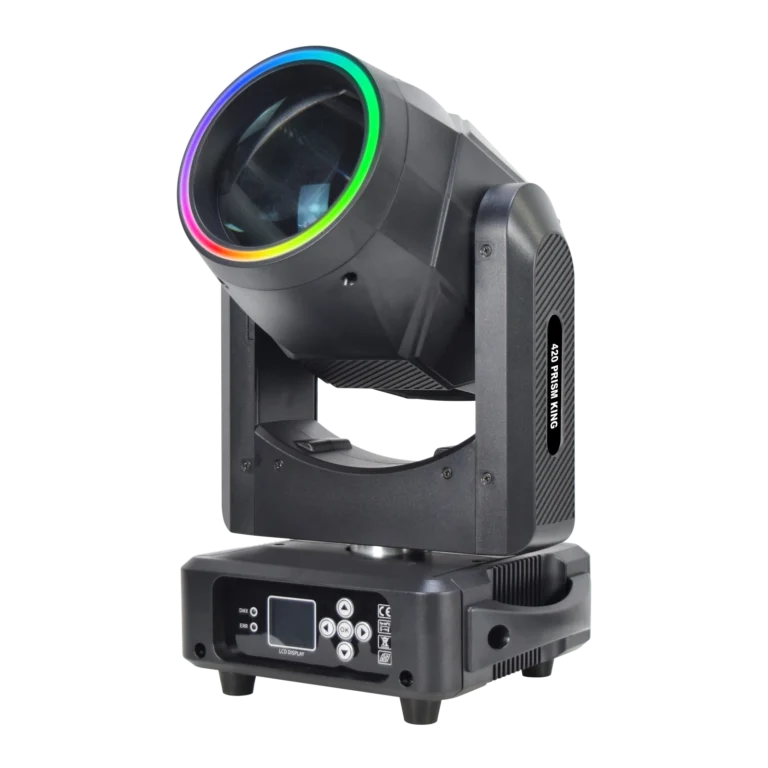
The 420 Prism King Beam Moving Head Light has a verified 2° beam specification. If that figure is treated as the full included angle in this ideal model, a hypothetical perpendicular target 10m away gives:
D = 2 × 10 × tan(1°) = 0.349m, approximately 0.35m.
This is a geometry illustration using the published nominal angle, not a measured footprint, lux reading, throw recommendation or gobo-size guarantee for the product. A prism creates multiple rays; it should not be treated as one uniformly filled wider cone. Frost or another optical state also requires its own assessment.
The RG-132 is a narrow-beam effect fixture with a 300W lamp and 450W fixture rating. Its 420 name is a series identifier, and its IP20 configuration is for indoor or properly protected use. These facts help identify the product; none supplies the missing photometry for the calculation.
When the job is aerial beam effects, compare actual movement, prism looks and visibility under representative conditions. When the job is surface illumination or readable projection, evaluate that task separately. The beam-angle selection guide covers the broader purchasing decision, while the Beam Moving Head Lights category provides the current commercial options.
Turn the calculation into a sample-check request
Send the supplier the target dimensions, centerline distance, aiming sketch, required optical state and intended result. Name the desired intensity boundary or ask how the stated angle was defined. If the project depends on illumination, request suitable photometric data or a measured sample test rather than only a cone drawing.
Retain the calculated value beside the observed result. Record the fixture version, optics, focus or zoom setting, target orientation and relevant ambient conditions. Differences between the ideal model and the sample can be useful evidence; they should not be hidden by changing the distance until the numbers appear to agree.
For a rental fleet, repeat the check at representative job distances. For a fixed installation, use the planned aiming geometry and target. Both approaches support a more useful quotation than asking for one “best” angle without explaining the task.
Beam calculation FAQ
How do I calculate beam angle from distance and diameter?
Use θ = 2 × arctan(D ÷ 2L), with diameter and distance in matching units. The result is the full angle for an ideal circular cone on a perpendicular target. Check whether your calculator returns degrees or radians.
Can I use a field angle in the same equation?
Yes, the geometry can estimate the diameter associated with that angular boundary. Keep the field-angle label: it is not automatically the same intensity boundary as a beam angle, and the resulting diameter is not a brightness guarantee.
Does doubling the distance double the diameter?
In the ideal point-origin cone with an unchanged angle, yes: D is proportional to L. Real optical behavior, aperture size and selected operating state can limit the approximation, especially close to the fixture.
Can the formula tell me how many lights a stage needs?
No. It provides one ideal footprint. Fixture quantity also requires the target layout, aiming positions, overlap, output, uniformity and the intended visual task. Use the calculation as one input to a documented design and sample assessment.
Send WUYESTAGE your target and throw-distance brief when comparing fixtures for a rental or stage project. Include the calculated estimate and what the actual sample must demonstrate.