How effective is digital signage in retail? Research supports a positive effect in some settings and mixed or negative results in others. Outcomes depend on the message, placement and store. A screen’s brightness, motion or modern appearance does not establish a return on investment.
For a retail buyer, the useful question is whether a display helps shoppers make a relevant decision—and whether the additional contribution covers the cost. This guide connects the evidence to a practical indoor LED poster pilot.
What does “effective” mean for a retail display?
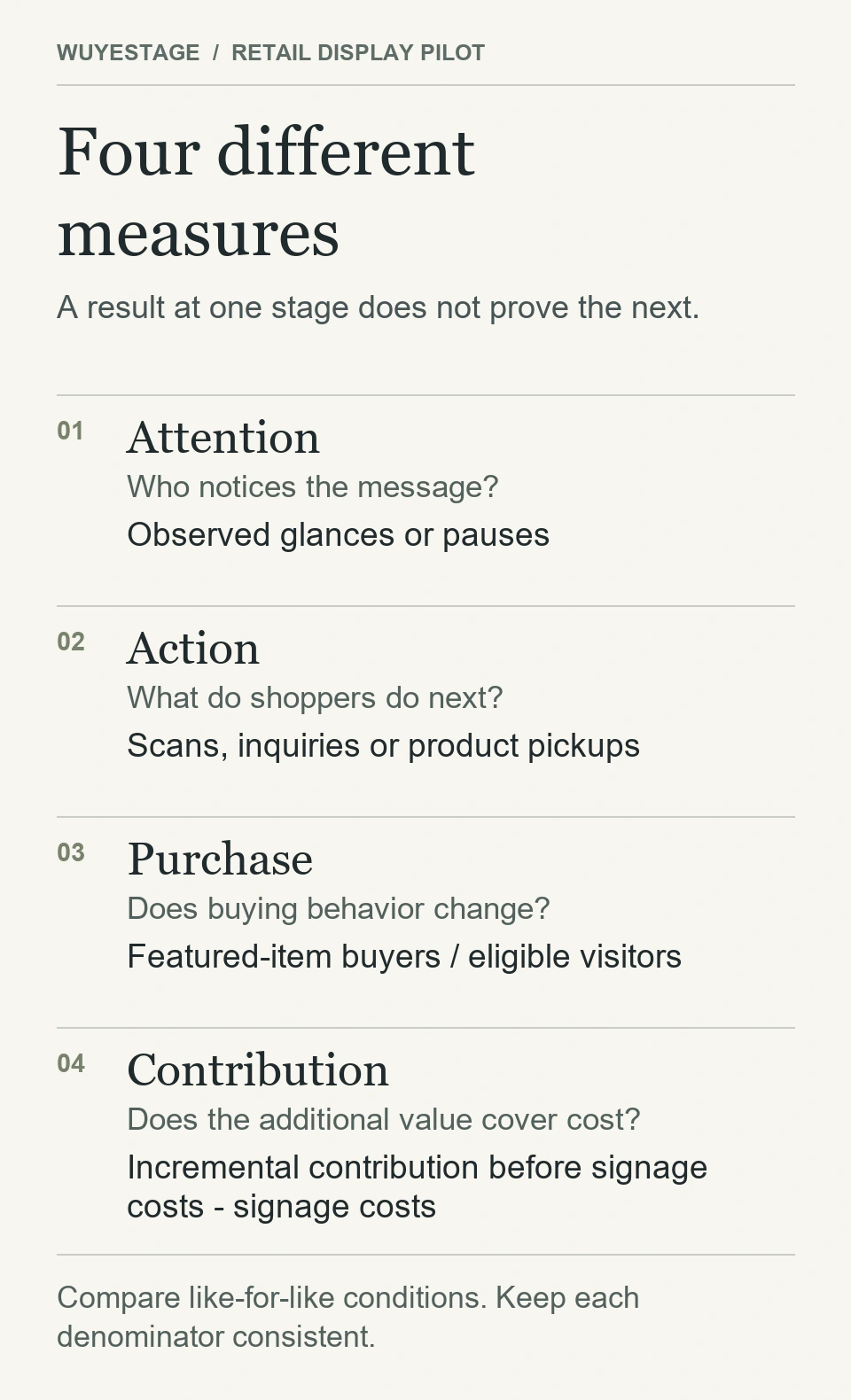
Attention, response and profit are different outcomes. A view-count statistic cannot answer whether a campaign makes money.
For a retail operator or display buyer, generic averages are unhelpful because screen performance is never uniform across store formats. Evaluate a display against three separate outcomes:
- Notice and comprehension: A shopper walking past actually sees the screen and understands the offer or product during the time they pass it.
- Relevant in-store action: The shopper changes behavior—pausing, turning down an aisle, picking up the featured item, or asking staff a question.
- Incremental purchases and profit: That action converts into a checkout transaction that would not have happened without the screen, with the resulting contribution compared against the display and campaign costs.
Succeeding at step one does not guarantee step two or step three. Eye-catching motion might make passersby look at a screen, annoyance or confusion can make them walk away, and an uncompetitive price will still block the final sale.
How effective is digital signage in real stores?
Retail field studies are more useful than an unattributed industry percentage because they identify what was measured and under which conditions.
In a large-scale study published in the Journal of Marketing (Herhausen, de Jong, & Grewal, 2025/2026), researchers analyzed field data from 2018 to 2022 covering 237 campaigns and 29,999,084 shopper observations. The campaigns used aisle screens running triggered video and audio ads rather than freestanding LED posters. Shopper exposure to an advertised product was associated with an odds ratio of 1.081 (p < .001), meaning 8.1% higher purchase odds in that study for the featured item.
Because baseline product-level purchase probabilities were small, this multiplicative change in odds approximates a relative probability shift—not an 8.1 percentage-point conversion jump, a guaranteed sales lift, or an 8.1% increase in total store revenue. Crucially, placement closer to the featured products was associated with stronger exposure effects, while shoppers who bought the advertised items did not spend statistically significantly more on those focal products.
Store format and message content also shape outcomes. Earlier research in the Journal of Retailing (Roggeveen, Nordfält, & Grewal, 2016) examined three field experiments across four retail formats. The authors found positive sales effects in hypermarkets, minimal effects in supercenters and supermarkets, and negative effects in small convenience stores. Price-promoting messages mattered to achieving positive effects in those experiments.
Neither study establishes a universal lift percentage or tests WUYESTAGE LED posters. The 2016 findings also do not mean every small store should avoid screens. They show why a buyer needs to test the relevant store, message and outcome rather than borrow a headline uplift from a different deployment.
Which benefits of digital signage matter in retail?
Understanding the operational benefits of digital signage in retail comes down to comparing dynamic screens against traditional printed foam boards, roll-up banners, and lightboxes.
Where Digital Displays Provide a Real Advantage
- Timely content transitions: One of the core advantages of digital signage is changing campaign messages without reprinting each design, provided the selected playback system and content workflow support the required updates. A clothing boutique or specialty retailer can highlight rainwear during a wet morning, switch to weekend bundle offers on Friday afternoon, and remove a promotion when staff identify low stock.
- Functional motion: Motion is valuable when it improves comprehension—such as showing the shape or use of a product. Motion that distracts from the item or hides the message is not an advantage.
- Repeat deployment across campaigns: When a store runs frequent seasonal rotations or vendor-funded spotlights, reusable hardware can reduce repeated printing and mounting. Compare those savings with creative work, update labor, electricity and maintenance.
Conditions, Costs, and When Static Signage Is Enough
Realizing these digital signage benefits requires meeting specific operational conditions:
- Upfront capital and power access: Compare the installed hardware and operating costs with the print option. Check power access and safe cable routing before choosing a floor position.
- Content formatting discipline: Use content designed for the actual screen canvas and viewing distance; a dense slide can be harder to read than a simple printed sign.
- When print wins: For a stable message such as a department label or fitting-room policy, a simple printed sign may be the more economical choice. An unlit printed sign needs no electrical supply. Frequent content changes are a reason to evaluate a screen, not proof that it will pay for itself.
How could an LED poster support a retail promotion?
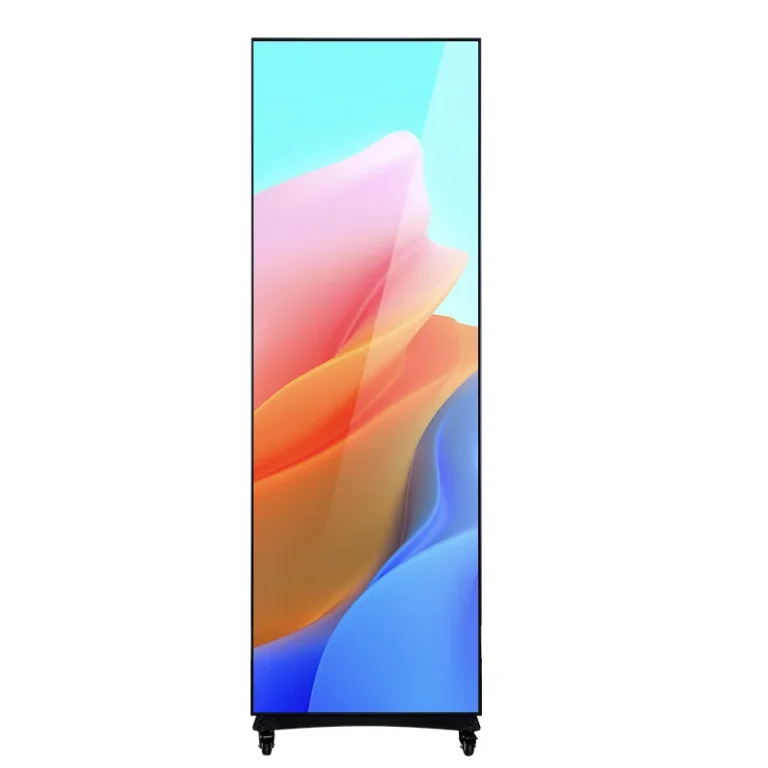
Not every digital signage project calls for the same hardware. Ceiling-hung LCDs, shelf-edge strips, and checkout monitors serve different zones. However, when a retailer wants a movable, floor-standing display to anchor a promotional zone or storefront entrance, buyers often evaluate a commercial LED poster display.
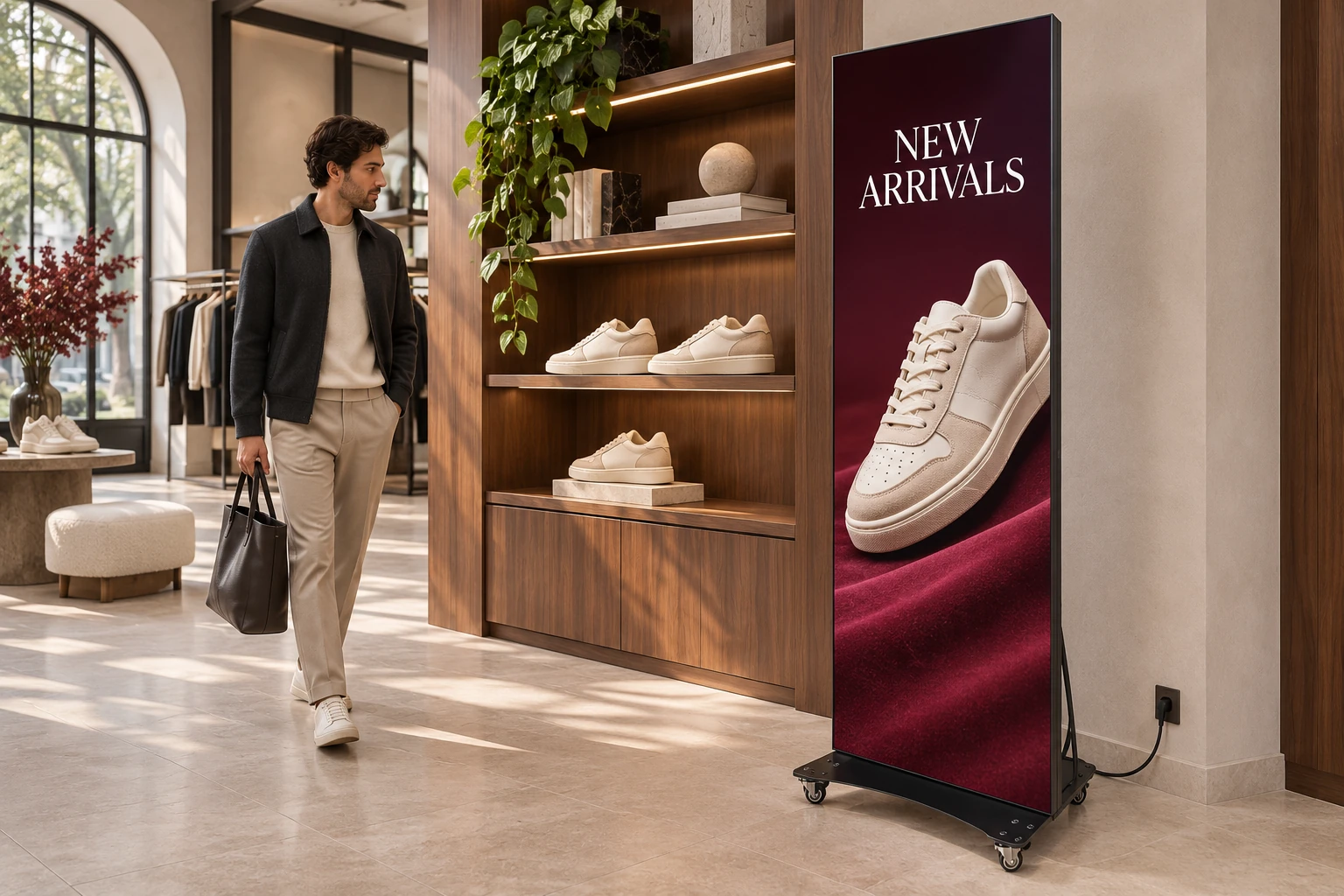
Consider a footwear shop introducing a new sneaker range. The following is a planning example for testing placement and content.
1. Positioning on the Approach to a Featured Range
Place the new range where shoppers can examine it. Instead of tucking a screen behind the cash wrap where shoppers are already done browsing, the store places an indoor LED poster display along the main sightline approaching the featured shelf.
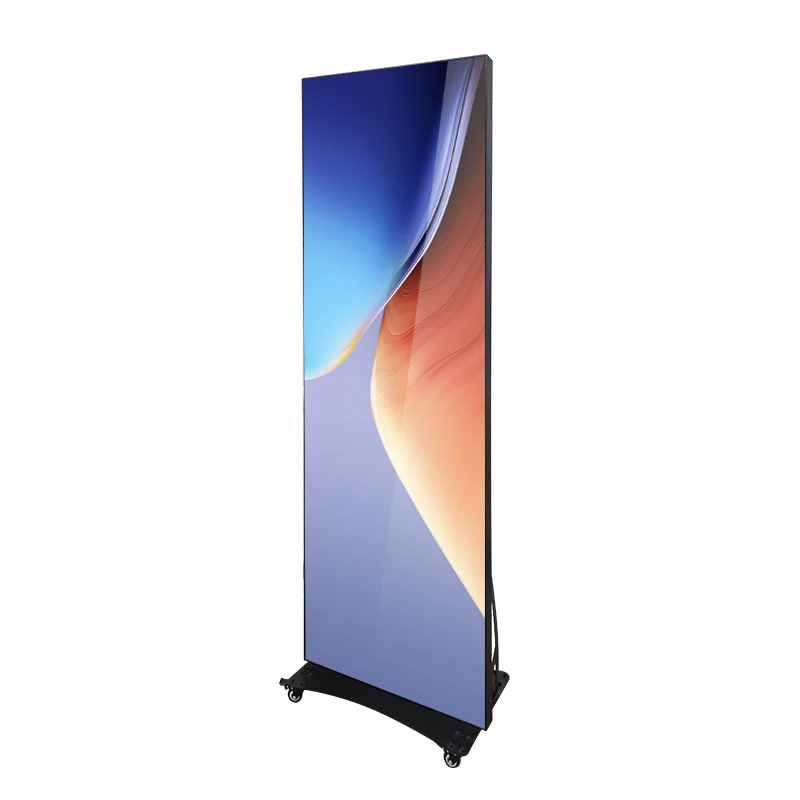
Because the unit sits on a mobile caster base, store merchandisers can test the exact angle on the sales floor before committing to a long-term layout. Before running the promotion:
- Maintain generous walkway clearance so shoppers with bags or strollers never have to sidestep the base.
- Angle the screen toward approaching foot traffic without blocking sightlines to the physical merchandise right behind it.
- Keep this IP31 indoor model in an appropriate indoor position; do not treat it as an outdoor or weatherproof display. Confirm the actual site conditions before installation.
2. Match the cabinet and viewing conditions
WUYESTAGE’s standard indoor poster series offers 640×1920 mm and 960×1920 mm cabinet formats. Those are cabinet dimensions, not the total floor space occupied by the base, support and cable clearance. Check the full unit drawing against the proposed location.
The series lists 500–700 nits brightness. Test your actual artwork under the store’s strongest expected ambient light, especially beside a window; the specification alone cannot establish readability or comfortable brightness at that site.
Select pixel pitch around the actual viewing distance, text size and image detail. Review a content sample at that distance instead of assuming a finer pitch will improve sales.
3. Design for a walk-by and the actual screen canvas
Even a well-placed screen fails if the creative assets are treated like a brochure. Check whether someone walking the actual approach can understand the message without stopping to read a paragraph. Effective poster content sticks to three elements on screen at once:
- One focal product shown clearly at scale.
- One concise value or price message in high-contrast typography.
- One immediate next step (e.g., “Try the new arrivals—on the shelf beside you”).
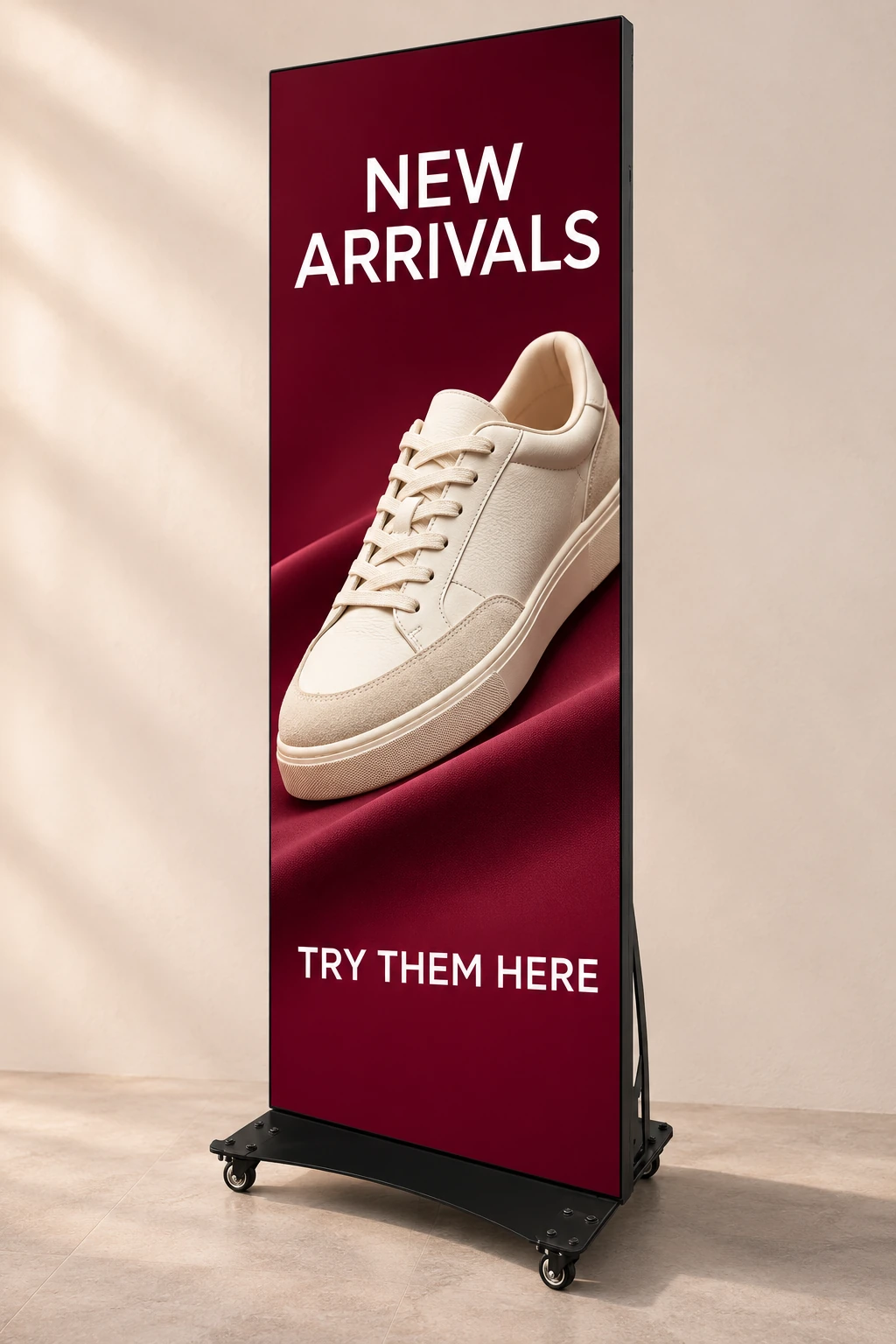
Design for the final pixel map. The 640×1920 mm cabinet format has a 1:3 proportion; ordinary 9:16 smartphone video may need a different layout rather than stretching. Confirm the configured active canvas before exporting artwork, then check that the product, headline and next step remain visible together.
How do you measure digital signage effectiveness and ROI?
Do not assume the display itself includes audience tracking. Select a measurable store outcome and a comparison that can distinguish a signage effect from changes in traffic, stock or promotions.
Run a store pilot with a useful comparison
Before rolling out displays across multiple locations, run a controlled pilot:
- Pick one primary outcome before launch: Decide in advance whether the screen’s job is to increase unit sales of a specific SKU group, lift attachment rates on a featured bundle, or drive redemptions of a displayed offer.
- Use matched periods or randomized blocks: Simply comparing a week with the screen turned on against the previous week can mislead you if payday traffic or weather shifted. Where possible, randomize comparable stores or time blocks into display and control conditions. If that is impractical, use matched stores or periods and report the remaining differences; a before-and-after comparison alone is weaker evidence. Avoid relying on an arbitrary 7-, 14-, or 30-day rule of thumb; choose a duration based on traffic, baseline purchase frequency and the effect size you need to detect. Include relevant weekly cycles; sparse purchases may require a longer test or more locations.
- Hold other variables steady: Keep prices, shelf stock levels, physical product placement, and staff incentives consistent between test and baseline periods.
- Track the denominator and log confounders: Record the same denominator in each condition. Featured-item buyers per eligible visitor can measure visitor conversion; promoted units per 1,000 transactions measures basket inclusion. They are different metrics. Neither confirms who actually saw the screen. Report sample sizes and uncertainty alongside the result. Keep a simple daily log of disruptions like out-of-stocks, nearby construction, or rival promotions.
- Recognize channel limits: If you place a QR code or promo code on the poster, remember that scans only measure shoppers willing to pull out their phones—they do not capture everyone who noticed the screen and picked the product straight off the shelf.
Calculate digital signage ROI over a defined period
When evaluating digital signage ROI, use a formula that isolates incremental gross profit contribution rather than gross sales revenue:
ROI (%) = [(incremental contribution before signage costs − signage costs) ÷ signage costs] × 100
To keep the calculation honest:
- Define incremental contribution before signage costs: Calculate the extra units sold attributable to the display (above a credible comparison), multiply by the actual selling price (accounting for any promotional discounts), and subtract the associated variable product and selling costs. Account for changes in margin and any displacement of other sales. Do not deduct signage costs inside the contribution figure, or you will subtract them twice.
- Include all relevant same-period signage costs: Allocate hardware purchase and installation costs consistently across your chosen evaluation horizon (for instance, monthly depreciation over the expected commercial service life), and add the same-period costs for creative production, staff labor to update files, external software licenses (if used), electricity, and routine maintenance.
Use the same cost scope in both places in the formula. For a full-project cash comparison, include the hardware and installation cash outlay over the project horizon. For an operating-period comparison, allocate those costs consistently and state the method. Do not compare a short period of sales against only part of its relevant cost.
A useful break-even question is: How much additional contribution must the campaign generate over this period to cover all signage costs? Use the store’s own margins and test results, not the research study’s uplift as a sales forecast.
Frequently Asked Questions
Can I measure effectiveness without camera analytics?
Yes. POS data can support a test of featured-product sales, basket inclusion or offer redemptions using comparable display and control conditions. Optional manual observations can help diagnose whether people notice and understand the message. These answer different questions: a glance does not prove a sale, and transaction data alone does not prove exposure. Neither requires the poster to contain built-in analytics.
Will choosing a brighter or finer-pitch LED poster automatically increase retail sales?
No. Brightness and pixel pitch affect whether the message can be seen and read. After checking that requirement in the real location, evaluate the offer, creative, product availability and placement. A higher specification is not evidence of higher sales; select it to meet the viewing task.
Planning a retail LED poster?
Digital signage is most effective when the physical display format matches your store floor, sightlines, and promotional workflow. If you have evaluated your retail layout and determined that a freestanding LED poster fits your merchandising strategy, WUYESTAGE can discuss a suitable indoor poster configuration.
When you reach out to our team, share a few practical details about your project:
- Store format and application: (e.g., apparel boutique entrance, supermarket promotional endcap, shopping mall concourse)
- Proposed position and viewing distance: How close shoppers will walk or stand when reading the screen
- Ambient lighting conditions: Indoor ceiling fixtures, bright spotlights, or nearby window daylight
- Sample content: Whether you plan to display fine text, price tables, or full-screen product motion
- Preferred cabinet format: The slim 640×1920 mm or wider 960×1920 mm indoor LED poster display
Contact WUYESTAGE with your floor requirements, and we will help you evaluate the appropriate pixel pitch and cabinet configuration for your retail space.