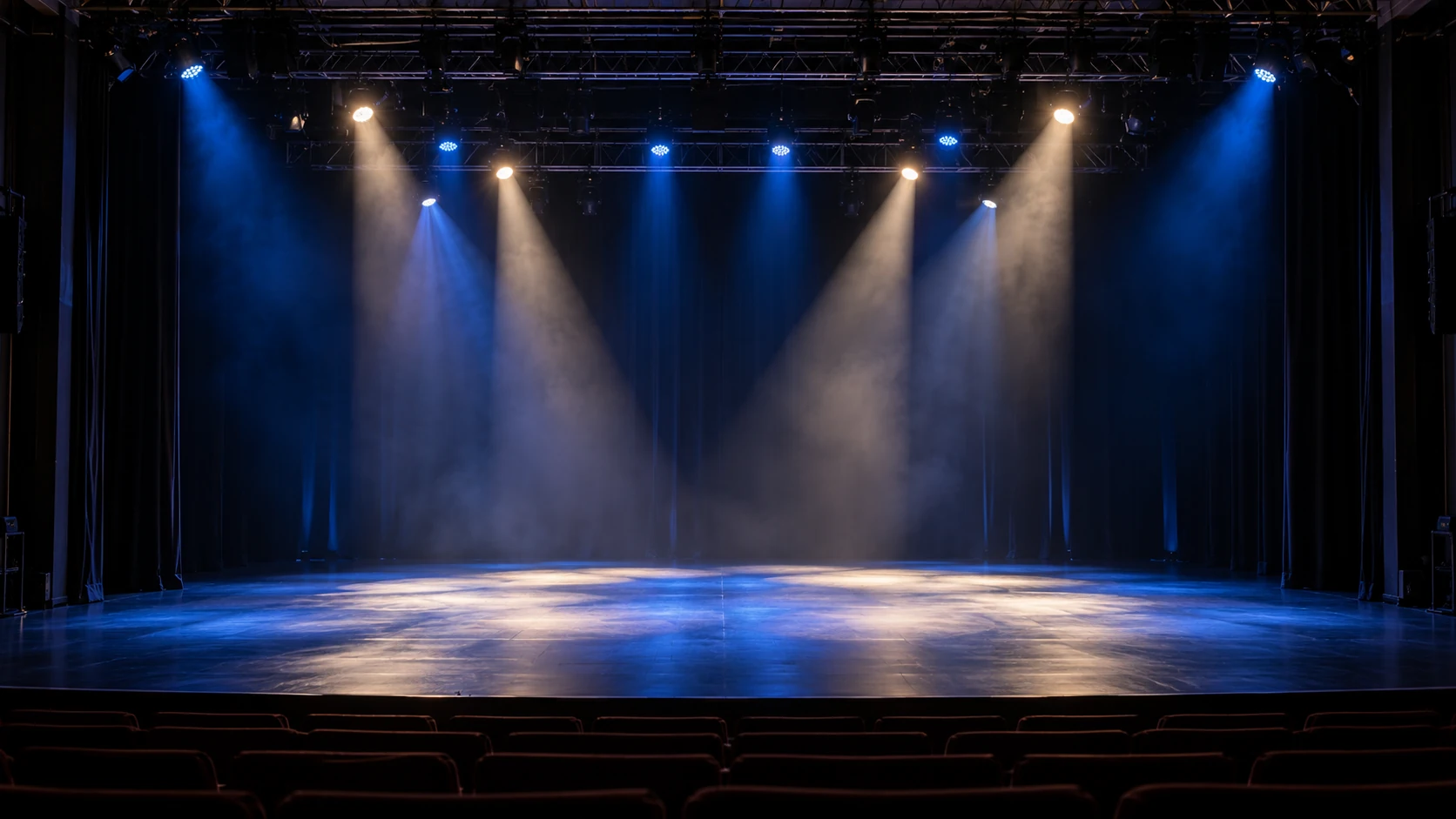
Two fixtures can carry the same angle on a quotation and still put light in different places. Before comparing the numbers, check what each number measures.
To compare beam angle vs field angle, start with the intensity threshold used to define the spread. In common entertainment-lighting photometry, beam angle uses 50% of peak luminous intensity; field angle uses 10%. Both describe a full included angle in a specified measurement plane and optical state.
That distinction helps answer two different questions: how wide is the central concentration of light, and how far does its lower-intensity spread extend? Neither number, by itself, tells you that a stage area will be evenly lit or that nearby scenery will remain dark.
What Is a Beam Angle Measuring?
A useful answer to “what is a beam angle?” starts with the intensity distribution, rather than a circle drawn on the floor.
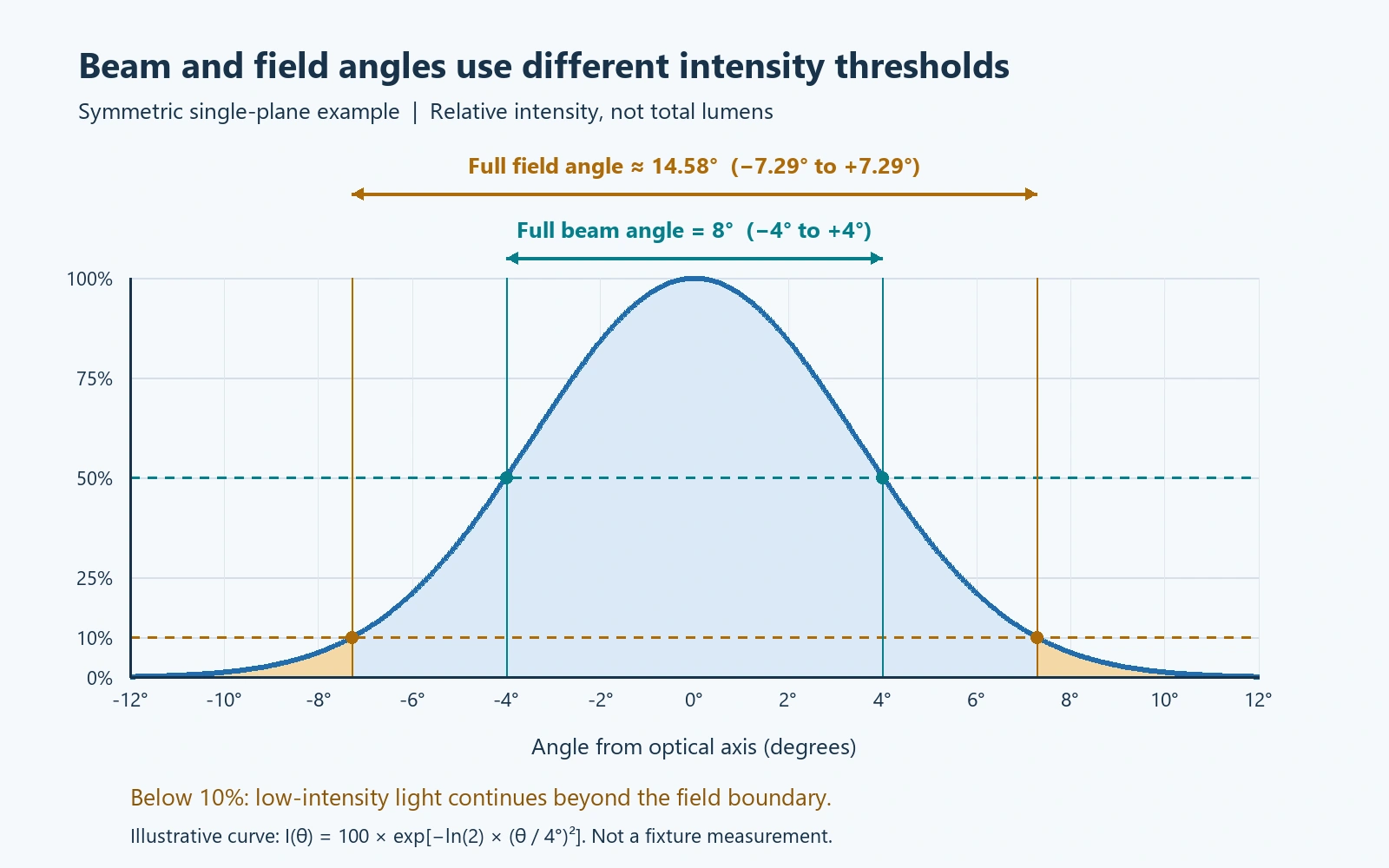
For a typical single central peak, imagine reading a candela curve from the center outward. The peak is the 100% reference. Find the directions on opposite sides where intensity falls to 50% of that reference: the angle between those directions is the beam angle. The corresponding 10% crossings define the field angle.
These percentages describe directional luminous intensity, measured in candela. They do not mean that half the fixture’s total lumens sit inside one boundary and one tenth sit inside the other.
There are two details worth checking on the chart:
- Full angle or half-angle? On a symmetric plot, crossings at −4° and +4° give an 8° full angle. A point marked 4° from the axis is a half-angle, not the complete spread.
- Which measurement plane? A round, rotationally symmetric distribution can be summarized by one representative plane. Oval lenses, linear diffusion and other asymmetric optics need more information, such as horizontal and vertical spreads or a contour diagram.
For a smooth, centrally peaked distribution, the 10% crossings lie farther out than the 50% crossings. For irregular or multi-peak distributions, check how the manufacturer defines and reports the boundaries rather than assuming a simple circular cone.
What the Two Boundaries Tell You—and What They Leave Out
For a useful beam angle vs field angle lighting comparison, keep these three limits in view.
The central spread is not an evenly lit patch
The intensity has already fallen from its peak by the time it reaches the 50% boundary. On an actual target, illuminance also depends on distance and incidence angle. A stated spread therefore cannot promise uniform lux across performers, a backdrop or a stage floor.
Use the published curve or relevant measurements to judge the falloff. For converting an angular boundary into a geometric diameter, see our beam angle calculation guide. The calculated diameter still describes the boundary you selected; it does not establish useful brightness throughout that area.
The outer spread is not a blackout line
The 10% threshold does not mean zero light beyond it. A distribution may have a low-intensity tail outside that boundary.
That matters when a wash sits beside dark masking or a projection surface. Whether the spill is noticeable depends on absolute output, ambient light, surface reflectance and viewing or camera conditions. A field specification is a useful reference, not a guarantee that everything outside it stays dark.
Two angles do not describe the whole falloff
A smaller gap between the 50% and 10% angles tells you those two threshold crossings are closer together. It does not reveal every change in intensity between them—or beyond them.
For fixture matching and wash overlap, read the curve as well as the angle pair. Two fixtures can share those crossings while having different distributions elsewhere.
Field Angle vs Beam Angle: Reading a Real Datasheet
The ETC Desire D60 photometric datasheet, page 5, provides a useful third-party example:
| Model | Beam angle | Field angle |
|---|---|---|
| D60 Vivid | 8° | 17° |
| D60 Lustr+ | 6° | 16° |
Here, comparing field angle vs beam angle reveals something that either column alone would miss. The outer angles differ by only one degree, while the central 50% angles are 8° and 6°. Similar outer spread does not mean the same central spread.
These are historical ETC product figures, not WUYESTAGE measurements or a universal ratio. They do not establish which fixture is brighter or better suited to a particular rig. Their value here is showing why a buyer should read both columns.
Compare the Conditions Before Comparing the Numbers
Before treating two specifications as equivalent, check the following:
| Check | What needs to match or be explained |
|---|---|
| Threshold | Is each number a 50% angle, a 10% angle or a nominal rating with no stated threshold? |
| Optical state | Which zoom position, lens, frost or other modifier produced the figure? |
| Measurement plane | Does the number refer to horizontal spread, vertical spread or a symmetric distribution? |
| Output evidence | Is there a relevant intensity curve or measurement for the actual model and state? |
| Target conditions | Will the working distance, aiming geometry and surrounding light-sensitive surfaces suit the intended task? |
If one sheet gives a 50% boundary and another gives a 10% boundary, equal degree values are not equivalent specifications. If the conditions are unclear, ask for clarification before using the numbers to plan overlap or spill control.
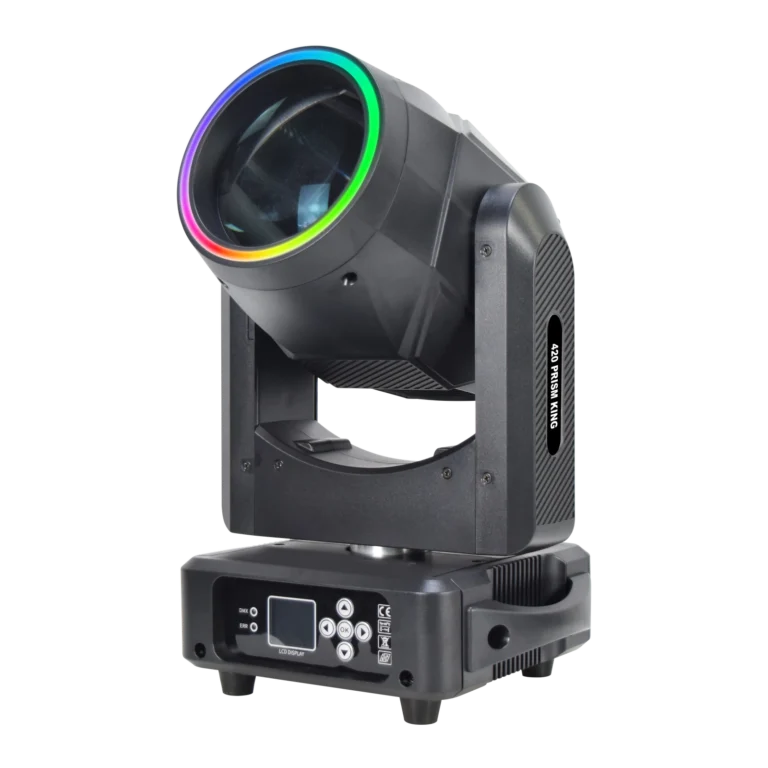
A single nominal value needs the same care. For example, WUYESTAGE’s 420 Prism King has a specified 2° nominal beam angle. That number alone does not supply a 10% field angle or establish a measured 50% boundary. It is a narrow aerial-effect fixture; it should not be treated as evidence of broad, even performer coverage.
For choosing angles by lighting task, use our moving head angle selection guide.
Beam and Field Angle FAQ
Does a wider field angle mean more usable light?
Not by itself. It describes the spread at the 10% intensity threshold, not uniform illuminance or total useful light on the target. Check the intensity distribution, working distance and required coverage before comparing fixtures.
Can I calculate field angle from a nominal beam angle?
There is no universal conversion ratio. You need the relevant intensity distribution or a separately stated field angle for the same optical state and measurement plane. A nominal 2° rating alone does not establish a 10% field boundary.
Does light stop outside the field angle?
The 10% threshold is not a hard cutoff. Lower-intensity light may continue beyond it. Whether that spill is noticeable depends on absolute output, ambient light, surface reflectance and viewing or camera conditions.
What should match when I compare two angle specifications?
First match the intensity threshold, optical state and measurement plane. Then check the available output evidence and the target conditions. Equal degree values are not equivalent specifications when one describes a 50% boundary and the other a 10% boundary.
Ask for the Evidence Your Application Needs
When discussing a fixture with WUYESTAGE, tell us the working distance, the area you need to light and any nearby surfaces you need to protect from spill. Include the intended optical state and whether your requested angle refers to a 50% boundary, a 10% boundary or a nominal specification.
If acceptance depends on a particular measurement or photometric document, identify it before ordering so its availability can be checked for the exact model and configuration.
Send your stage lighting requirements with those details. A degree value is a starting point; the useful comparison connects that value to its definition, operating conditions and your actual lighting task.