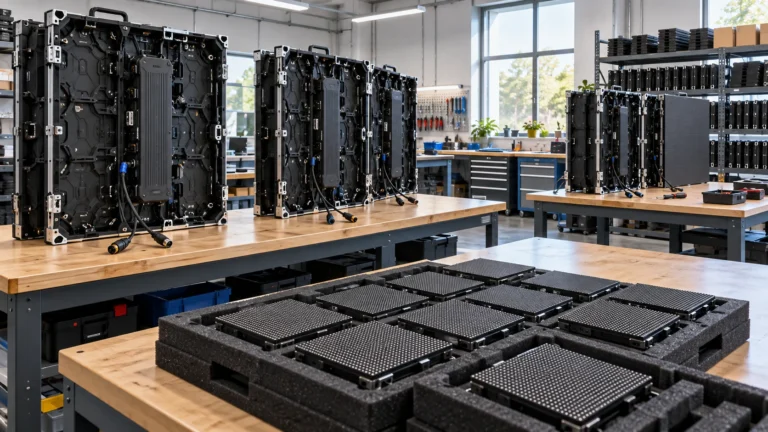
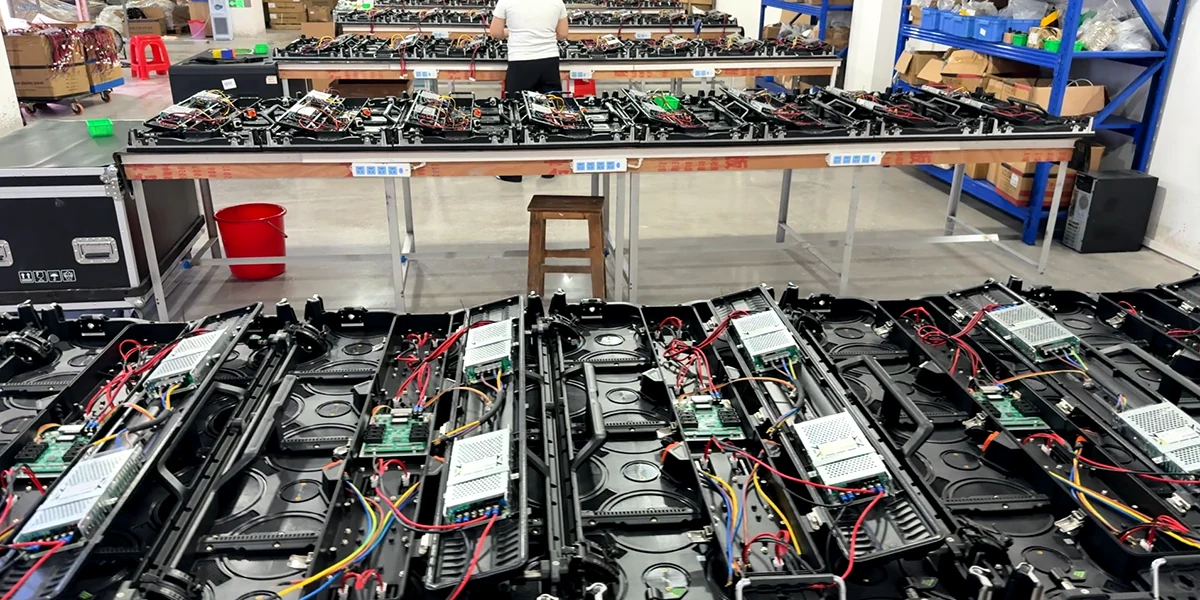
Cover photograph: P3.91 rental LED cabinets opened for workshop inspection.
Two LED display quotations may both promise a protected surface, yet describe different constructions. One says COB; the other says GOB. Choosing between them takes more than deciding which acronym sounds newer.
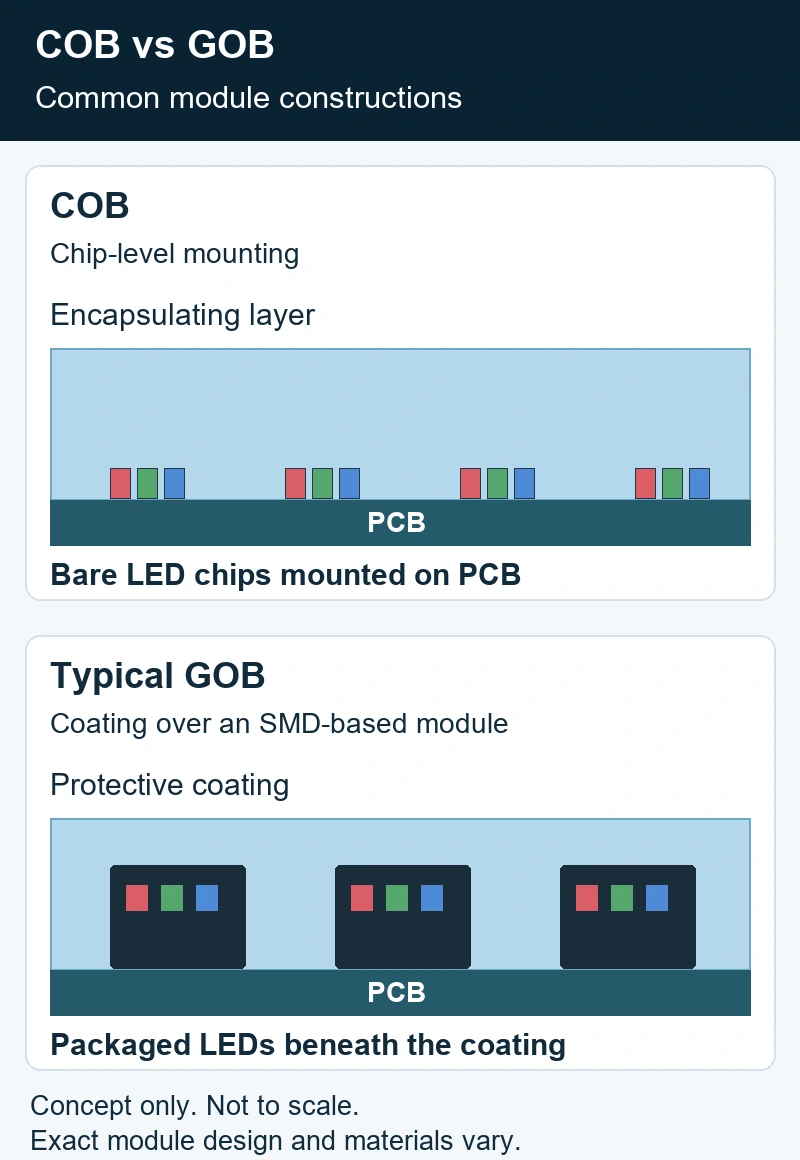
The main difference is where the LED chips sit in the construction. COB, or chip on board, mounts LED chips directly on the circuit board before encapsulation. GOB, or glue on board, usually adds a protective coating to an assembled LED module, commonly one built with packaged SMD LEDs.
For buyers, that distinction starts the comparison. The complete product still determines whether the screen delivers the required image, survives its handling routine and can be supported when a fault occurs.
Read the construction before the performance claims
COB describes chip-level construction. GOB commonly describes an additional surface-protection process. They are therefore not two grades on a single quality scale.
| Term | What it tells you | What it does not establish |
|---|---|---|
| COB | LED chips are mounted directly at board level, then encapsulated | The exact pixel pitch, surface finish, image quality or service policy |
| GOB | An assembled LED module has an added protective coating, commonly over SMD LEDs | The complete screen’s weather rating, impact-test result or repair cost |
| SMD | Individually packaged LEDs are mounted on the board | Whether that particular module also receives a GOB treatment |
A GOB product can still be based on SMD construction. A COB product can use different chip-bonding and encapsulation designs. Ask for the exact module description rather than assuming every product carrying the same label is built identically.
Make the viewing task the first filter
Start with the content and the nearest important viewing position. A display used for detailed dashboards has a different task from a presentation background viewed across an event hall.
Compare the proposed pixel pitch, active image dimensions and native resolution. If the quotations differ on these items, record that difference before attributing an image-quality advantage to COB or GOB.
Then show both candidates the same material under representative room lighting. Include small text, fine lines, dark content and the images the audience actually needs to judge. Look from the intended seats and from off-axis positions that matter to the room.
Surface finish and room reflections deserve their own check. A screen that looks impressive in a dark demonstration area may behave differently beside windows or under exhibition lighting. Evaluate the supplied sample rather than assigning a universal contrast or glare ranking to a packaging name.
For a filmed production, also test the actual camera setup. Neither label guarantees clean recorded footage; our LED wall moiré guide explains why camera position, lens and framing belong in that assessment.
Follow the display through its working day
For a portable or rental display, list where damage could occur: unpacking, moving through a doorway, building the screen, removing a module and packing for the next job. The surface layer is only one part of that route.
Ask the supplier to demonstrate normal handling and the approved cleaning procedure. Inspect edges, corners, module retention, cabinet alignment and the protection offered by the transport arrangement. Do not use improvised hammer, scratch or water demonstrations as substitutes for documented product requirements.
For a fixed installation, the priorities may be different. Consider contact with the display face, cleaning access, the position of adjacent equipment and whether service work can be carried out without dismantling the room.
These checks do not make either technology the automatic winner. They show whether the particular cabinet and module design fit the way the equipment will be used.
Separate surface protection from outdoor suitability
A coated or encapsulated face does not establish the protection of the complete assembly. Cabinet joints, the rear enclosure, cable entries and connections also matter.
IEC 60529 classifies degrees of protection provided by enclosures. For an actual order, ask which model and configuration the stated IP rating covers, whether front and rear ratings differ, and what installation conditions apply.
Do not approve outdoor use from the words GOB or COB alone. Likewise, an ingress-protection rating does not, by itself, answer a separate question about resistance to physical impacts. Keep the required environmental and handling evidence distinct in the quotation.
Compare the recovery plan, not just the protected face
Ask what happens when one part of the display fails. Who identifies the problem? Can the intended service team replace the relevant module? What must be returned for specialist repair?
Separate module replacement from component-level repair. A team may be able to exchange a complete module on site while chip, LED or coating work requires a different repair process. Do not assume GOB can be repaired exactly like an uncoated SMD module, or that every COB fault requires the same replacement scope.
Use the supplier’s approved procedure to check access, tools, spare identification and the steps needed to restore the picture. Where installation access is a constraint, the front versus rear service guide helps frame the component-access questions.
Include replacement availability and visual matching in the discussion. A spare that fits mechanically still needs the correct electrical and control configuration and a suitable brightness-and-colour match. Agree how the ordered batch and its spares will be identified.
Keep the technology and the product format separate
WUYESTAGE’s P1.86 GOB tri-fold display combines a GOB surface, a tri-fold structure and a caster base. These describe different aspects of the product. GOB does not define the folding mechanism, and the folding mechanism does not establish an outdoor rating.
The indoor rental cabinet series includes a P1.953 GOB option in a different equipment format. A floor-standing folding display and a rental cabinet wall solve different placement and operating tasks, even when both use the term GOB.
Choose the physical format around the project first, then compare the available module construction and image performance within a suitable configuration. Do not treat two products as interchangeable simply because their surface-technology labels match.
Put the differences into a comparable quotation
Before choosing COB or GOB, ask suppliers to complete the same short comparison. Keep model-specific answers with the quote rather than relying on a general technology brochure.
| Compare | Information to retain |
|---|---|
| Image requirement | Content sample, viewing positions, active size, pitch and native resolution |
| Operating conditions | Room lighting, indoor or outdoor location, camera use and operating routine |
| Physical format | Cabinet or complete-unit arrangement, installation, movement and packing |
| Protection | Exact rated configuration, handling requirements and approved cleaning procedure |
| Recovery | Service access, replaceable unit, matching spares and repair responsibility |
| Complete order | Processing, accessories, spares, packing, delivery and written support terms |
A lower price is meaningful only when you can see what changed. If one offer uses a different pitch, a different screen size or a smaller spare package, compare those differences explicitly before calling it a cheaper version of the same system.
Send WUYESTAGE your intended use, content example, viewing distance, screen size and handling requirements when discussing a GOB display configuration. Those details help narrow the equipment options and identify the checks needed before approving the order.