




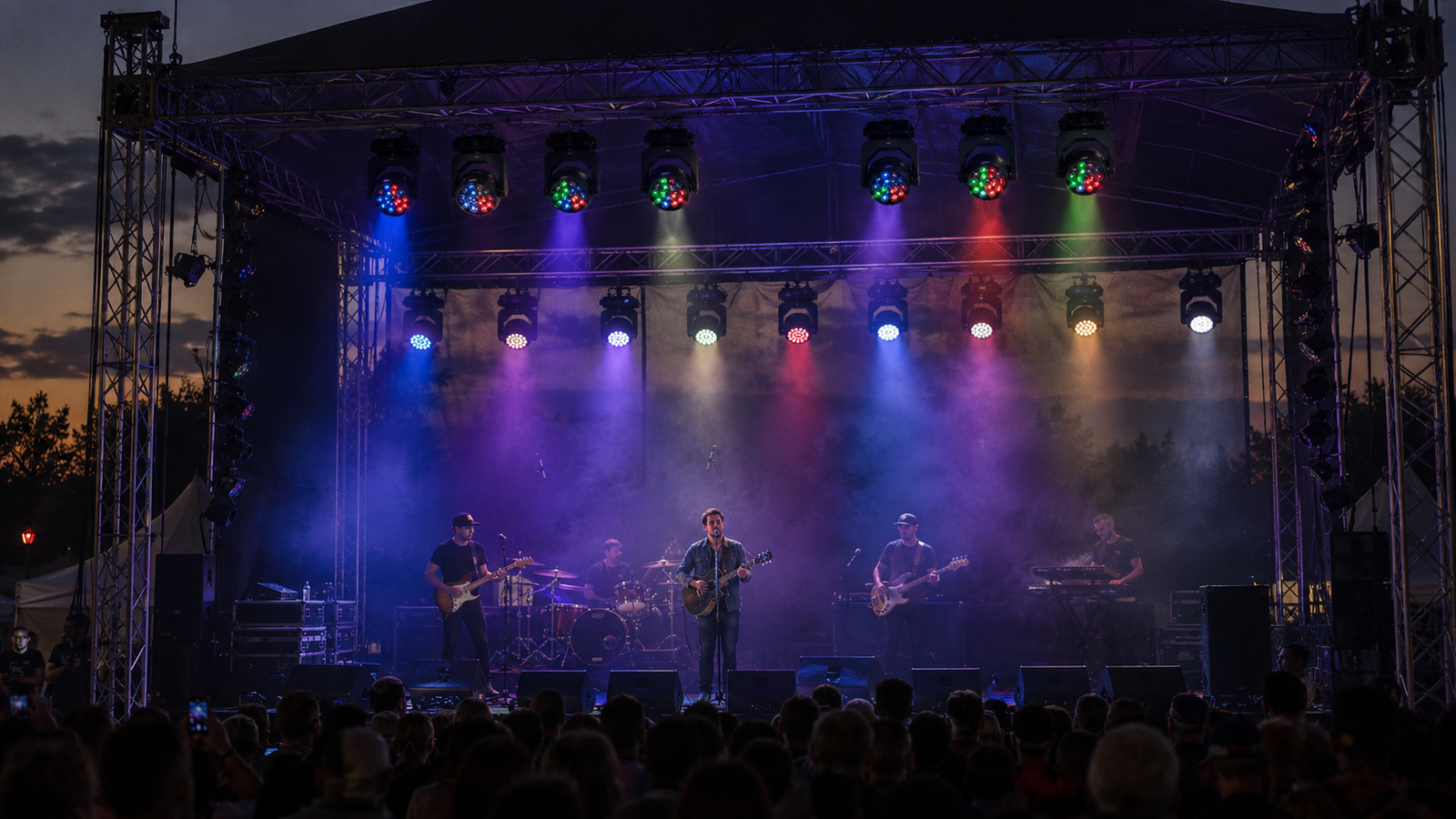
The best wash lights for festivals provide wide, even color coverage while remaining practical for outdoor weather, long operating hours, camera use, fast programming, repeated transport, and safe rigging. A powerful fixture is not automatically the best choice. Buyers must match the IP rating, zoom range, color system, movement, control modes, weight, and quantity to the actual stage.
For open-air festivals, an IP65 moving wash is usually the safer starting point. On covered stages, a non-weather-rated wash or beam-and-wash hybrid can still be useful, but it needs reliable protection from rain and moisture. This guide explains how rental companies, event contractors, and distributors can compare festival wash lights without relying on wattage alone.
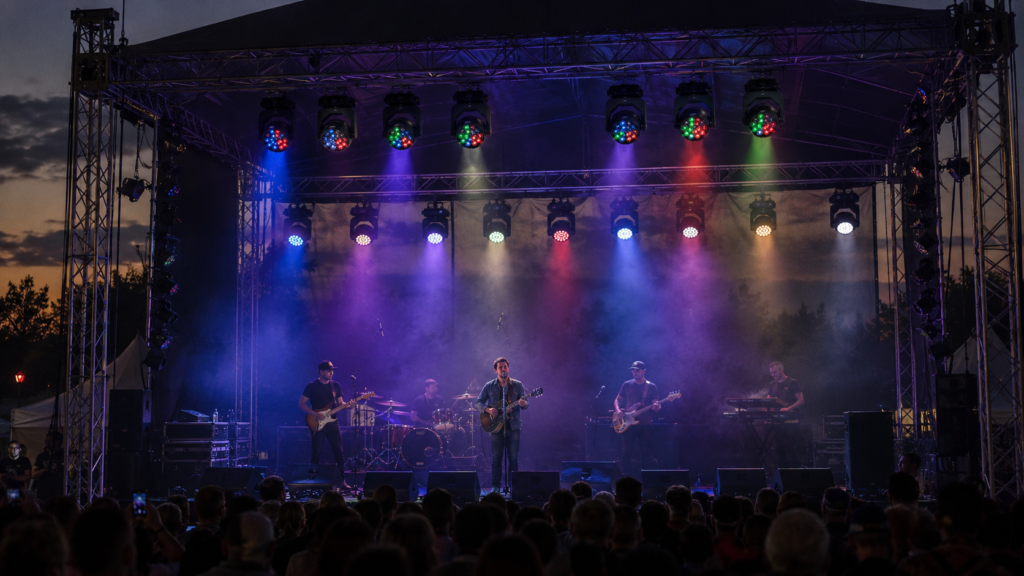
A festival wash light must cover performers, scenery, truss, or audience areas without obvious dark gaps or hot spots. It also needs strong saturated color for early evening, smooth dimming after dark, and stable camera performance for televised or streamed events.
Before selecting a model, define these project inputs:
These inputs are more useful than asking for a universal “best festival light.”
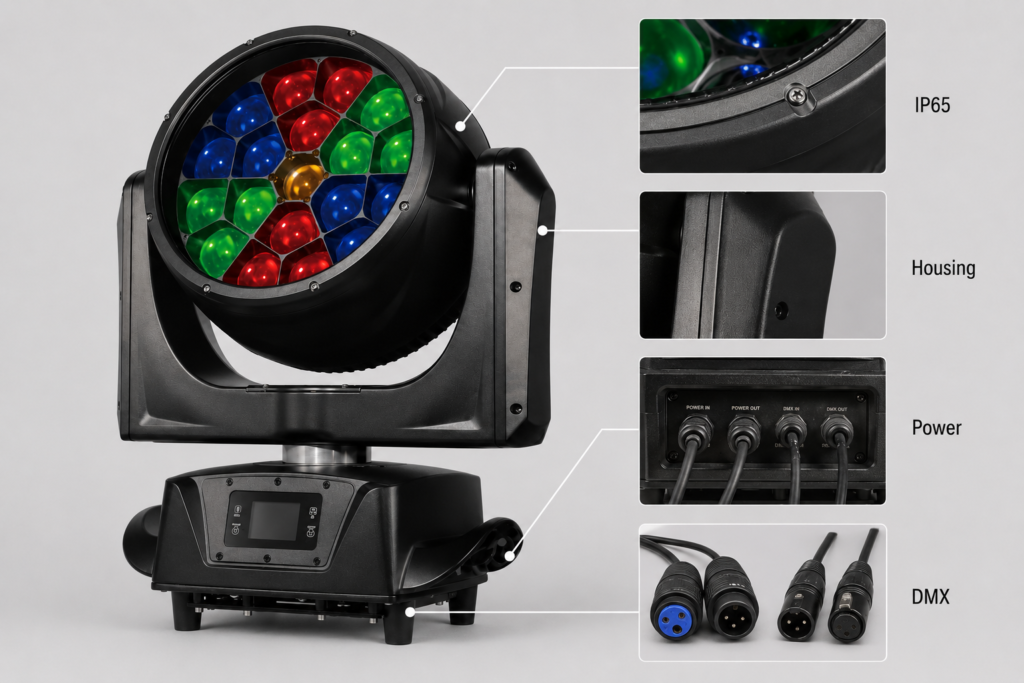
For fixtures directly exposed to outdoor weather, IP65 is a strong purchasing requirement. It indicates protection against dust and water jets under the applicable test conditions. However, buyers should confirm that the rating applies to the complete fixture, including the housing, display, seals, power input, signal connectors, and cable interfaces.
The RG-371 is a relevant outdoor reference because its catalog specifies IP65 protection. It uses 19 four-in-one 40W LED sources, has a maximum fixture power of 730W, and provides an 8.5°-45° spot angle. As a result, one model can create tighter looks or wider festival washes while remaining designed for exposed outdoor use.
Non-IP-rated fixtures should not be described as outdoor products. The RG-812 and RG-771 product files do not confirm an IP rating. They may be appropriate on a properly protected stage, but the production company must manage rain protection, condensation, drainage, cable routing, and emergency shutdown procedures.
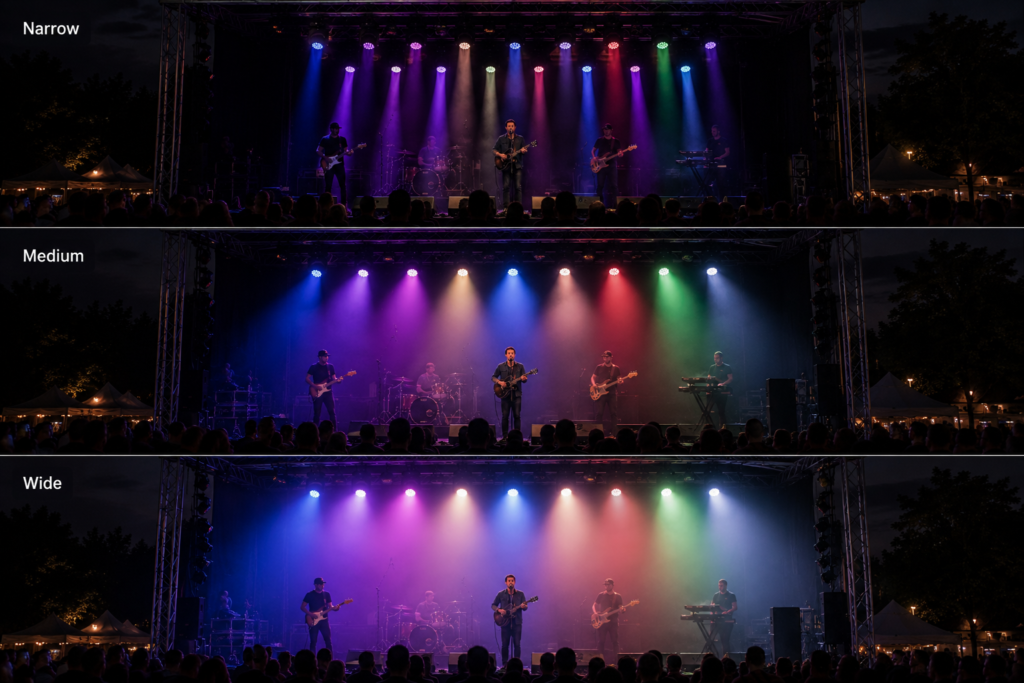
Zoom controls coverage from a given distance. Therefore, select it according to throw distance, trim height, fixture spacing, and the illuminated surface.
The RG-371 provides an 8.5°-45° spot angle. This range gives designers useful flexibility when the same rental stock must cover medium stages, larger festival structures, and different rigging positions.
The RG-771 lists a 2.8°-31° beam angle and a 5°-60° field angle. Its five 60W RGBW sources are combined with cool-white and warm-white auxiliary LEDs. Nevertheless, because no IP rating is confirmed, it belongs in protected or indoor applications unless the supplier provides a verified outdoor version.
Ask for photometric data or test a sample at the intended throw. Inspect center brightness, edge softness, color consistency, and overlap between adjacent fixtures.
Festivals need saturated effects as well as clean whites and pastels. RGBW adds a dedicated white component, while CTO adjusts white balance for cameras, performers, and scenery.
The RG-371 combines RGBW LEDs with a listed 2800K-8500K color-temperature range and supports wash, beam, CTO, vortex, and kaleidoscope effects. It also provides single-LED pixel control and dedicated pixel channel modes. Therefore, it can serve both as a broad wash source and as a visual effect fixture.
The RG-812 uses 12x40W RGBW wash LEDs around a separate 200W LED beam source. Its CTO range is listed as 2500K-8000K. This hybrid structure is useful when a covered festival stage needs color wash and a central beam from the same fixture position.
Still, buyers should compare actual mixed colors rather than relying only on source labels. Test red, green, blue, white, pastel colors, low-saturation skin tones, and matched colors across several units from the same batch.
Moving washes can reposition color during a show. Bee-eye and pixel-controlled fixtures add lens or pattern effects, but also increase DMX channels and programming time.
The RG-371 offers standard channel modes from 21 to 37 channels and pixel modes at 57 or 76 channels. In practice, a rental company may use a compact mode for simple shows and a pixel mode for headline productions. The console, network, operator, and programming schedule must support the selected mode.
The RG-812 uses 34 DMX channels and combines beam, wash, fixed colors, gobos, and prisms. By contrast, the RG-771 offers several channel modes from 24 to 57 channels for its wash, strobe, rotation, movement, and auxiliary-light functions.
Before buying a large quantity, request the DMX chart and test fixture response, position accuracy, reset behavior, dimming, strobe, zoom, pixel control, and signal-loss behavior.
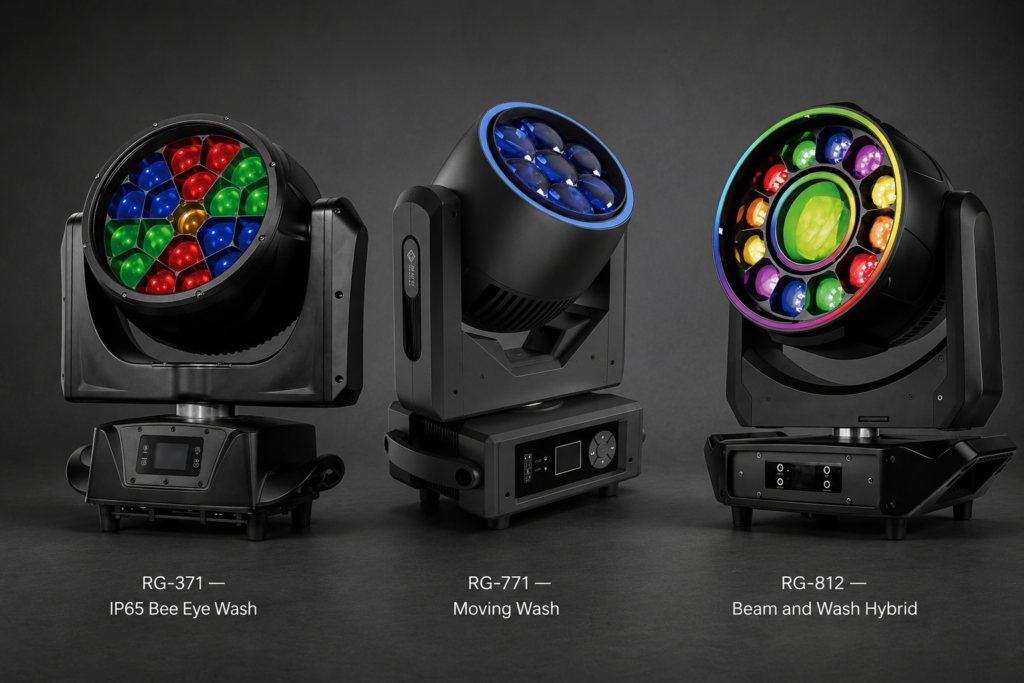
Each fixture type serves a different festival role.
| Fixture Type | Best Use | Main Trade-Off |
|---|---|---|
| RGBW moving wash | Broad performer and scenic color | Fewer special effects than a bee-eye fixture |
| IP65 bee eye wash | Outdoor wash plus pixel and lens effects | More channels and programming complexity |
| Beam-and-wash hybrid | Combined aerial beam and color wash | Heavier fixture and more functions to manage |
| Static LED PAR wash | Simple fixed coverage and backup positions | No moving repositioning |
For exposed outdoor festivals, start by confirming weather protection. Then choose the optical and effect type. A feature-rich hybrid is valuable only when the show will use those features and the rig can support its weight and power.
There is no reliable universal fixture count. Quantity depends on stage width, depth, throw distance, trim height, zoom setting, output, target brightness, scenic design, camera exposure, and the number of lighting zones.
Instead, divide the stage into front, side, overhead, scenic, and audience-wash zones. Next, calculate whether adjacent beams overlap at the chosen zoom setting. Finally, add redundancy for critical positions and confirm the total power, data, rigging, transport, and spare-unit requirements.
For example, a wide main stage with high trim and long throws may require more powerful moving washes than a compact covered side stage. Likewise, a camera-focused event may use more positions to achieve uniform performer coverage and avoid deep shadows.
Because festival fixtures are handled repeatedly, inspect handles, clamps, safety points, connector placement, housing strength, and service access. Weight also affects truss loading and crew handling.
The RG-812 has a verified net weight of 26kg, so its rigging and transport plan must account for a heavier hybrid fixture. In comparison, the RG-371 file confirms its optical and electrical specifications but does not provide a verified weight; buyers should request that value before finalizing a rig calculation.
Plan power from maximum fixture input, including distribution, circuit loading, grounding, weather-resistant connections, and backup control paths.
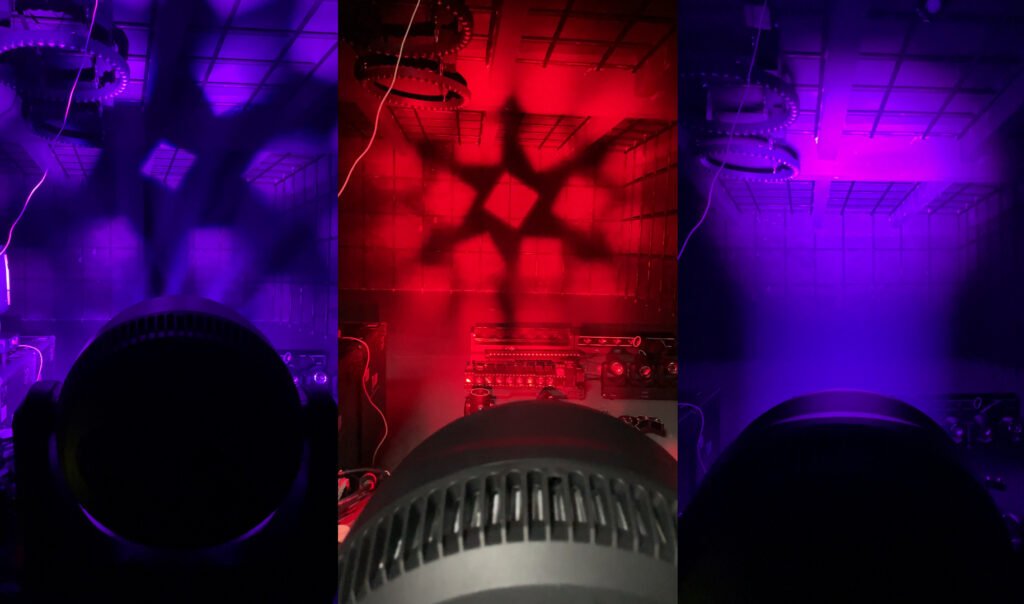
Sample testing should reproduce real festival conditions as closely as possible. A useful inspection includes:
Record the approved firmware, channel chart, connectors, packing, and test standard to reduce differences in repeat orders.
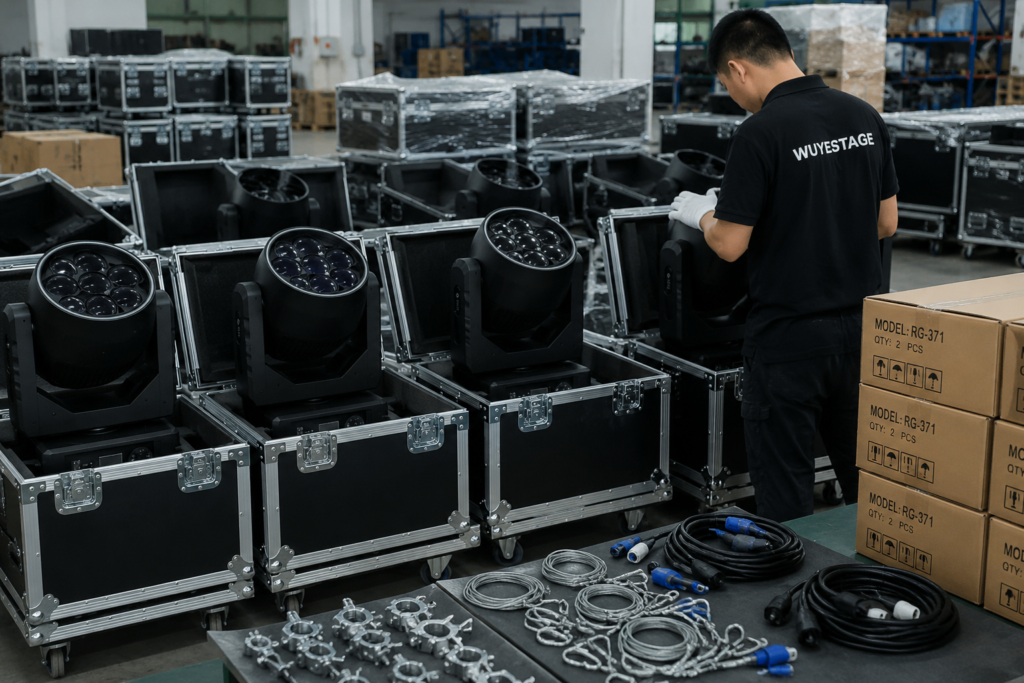
The RG-371 IP65 Bee Eye Light is the strongest current WUYESTAGE reference for exposed festival use. Its verified specifications include IP65, 19x40W RGBW LEDs, 8.5°-45° zoom, 2800K-8500K CTO, linear dimming, multiple channel modes, and pixel control.
The RG-812 LED Beam Wash Light combines a 200W beam source with 12x40W RGBW wash LEDs, CTO, colors, gobos, and prisms. It is suitable for covered stages that need both wash and aerial effects, but its product file does not confirm an outdoor IP rating.
The RG-771 combines five 60W RGBW sources with cool-white and warm-white auxiliary LEDs, zoom, strobe, movement, and rotating effects. It can support protected festival stages and indoor event projects. Again, outdoor use should not be claimed without a verified IP-rated version.
For a broader project mix, review WUYESTAGE professional stage lighting, compare the current LED wash light range, and check the real stage layout before selecting quantities.
Start with an IP65 fixture that provides suitable output, zoom coverage, RGBW mixing, reliable DMX control, safe rigging, and documented testing. The final model still depends on throw distance, stage size, camera use, and desired effects.
Zoom is highly useful when the same fixtures must work at different distances and stage sizes. However, a fixed-angle fixture can still be suitable when its coverage matches a consistent installation position.
A bee-eye fixture can create wash light, but it may also include pixel control, rotating lens effects, or tighter beam looks. Therefore, it often requires more programming than a basic wash fixture.
Only with an appropriate weather-protection plan and risk assessment. A roof does not always prevent wind-driven rain, condensation, or wet cable connections. Never describe a fixture as weatherproof unless its complete IP rating is verified.
Send stage dimensions, trim height, fixture positions, throw distances, outdoor exposure, desired coverage, control system, camera requirements, quantity, power standard, destination, schedule, and packing needs.
Send WUYESTAGE your festival stage drawing, rigging height, outdoor exposure, wash zones, camera requirements, preferred zoom range, target quantity, power standard, and destination. We can help compare IP65 bee-eye wash, moving wash, beam-and-wash hybrid, and protected-stage options, then prepare a sample or bulk-order quotation based on the real project.