Theatre stage lighting design should begin with the productions, stage geometry, audience sightlines, and operating team, not with a fixture shopping list. A practical system normally combines controlled front light, side and back light, broad wash, scenic or cyc lighting, and selected effects. It also needs suitable power, data distribution, control, access, documentation, and safe mounting planned before installation begins.
For project buyers and integrators, the goal is not to purchase every type of stage light. It is to assign each fixture a clear job, confirm that the proposed positions can produce the required coverage, and make the completed system easy to program, maintain, and expand.
This guide provides a structured workflow for theatre stage lighting projects. It covers fixture roles, lighting zones, control and power planning, installation checks, commissioning, and the information buyers should prepare before requesting a quotation.
A professional stage lighting installation turns the lighting design into a documented system of fixture positions, mounting methods, DMX addresses, data paths, power distribution, focus settings, and acceptance tests. For a permanent theatrical lighting installation, these decisions should be confirmed before equipment is mounted so that coverage, access, control, and future maintenance remain practical.
Define the Theatre Stage Lighting Design Requirements
A theatre may host drama, dance, musicals, school productions, conferences, or community events. These uses do not need identical lighting. Start by documenting the real operating conditions:
- Stage width, depth, and usable performance areas
- Proscenium opening or stage configuration
- Ceiling, bridge, catwalk, and mounting heights
- Front-of-house and onstage lighting positions
- Typical performer positions and scenic layouts
- Audience sightlines and glare-sensitive directions
- Existing power, dimming, network, and DMX infrastructure
- Control-console model and available universes
- Camera or livestream requirements
- Crew experience, maintenance access, and expansion plans
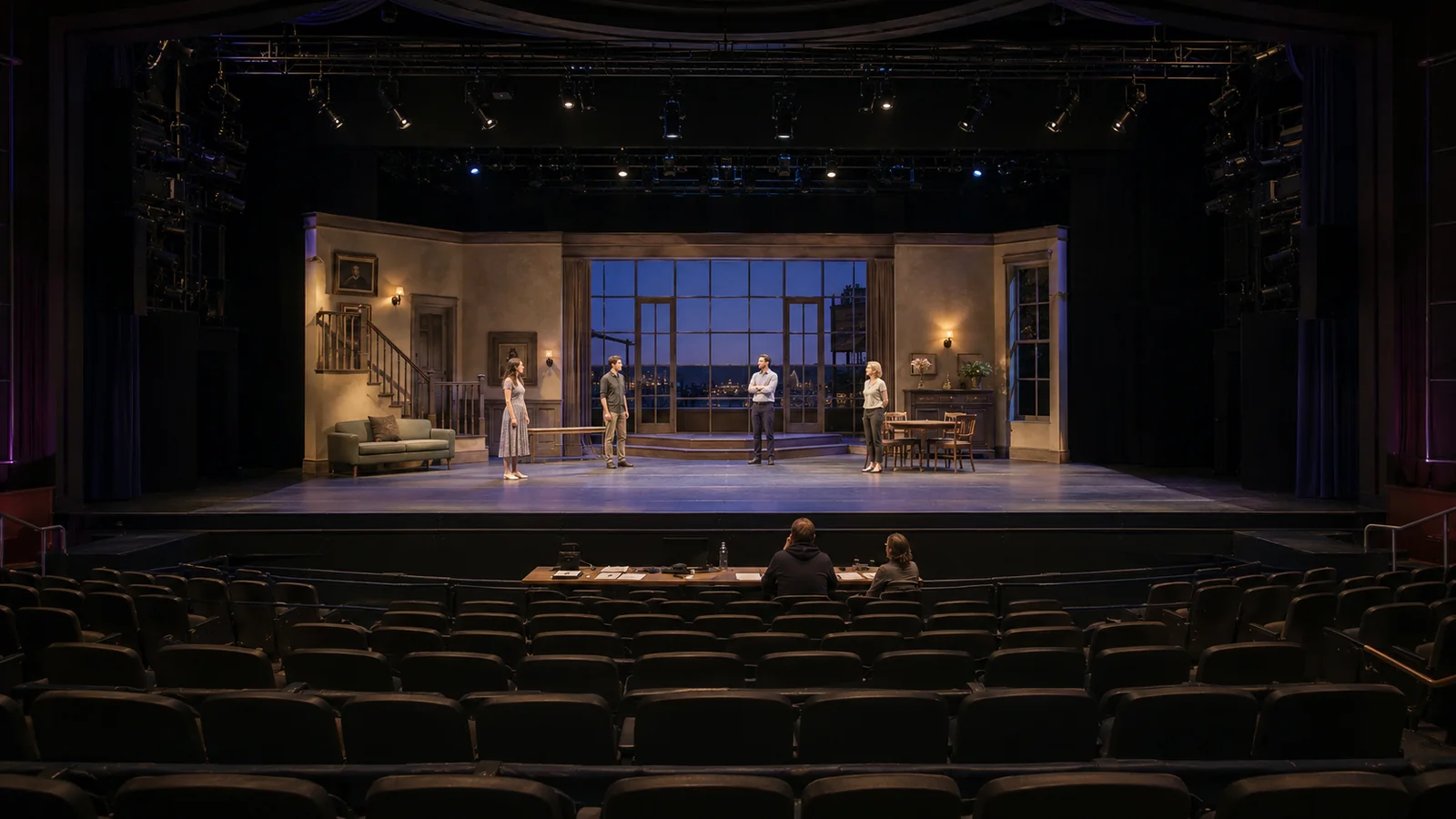
Theatre-in-the-round, thrust, black-box, and proscenium stages require different lighting approaches. For example, a proscenium theatre may have defined front-of-house positions, while a flexible black-box venue may need fixtures that can be moved and refocused between productions.
A buyer should also separate permanent infrastructure from production inventory. Power outlets, data nodes, rigging positions, work-light access, and the control network form the long-term system. Fixtures, gobos, accessories, and show-specific effects may change more frequently.
Understand the Main Types of Stage Lighting in Theatre
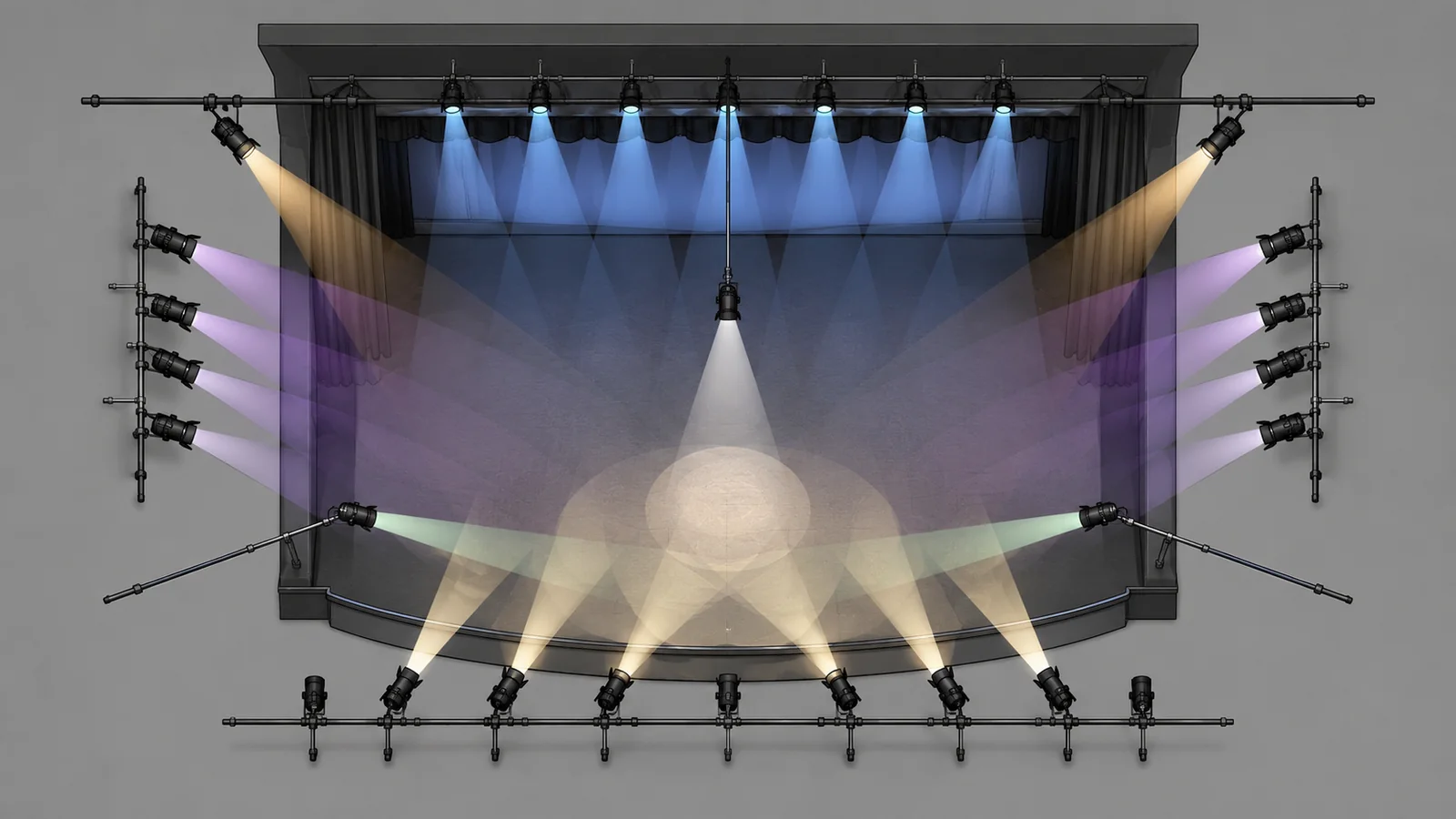
In practical theatre stage lighting design, the most useful way to classify equipment is by function.
| Fixture role | Typical job | Important buyer checks |
|---|---|---|
| Profile or ellipsoidal spotlight | Controlled front light, specials, gobos, scenic shaping | Beam angle, shutter control, source option, focus, dimming, mounting distance |
| COB or Fresnel-style light | Soft front light, area wash, rehearsal and general stage coverage | Zoom range, color temperature, dimming, barn doors, fan noise |
| LED PAR light | Color wash, side light, back light, scenic accents | Color configuration, beam angle, low-level dimming, noise, channel modes |
| LED wash or moving wash | Variable coverage, color, repositionable wash | Zoom, field quality, movement, color mixing, channel footprint |
| Moving spot or profile | Repositionable specials, gobos, framing, effects | Optical functions, movement, noise, maintenance, programming workload |
| Cyc or strip light | Even backdrop, cyclorama, or scenic-surface coverage | Throw distance, lens distribution, color consistency, fixture spacing |
| Followspot | Manually follows performers | Throw, operator position, beam control, access, ventilation |
A usable rig does not need every fixture family. It needs enough control to light performers clearly, reveal depth, support scenery, and create repeatable cues.
Build the Design in Lighting Layers
Front Light for Faces and Focus
Front light helps the audience read faces and directs attention to speaking or performance positions. Profile spotlights and moving profile lights are useful when the designer needs a defined beam, shutters, gobos, or controlled projection.
The WUYESTAGE RG-309 product record, for example, lists a 200W or 300W LED source, a standard 25-degree beam with 15-, 45-, and 60-degree options, 3200K or 6500K source options for the 200W configuration, DMX512 control, and 2- or 4-channel operation. These specifications make it a relevant product to compare for fixed theatre front-light and special positions, but the final source, lens, and color-temperature configuration must be confirmed on the quotation.
See the LED Profile Spotlight for the current published product route.
Side Light for Shape and Movement
Side light reveals body shape and is especially useful for dance. It can come from boom positions, side ladders, wings, or overhead angles. The design team should check whether scenery, masking, performers, and stage traffic will block the beam.
Different heights can produce different effects. Low side light emphasizes legs and movement, while higher side positions can provide broader body coverage. Fixture placement must remain compatible with safe access and stage operations.
Back Light for Separation
Back light separates performers from scenery and adds depth. LED PAR or wash fixtures can provide white, tinted, or saturated back light. A design should avoid creating unnecessary glare toward the audience or cameras.
For quiet venues, operating noise matters as much as color. The RG-317B Mute PAR record lists 18 RGBW main LEDs, a 34-pixel RGB strip, 0-100% linear dimming, DMX512 and standalone control, and 7-, 10-, or 106-channel modes. Final output, noise behavior, thermal performance, and mounting details should be checked on the production sample. See the Mute LED PAR Light for the published product route.
Scenic, Cyc, and Color Wash
Backdrop and scenic lighting should be planned from the surface dimensions and available throw distance. Even coverage normally requires overlapping fields and consistent fixture spacing. A few bright pools are not a substitute for a calculated wash.
LED PAR fixtures can support compact stages and scenic accents, while purpose-selected wash or cyc fixtures may be more appropriate for large backgrounds. Compare the LED PAR Light Collection when building the wash layer.
Effects and Moving Fixtures
Moving fixtures can add gobos, repositionable specials, movement, and selected effects. In theatre, programming should follow the production rather than remain active continuously. Buyers should consider fan noise, reset noise, fixture size, service access, channel count, and operator workload before adding a large moving-light package.
Match Fixture Specifications to the Real Position
Wattage alone does not determine whether a light will work. For each proposed position, record:
- Required beam or field angle
- Throw distance
- Desired coverage area
- White-light or color requirement
- Dimming and fade requirements
- Need for shutters, gobos, zoom, framing, or movement
- Expected ambient temperature and ventilation
- Indoor or exposed environment
- Camera frame rate and shutter settings, when relevant
- Maximum acceptable operating noise
- Fixture weight and approved mounting method
The RG-320 COB PAR provides a useful example of role-based selection. Its source record lists 100W or 200W options, white, warm-white, or bi-color configurations, 0-100% linear dimming, DMX512 and standalone modes, and a six-channel mode. It can be compared for face light, general white wash, and compact theatre positions where saturated color is not the primary job.
Review the published COB LED PAR Light page for the available route, then confirm the exact ordered configuration.
Theatre Stage Lighting Installation Workflow
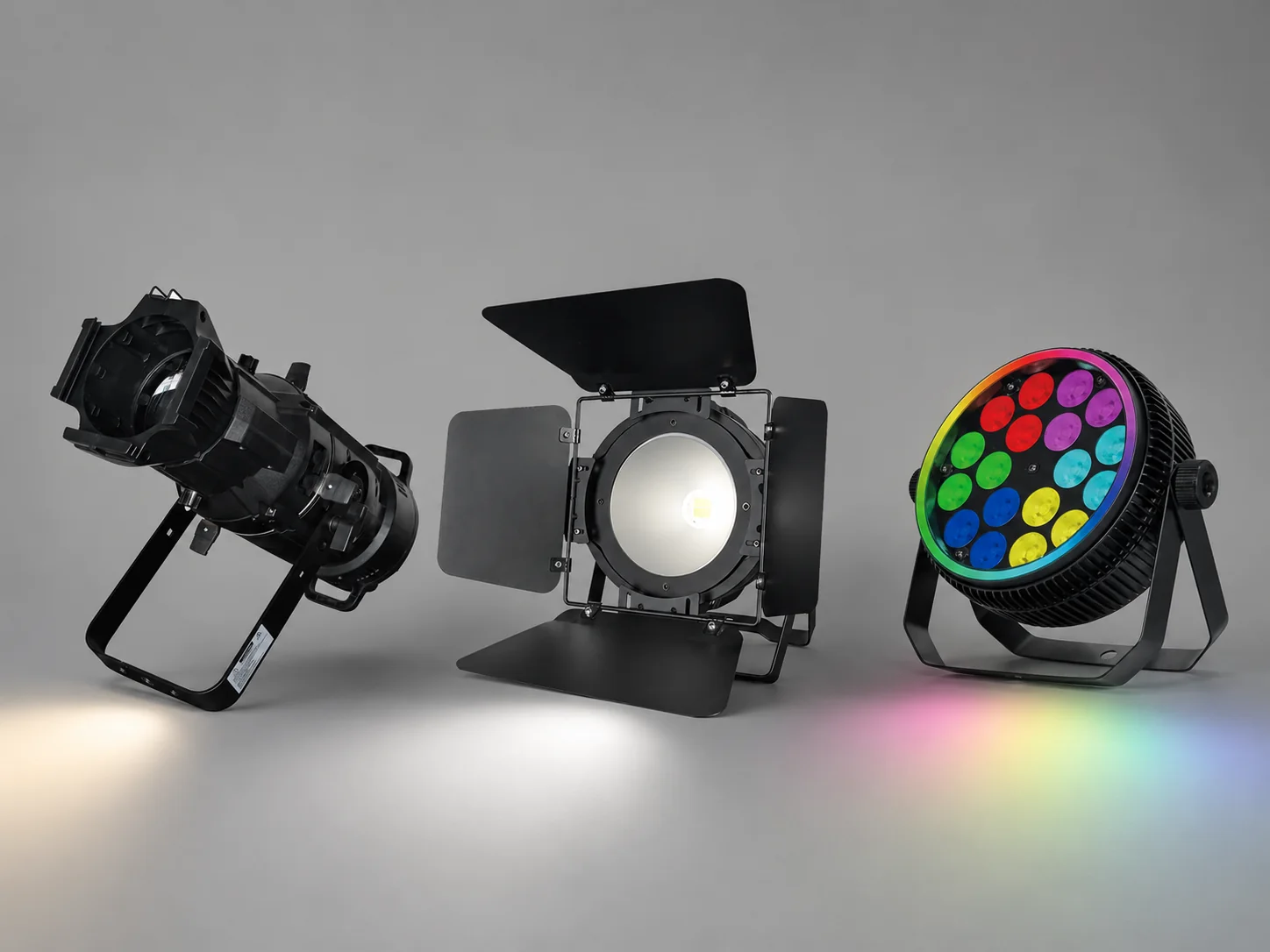
A reliable theatre stage lighting installation should move from drawings and approved fixture positions to control, power, mounting, focus, testing, and handover. Buyers should request a clear deliverable at every stage instead of approving only a fixture list.
| Installation Stage | What to Confirm | Required Deliverable |
|---|---|---|
| 1. Site Survey | Stage dimensions, mounting heights, throw distances, sightlines, access and existing infrastructure | Approved stage and lighting-position drawing |
| 2. Fixture Layout | Fixture role, beam angle, coverage, quantity, mounting position and maintenance clearance | Fixture schedule with position IDs |
| 3. DMX and Power | DMX universe, address, channel mode, data path, power outlets and circuit allocation | Stage lighting wiring diagram and patch schedule |
| 4. Mounting and Focus | Rated mounting hardware, safety cables, fixture orientation, labeling and final focus | Installed and labeled lighting rig |
| 5. Commissioning | Addressing, dimming, color, movement, noise, control response, backup and maintenance access | Acceptance record and final system documentation |
For buyers asking how to set up a stage lighting system, the main requirement is coordination: the fixture schedule, DMX plan, electrical plan and physical installation must describe the same final system. Electrical circuits, structural loading and permanent mounting must be reviewed and approved by qualified local professionals.
When retrofitting stage lighting systems, record the existing console, dimmers, circuits, connectors, network equipment and usable mounting positions before selecting replacement fixtures. This helps identify which infrastructure can remain and which parts require local engineering review.
Plan Control, DMX, Network, and Power Together
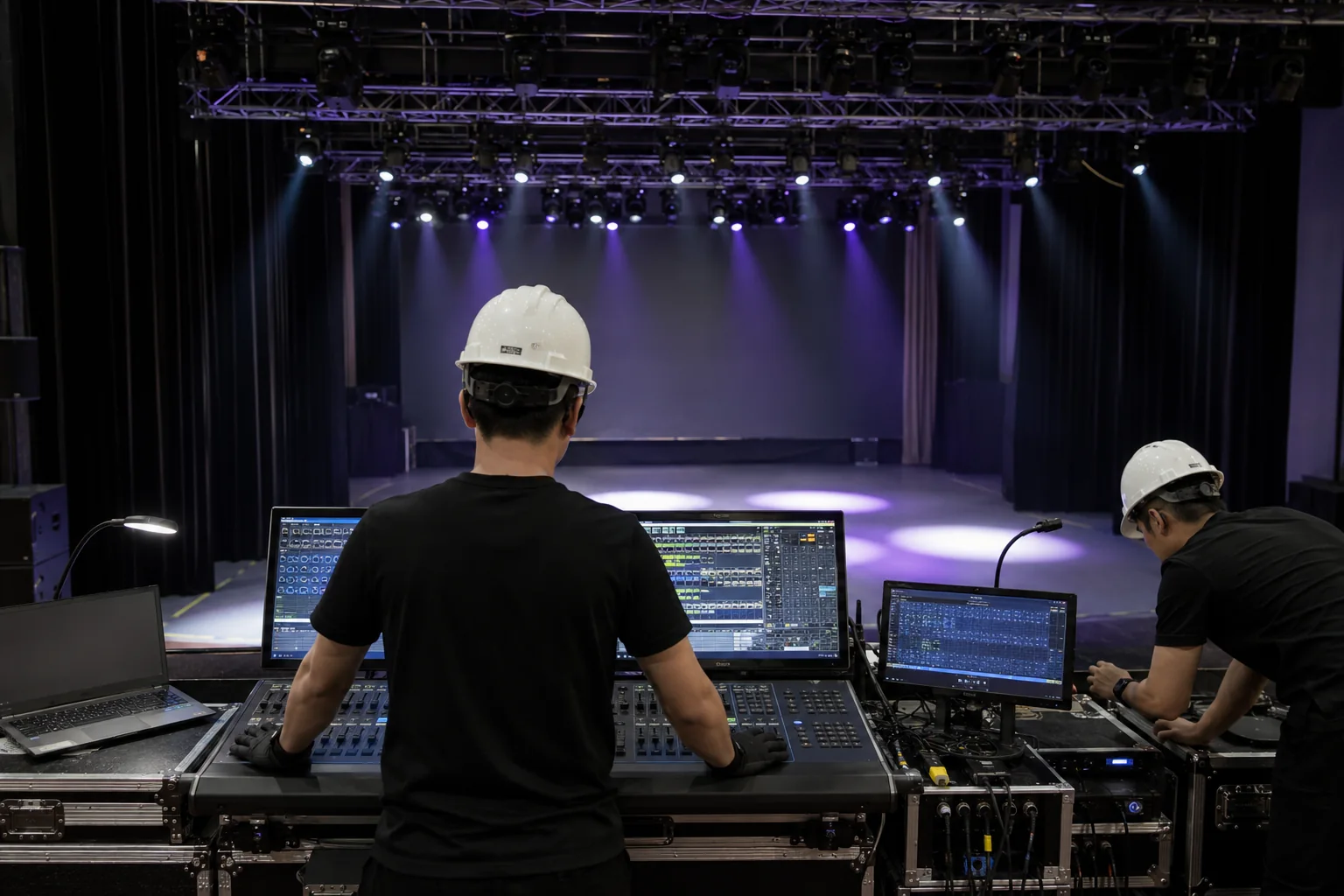
The lighting plot and control design should be developed as one system. Theatre stage lighting design becomes difficult to commission when a fixture’s data route, addressing, profile, or channel mode is unclear.
Prepare a control schedule containing:
- Fixture ID and mounting position
- Product model and ordered configuration
- DMX mode and channel count
- Universe and start address
- Console fixture profile
- Data path and node or splitter
- Power circuit and connector
- Backup or signal-loss behavior
- Firmware and approved channel chart
Leave sensible capacity for expansion, but do not inflate channel modes without a programming reason. A simple mode may be easier for schools and community theatres, while a detailed mode may be necessary for pixel control, framing, or advanced color functions.
Power planning must use verified fixture loads, connector ratings, circuit design, inrush behavior where applicable, and local electrical requirements. Permanent electrical work should be completed by qualified professionals. Do not estimate circuit capacity from fixture wattage labels alone.
Treat Rigging and Access as Engineering Requirements
Stage-lighting installation involves overhead equipment and electrical systems. Fixture positions, support structures, clamps, safety attachments, access equipment, and inspection procedures must be selected by qualified personnel using manufacturer instructions, applicable standards, and local regulations.
The content of a sales page or buyer guide cannot approve a suspension point or determine a safe load. Project documentation should identify:
- Approved mounting structure and position
- Fixture, accessory, clamp, and cable weights
- Manufacturer-approved mounting orientation
- Primary attachment and required secondary retention
- Cable routing and strain relief
- Service and focusing access
- Inspection responsibility and schedule
- Emergency and work-light conditions
For current entertainment-technology standards, the project team can consult the ESTA Technical Standards Program together with the rules that apply in the installation country.
Commission the System Before Final Acceptance
Commissioning should verify the installed system, not only confirm that each fixture powers on.
Physical and Electrical Checks
- Confirm model, voltage, connector, lens, and ordered configuration
- Inspect mounting, secondary retention, cable routing, and labels
- Verify power circuits and protective devices through qualified personnel
- Confirm ventilation and maintenance clearance
Control Checks
- Test DMX addressing and every channel
- Confirm console profiles and channel modes
- Test signal-loss and power-cycle behavior
- Save and back up the show file, patch, and fixture profiles
Optical and Show Checks
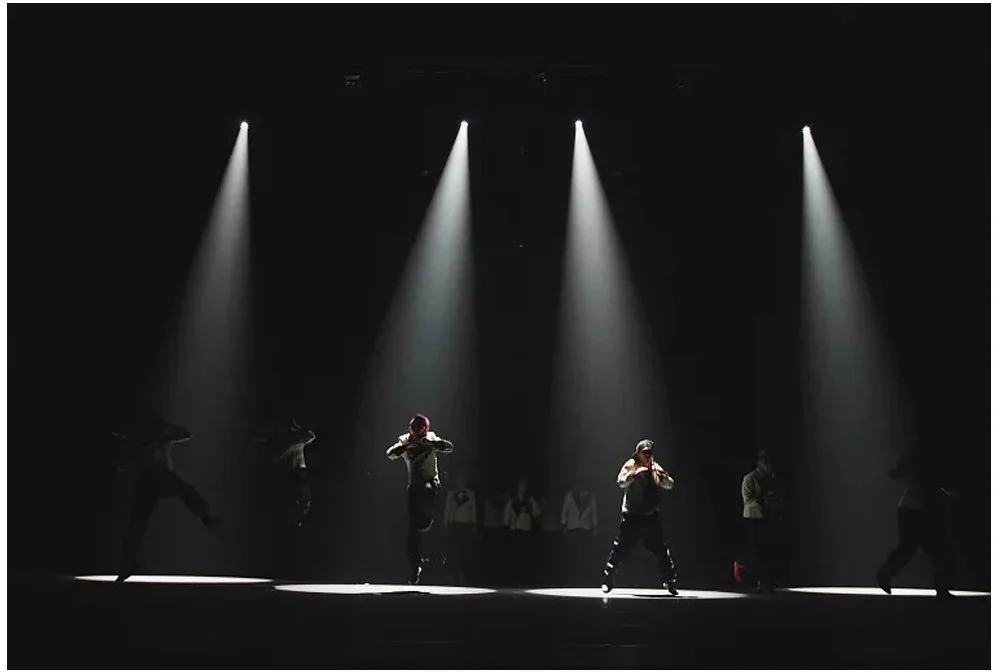
- Focus front-light zones and specials
- Check overlap and uniformity across performance areas
- Test low-level dimming and slow fades
- Compare white light and color consistency across multiple units
- Review glare from audience, camera, and performer positions
- Program representative drama, dance, rehearsal, and event cues
Handover Checks
- Provide the final plot, patch, channel charts, and circuit information
- Record serial numbers, firmware, and approved configurations
- Deliver spare-part and accessory lists
- Train operators on presets, shutdown, inspection, and fault reporting
- Agree on warranty contacts and future reorder specifications
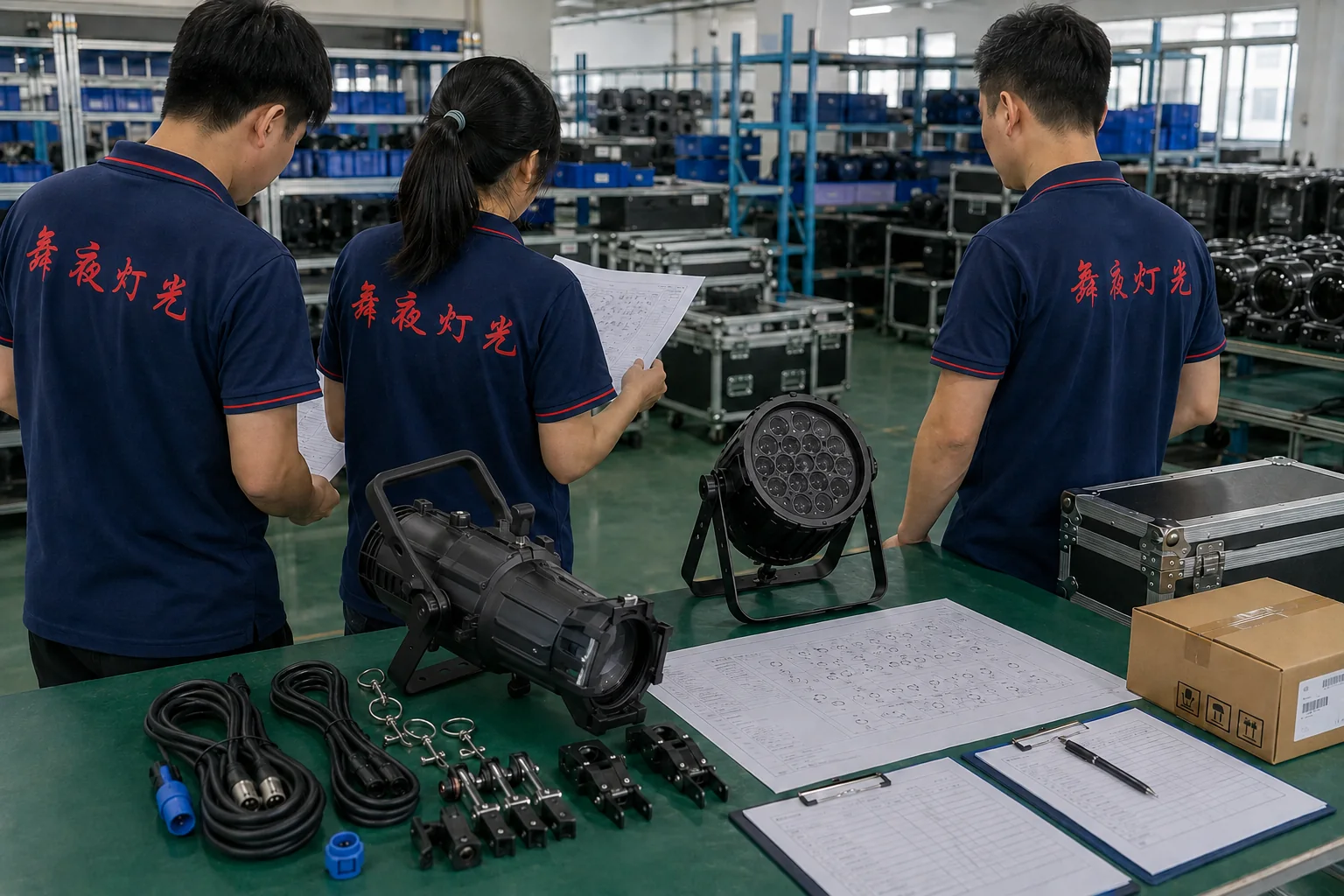
Theatre Stage Lighting Procurement Checklist
A complete theatre stage lighting design package gives suppliers and integrators enough project information to select and configure products. Before requesting a quotation, send:
| Project input | Why it matters |
|---|---|
| Stage and room drawings | Defines coverage, throw, and installation limits |
| Mounting heights and available positions | Determines optics and access |
| Production types | Sets the required lighting roles |
| Existing console, DMX, and network | Prevents control incompatibility |
| Local voltage and connector standard | Supports correct configuration |
| Camera or livestream use | Adds dimming and flicker-test requirements |
| Noise limits | Helps select fixtures near the audience and stage |
| Required fixture functions | Prevents feature-driven overspecification |
| Quantity, delivery country, and schedule | Supports quotation and packing planning |
| Sample and acceptance requirements | Defines what must be verified before bulk production |
A good quotation should identify the exact model, source option, lens or beam angle, color configuration, DMX mode, connector, accessories, packing, and documentation. Product-family names alone may hide multiple configurations.
Frequently Asked Questions
What are the main types of stage lighting used in theatre?
The main types include profile spotlights, Fresnel or COB lights, LED PAR lights, wash lights, moving spots or profiles, cyc or strip lights, and followspots. Choose each type for a defined lighting job rather than trying to use one fixture family everywhere.
What should theatre stage lighting design start with?
Start with stage geometry, production types, performer positions, sightlines, lighting positions, existing power and control infrastructure, camera needs, and the experience of the operating team. The fixture list should follow those requirements.
Are profile spotlights or PAR lights better for theatre?
Neither is universally better. Profile spotlights provide controlled beams, shutters, specials, and gobo options. PAR and wash fixtures are practical for broad color coverage, side light, back light, and scenic wash. Many theatre systems use both.
How many stage lights does a theatre need?
There is no reliable universal quantity. The count depends on the number of performance zones, fixture positions, throw distances, beam angles, required lighting layers, scenic coverage, production types, and redundancy. Build a position-by-position lighting schedule before calculating quantity.
What information should be included in a theatre lighting quotation?
Include the exact model and configuration, source, lens or beam angle, color system, channel mode, voltage, connectors, mounting accessories, packing, documentation, sample requirements, delivery terms, and the project drawings used for selection.
Who should install permanent theatre stage lighting?
Qualified rigging, electrical, and integration professionals should design and install permanent systems according to manufacturer instructions, applicable standards, and local regulations. A supplier quotation does not replace structural, electrical, or safety approval.
Request a Theatre Stage Lighting Recommendation
Planning a new theatre, school stage, performance hall, or lighting upgrade? Send WUYESTAGE your stage drawings, mounting positions, throw distances, production types, control system, local power standard, target quantity, and delivery country. We can help your procurement or integration team compare suitable stage lighting products, confirm available fixture configurations, and prepare a project-oriented quotation for samples or bulk orders.
Request a Theatre Lighting Recommendation