






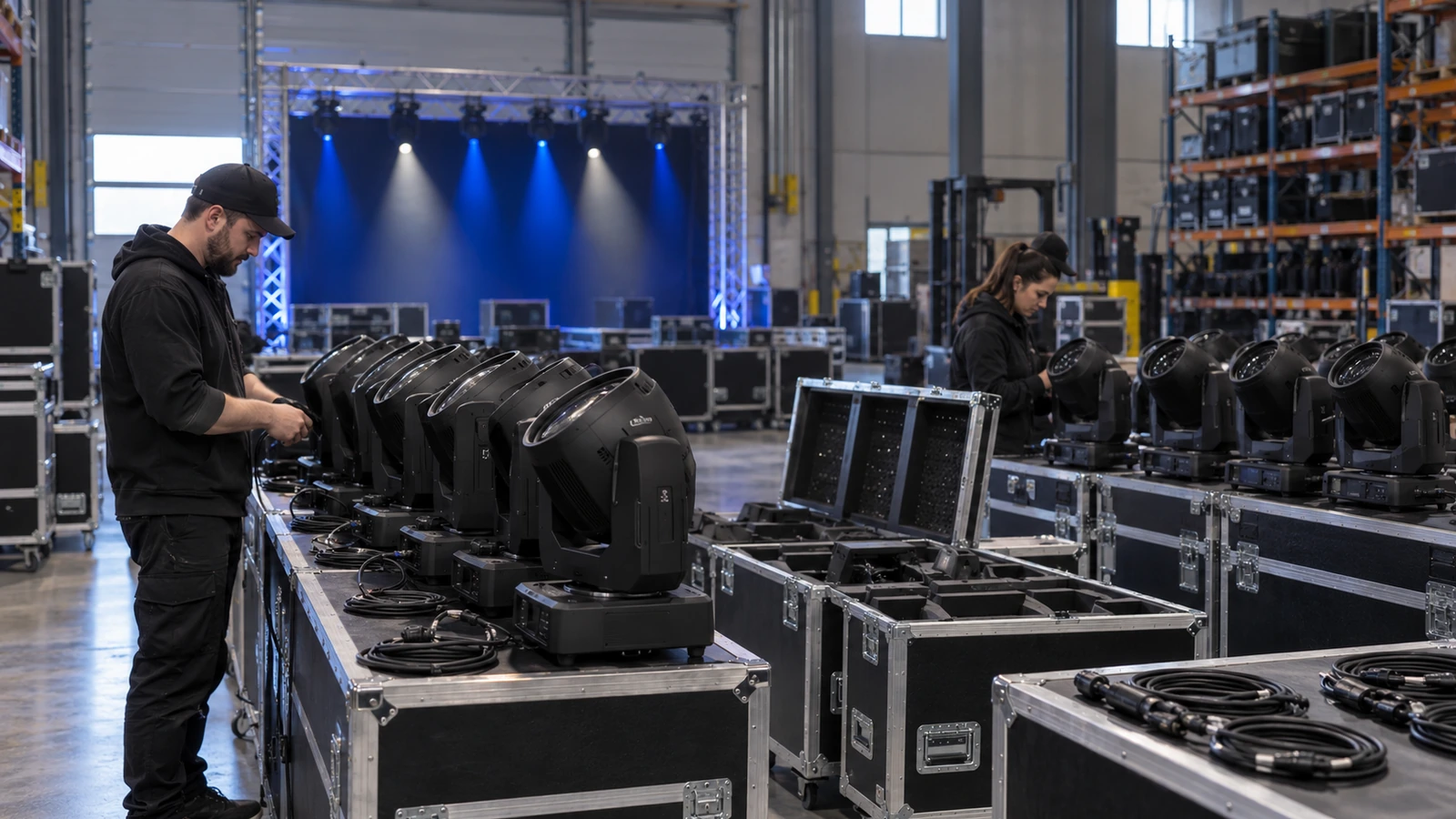
Plan a moving head rental fleet around booking demand, fixture roles, DMX compatibility, service reserve, utilization and sample testing.
A profitable moving head rental fleet is not simply a collection of bright fixtures. It is a repeatable operating system: the lights must fit the jobs customers actually book, share workable control and power conventions, travel safely, return to service quickly and earn revenue often enough to justify their total cost.
For most rental companies, the right starting point is the booking calendar rather than the product catalogue. Record the visual roles required by recurring jobs, calculate how many identical units may be needed at the same time, add a deliberate service reserve, and then shortlist fixtures that the crew can program, case and maintain consistently.
This is a purchasing and fleet-planning guide for professional event suppliers. It does not describe a local moving head hire service.
Review at least one representative operating cycle rather than the last show alone. Separate confirmed bookings from occasional requests, then record the stage size, fixture positions, indoor or exposed conditions, required effects, camera use, crew size and turnaround time for each job type.
The same fixture can be attractive in a demonstration and inefficient in a fleet. A complex moving head may create excellent looks, yet produce low utilization if only one programmer understands it or if its flight case does not fit the company’s normal transport plan.
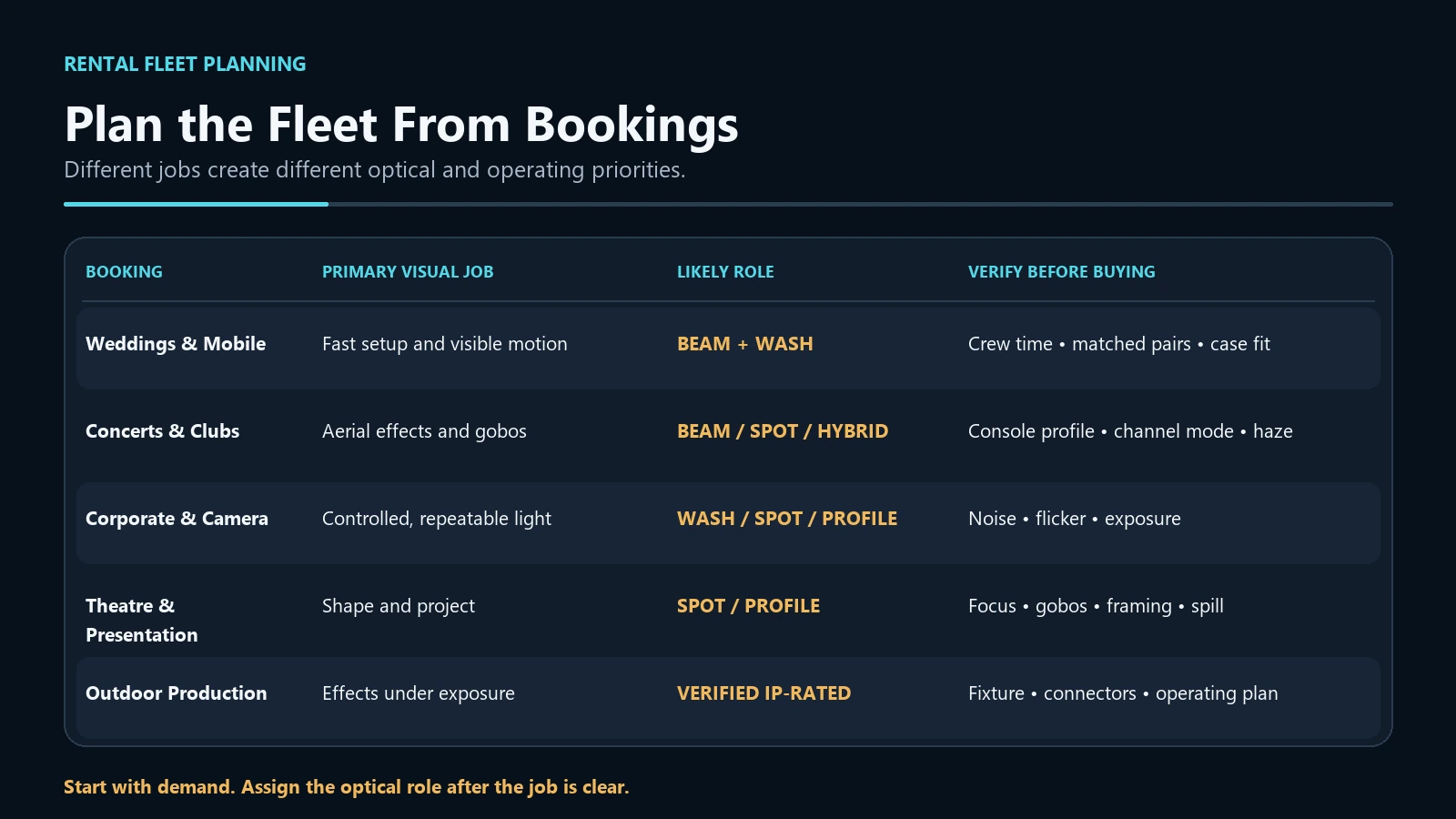
Use a demand map like this:
| Recurring booking | Required visual job | Likely moving-head role | Operational question |
|---|---|---|---|
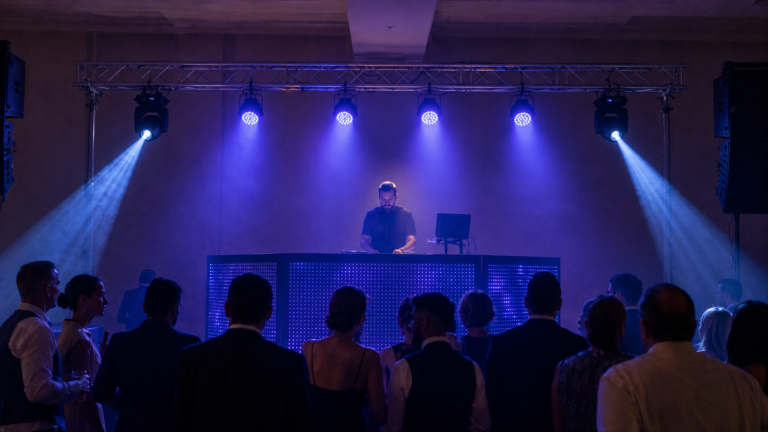
| Weddings and mobile events | Visible movement and aerial accents | Compact Beam or Beam-led package | Can one crew deploy, address and pack it quickly? |
| Concerts and club shows | Strong aerial effects, gobos and movement | Beam, Spot or Hybrid | Does the console file support the required channel mode? |
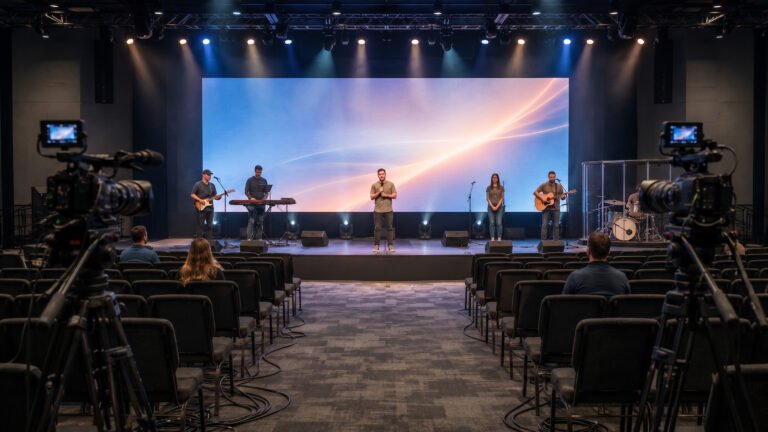
| Corporate and camera-recorded events | Controlled color, quiet operation and repeatability | Wash, Spot or Profile according to the cue | Have noise, flicker and exposure been tested with the real camera? |
| Theatre and presentation work | Defined projection and spill control | Spot or Profile | Does the fixture provide the required focus, gobo or framing function? |
| Outdoor productions | Effects under changing environmental conditions | A verified IP-rated product direction | Are the complete fixture, connectors and operating plan suitable for exposure? |
The purpose of the table is to identify missing roles, not to assign a universal product mix. Two rental companies with the same number of fixtures may need different fleets because their bookings, transport and technicians differ.
A useful fleet has three purchasing tiers.
Core stock should cover the events that appear most often and should be available in matched groups. Consistent models, firmware, channel maps, cases and accessories reduce setup time and make substitutions easier.
For a music-led rental business, core stock may include Beam fixtures for aerial effects and Wash fixtures for color coverage. A corporate or theatre-focused supplier may place more value on quiet Wash, Spot or Profile functions. The correct core is defined by booking frequency and operational fit, not by what is most visually dramatic.
Add-on fixtures solve a recurring secondary need without becoming the default unit for every job. Examples include Spot fixtures for projected gobos, Bee-Eye Wash products for more visible lens effects or Hybrid units when one position must switch between Beam, Spot and Wash behavior.
An add-on should improve the package without forcing unnecessary complexity into ordinary jobs. Check whether the extra channel count, optical functions and case size are justified by real customer demand.
Profile, high-output outdoor and unusual effect fixtures should normally have a clear project reason. Before expanding this tier, identify who books the function, how often it is requested, who can program it and whether a cross-rental or project purchase would be more economical during low demand.
Annual booking count alone can hide the days when several jobs overlap. Plan around the busiest realistic period that the business intends to serve.
Use this planning formula for each fixture role:
Planned fleet quantity = peak simultaneous rigs × units in the standard rig + service reserve
The service reserve is not a fixed percentage. It should reflect whether shows require symmetrical pairs, how quickly a failed unit can be repaired, whether another model can substitute without reprogramming, and how costly it would be to miss a booking.
For example, if two overlapping events each use four identical Beam fixtures, the working demand is eight. If the package cannot operate acceptably after losing one fixture, the reserve should protect the required geometry rather than merely adding the cheapest spare available. This example explains the method; it is not a recommended quantity for every rental company.
Calculate separately for Beam, Wash, Spot, Profile and Hybrid roles. Combining unlike fixtures into one total produces a large inventory number but does not prove that the company can fulfil a particular show.
Fleet compatibility often matters more than one additional effect. Before approving a model, compare these operating details with the equipment already owned:
DMX512-A defines the control-data method used by compatible entertainment-lighting equipment, while every fixture still needs its correct channel map and profile. Buyers can reference the current ANSI E1.11 listing from ESTA and then verify the ordered model’s implementation with the supplier and console.
More channels do not automatically create a better rental product. Detailed modes can support complex programming; compact modes can reduce setup time for standard packages. A rental fleet may need both, but the show file and technician workflow should determine the choice.
The following comparison keeps broad product selection on the correct category pages while showing where each role fits a fleet.
| Fixture role | What it earns bookings for | Poor fit when | Current WUYESTAGE route |
|---|---|---|---|
| Beam | Narrow aerial shafts, prism looks and movement through suitable haze | The job mainly needs broad coverage or controlled face light | Beam Moving Head Lights |
| Wash | Broad color coverage, zoomed wash looks and performer or scenic color | The customer primarily needs sharp gobos or narrow aerial output | LED Wash Lights |
| Spot | Focused projection, gobos, colors and programmed positions | Independent framing and precise spill control are essential | Profile and Spot Lights |
| Profile | Framing, controlled projection and screen- or scenery-sensitive placement | The booking only values fast aerial effects | Profile and Spot Lights |
| Hybrid / BSW | Several optical roles from one rigging position | The product compromises the one role used on nearly every show | Moving Head Lights |
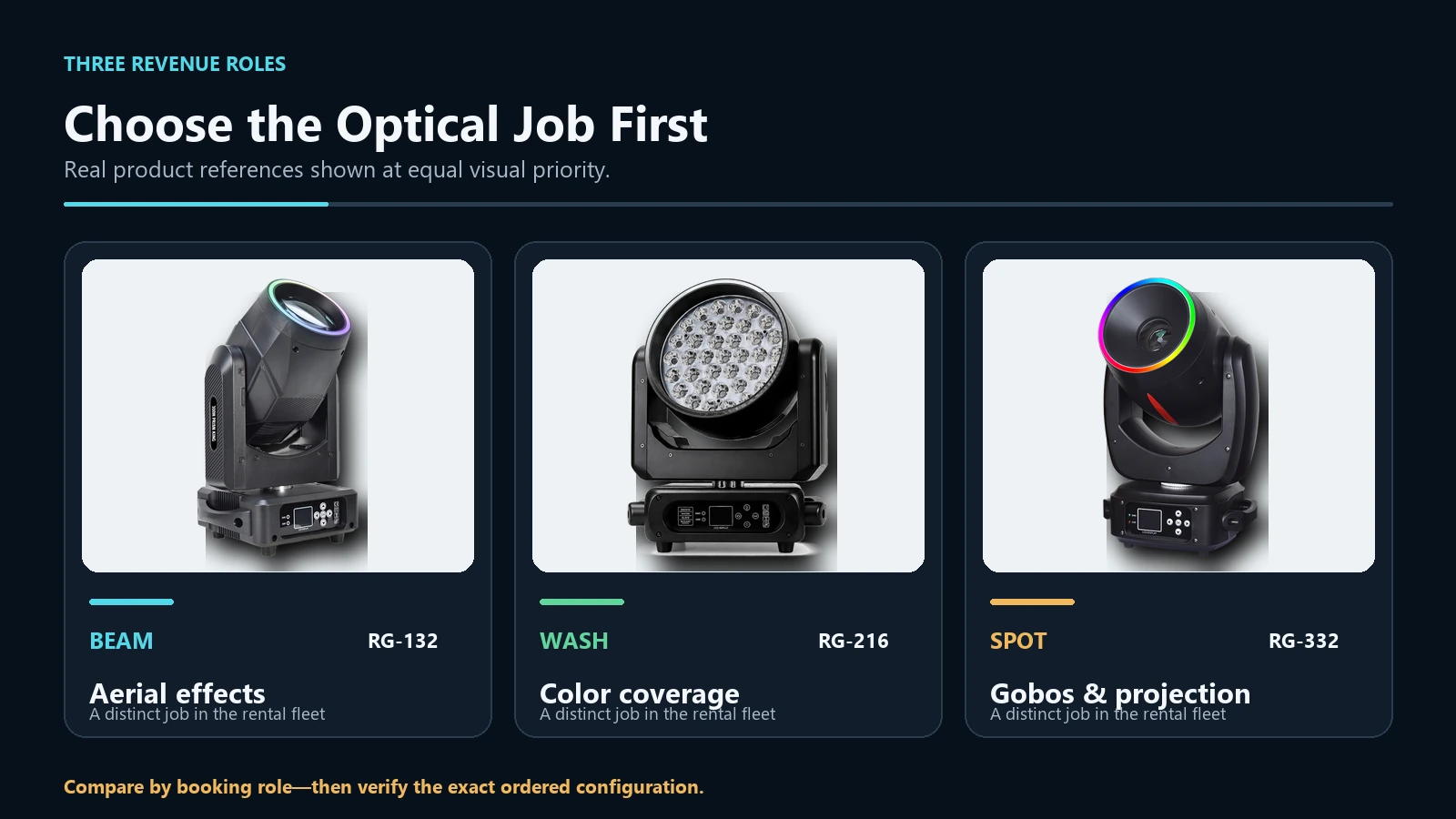
The new-appearance 300W Beam Moving Head uses a verified 300W lamp, a 2-degree beam, four prism configurations, 18/22-channel DMX modes and a 24 × 0.5W RGB three-in-one front ring. It is IP20, so it belongs in indoor or properly protected operating conditions. Its narrow Beam and prism system can suit music-led event packages, but it should not be treated as Wash coverage or camera key light.
The 37x25W Moving Head Wash combines a 37 × 25W RGBW main array with auxiliary matrix and ring effects, 40/48-channel modes, linear dimming and moving coverage. It can suit buyers who earn revenue from broad color plus visible lens effects. No IP rating should be assumed from the current evidence, and the final ordered configuration still requires confirmation.
The 200W Spot Moving Head is a 200W product-class fixture with a verified 180W LED source, 11/16-channel modes, fixed and rotating gobo wheels, 13 colors plus open and a bidirectionally rotating three-facet prism. It supports gobo and position work, but it should not be described as a framing Profile fixture.
These models demonstrate three different revenue roles; they are not presented as a universal package or as equal substitutes.
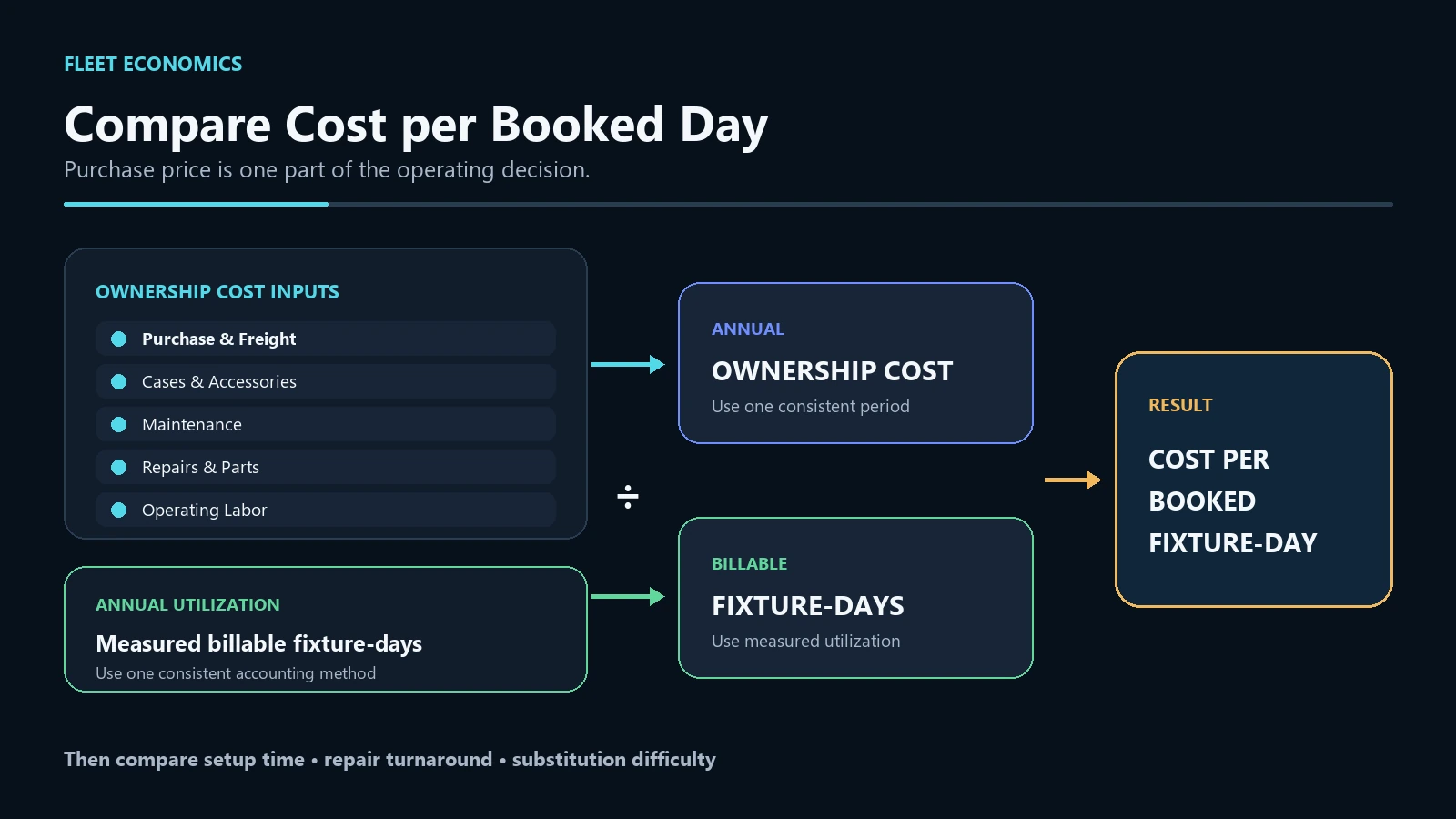
The lower quotation is not always the lower-cost fleet choice. Cases, freight, accessories, programming, maintenance and lost availability can change the result.
Use two calculations:
Annual ownership cost = annualized purchase and freight + cases and accessories + scheduled maintenance + repairs and parts + operating labor attributable to the model
Cost per booked fixture-day = annual ownership cost ÷ billable fixture-days
A billable fixture-day is one fixture deployed for one chargeable day under the company’s own accounting method. Keep the definition consistent when comparing models. If a fixture is frequently requested but spends long periods waiting for a specialist part, its theoretical rental rate does not show its real fleet contribution.
Also record setup minutes, average case volume, repair turnaround and substitution difficulty. These measures reveal when a visually impressive product adds hidden operating cost.
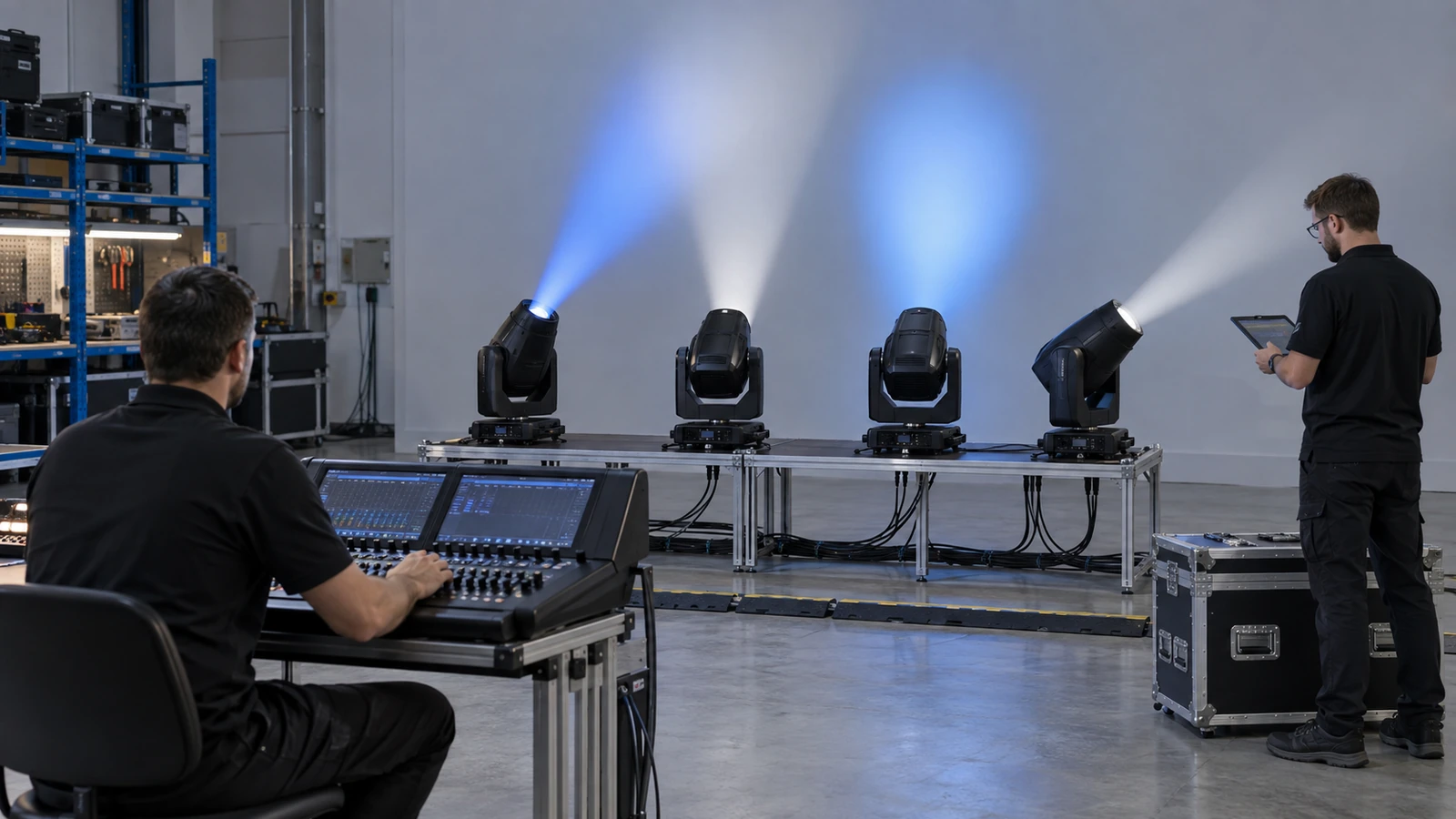
A catalogue and video can support shortlisting, but a rental company should approve a physical sample or a clearly recorded reference configuration before scaling the order.
The acceptance record should contain:
Run the sample through a duty cycle that represents actual rehearsals, show operation and restart conditions. There is no universal short test duration that proves long-term reliability.
For the production batch, compare selected units with the approved record. Confirm appearance, firmware, channel behavior, movement, optics, labels, accessories and packing before shipment. Record any accepted variation instead of allowing an undocumented substitution.
A supplier cannot recommend a reliable mix from quantity and wattage alone. Send a brief that includes:
This information allows the supplier to respond with a configuration, sample path, packing plan and quotation that can be checked against the operating model.
Start with matched fixtures that serve the company’s most frequent bookings and that the existing crew can program, transport and maintain. Beam and Wash units often cover different music-event roles, while Spot, Profile or Hybrid fixtures should be added when recurring jobs require their specific optics. There is no universal first package.
Calculate each role separately: peak simultaneous rigs multiplied by the units used in the standard rig, plus a service reserve. Set the reserve according to symmetry, repair time, substitution options and the cost of missing a booking rather than applying one fixed percentage.
A Hybrid can reduce the number of fixture types needed in one position, but it is only better when its Beam, Spot and Wash ranges match the jobs being sold. A dedicated fixture may deliver a better result or simpler workflow for a role used on nearly every booking.
Confirm model identity, firmware, channel modes, movement, optics, dimming, strobe, restart behavior, multi-unit synchronization, noise, camera behavior where relevant, power, accessories and case fit. Preserve the approved sample record for comparison with the production batch.
Choose according to real exposure. An IP rating can support outdoor work only when the complete fixture, connectors, power distribution, rigging and operating plan are suitable. Do not expose an IP20 indoor fixture to rain, and do not assume temporary cover converts it into a rated outdoor system.
Compare cost per booked fixture-day using annualized purchase and freight, cases, accessories, maintenance, repairs, parts and attributable operating labor. Add utilization, setup time, repair turnaround and substitution difficulty so the decision reflects fleet operation rather than purchase price alone.
A moving head rental fleet should make profitable jobs easier to fulfil repeatedly. Map demand, define standard rigs, protect peak dates with a deliberate reserve, standardize control and service details, and test an approved sample before committing to a batch.
Review WUYESTAGE professional moving head lights or contact the team with your booking types, fixture roles, quantities, destination, control requirements, packing plan and schedule. WUYESTAGE can review the requested configuration and prepare a sample or bulk-order quotation based on the information supplied.