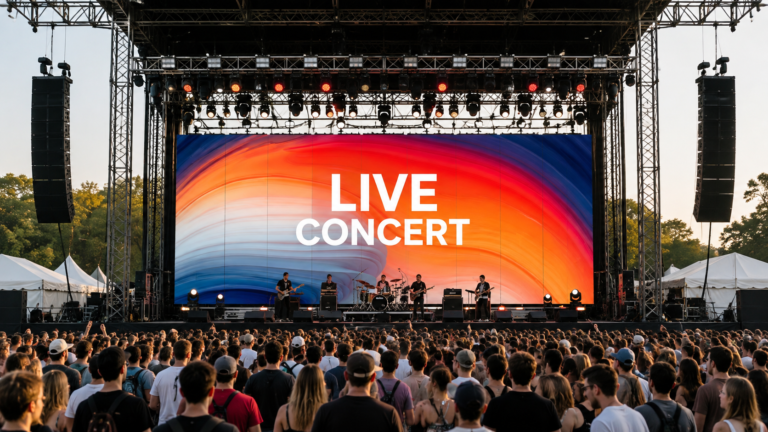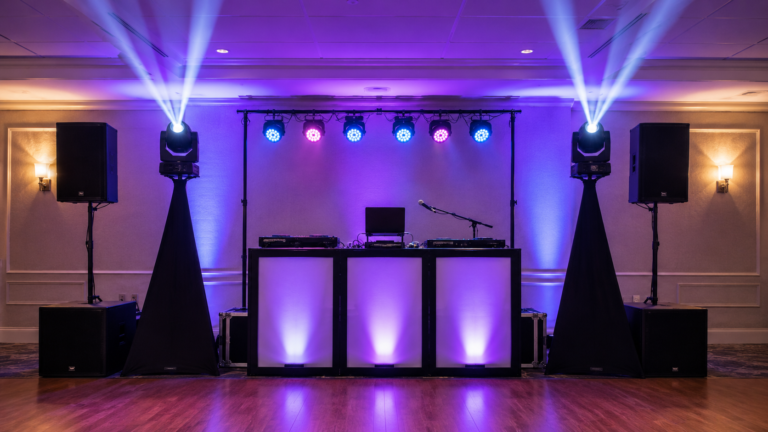



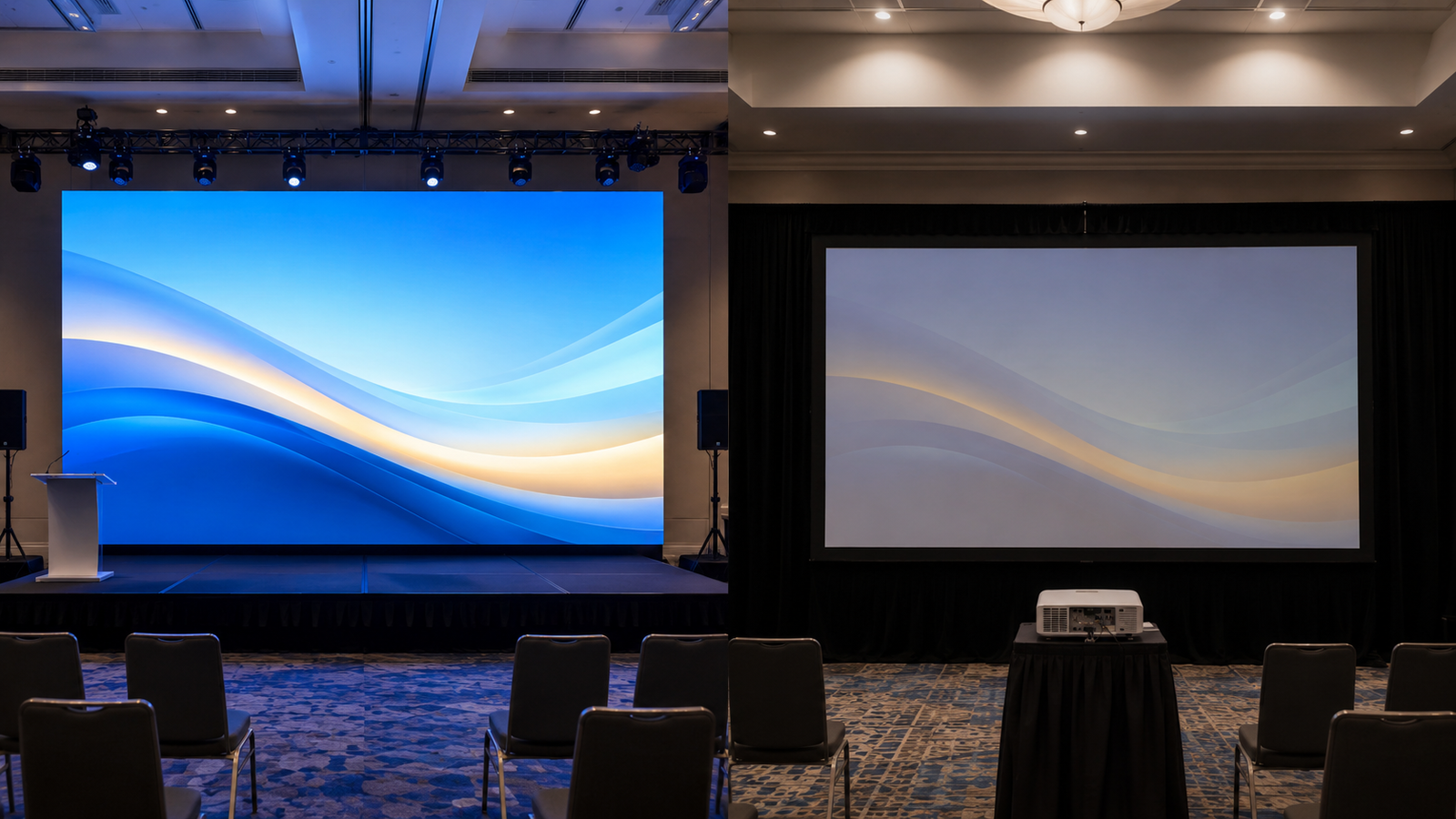
The practical answer to LED wall vs projector is usually this: choose an LED wall when the display must remain visible in substantial ambient light, scale through modular cabinets, work outdoors with the correct configuration, or serve camera-heavy productions. Choose a projector when the room can be darkened, a clear projection path is available, the screen size is moderate, and the project benefits from a simpler temporary display package.
Neither technology wins every project. A bright outdoor concert, a dark ballroom presentation and a permanent church installation create different constraints. Buyers should decide from the venue backward instead of comparing one brightness number or one equipment price.
This guide uses a six-part decision method: ambient light, image geometry, physical installation, camera workflow, operating model and total project cost.
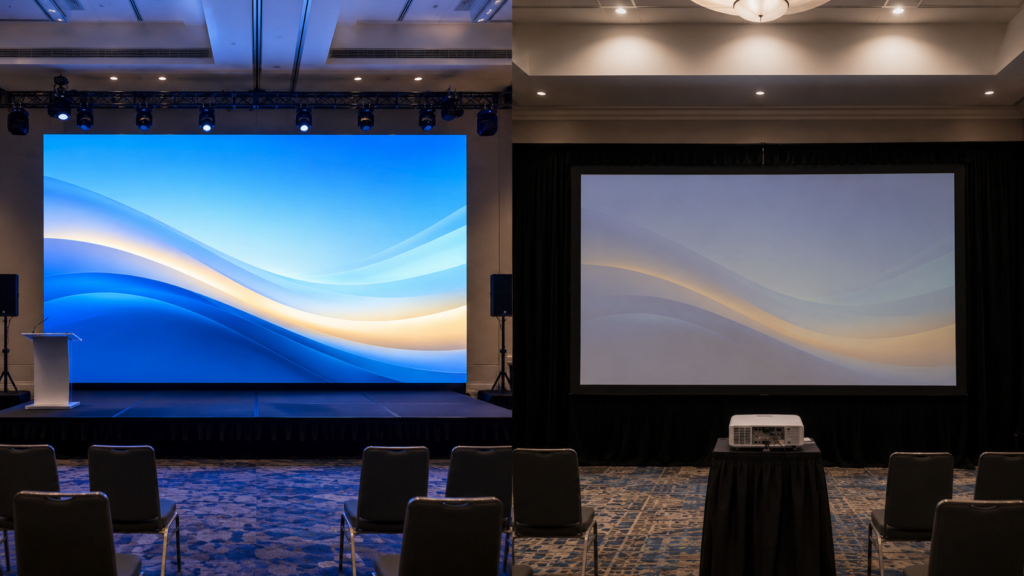
An LED display is self-emissive: the pixels produce the visible image. A projector sends light across the room to a separate surface, and the audience sees the light reflected from that surface. That difference changes how each system behaves when daylight, house lighting or stage lighting reaches the image area.
For an event space with controllable light, a correctly selected projector and screen can produce an effective large image. However, the result depends on the projector, lens, image size, screen material, throw position and ambient light. Enlarging the projected image spreads the available light over a greater area, so the same projector does not maintain identical image intensity at every screen size.
An LED wall is normally the stronger starting point when the image must compete with daylight or bright production lighting. The ordered LED product still has to match the environment. WUYESTAGE’s verified rental LED reference lists indoor configurations at 800-1200 cd/m2 and outdoor P3.91 configurations at 3500-4200 cd/m2 with an IP65 reference. Those figures apply to the verified configurations, not to every LED panel on the market.
Professional conclusion 1: if the venue cannot reliably control ambient light, solve that problem before comparing purchase prices. A display that is inexpensive but visually washed out has failed its main job.
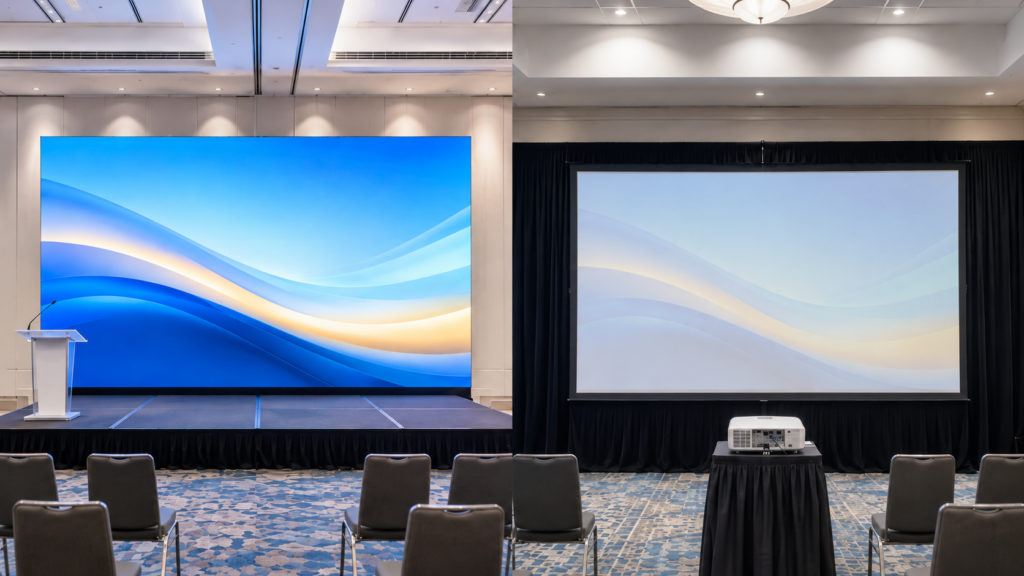
A projector needs a suitable lens position and an unobstructed optical path to the screen. The required distance varies by projector, lens and image width. Front projection also creates a practical risk: presenters, scenic elements or suspended equipment can enter the beam. Rear projection removes some audience-side obstruction but requires space behind the screen.
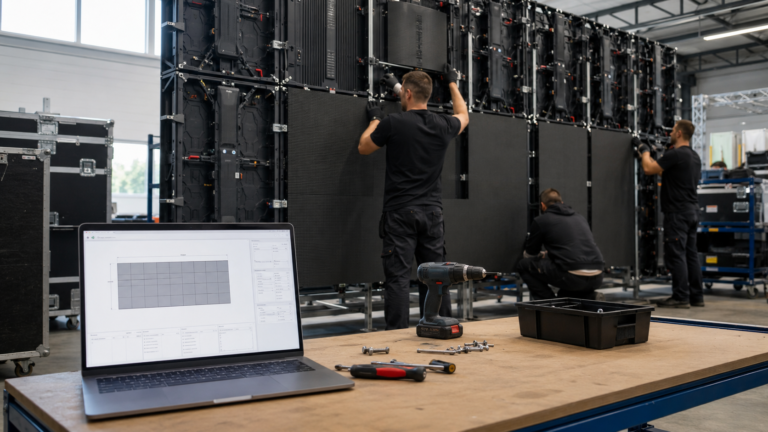
An LED wall does not need projection distance. It does need physical depth, a supporting method, signal distribution, power distribution and service access. A hanging wall requires verified rigging capacity; a ground-supported wall occupies floor space and must remain stable. Outdoor projects add weather and wind considerations that a screen-size calculation cannot approve.
Use this early venue test:
| Venue question | LED wall implication | Projector implication |
|---|---|---|
| Is there a clear throw path? | Not required | Required unless another projection layout solves it |
| Is rear space available? | Service access may still be needed | Rear projection may become possible |
| Can the structure support the display system? | Cabinet, frame and accessories require engineering review | Projector and screen mounting still require safe support |
| Will people cross in front of the image? | No projected beam to block | Front projection may be interrupted |
| Must the display be exposed outdoors? | Use a verified outdoor configuration and engineering plan | Projector, lens and screen need appropriate protection and wind planning |
Professional conclusion 2: a venue with no safe throw path is not a projector problem to solve later. It is an immediate reason to test an LED-wall layout or redesign the display position.
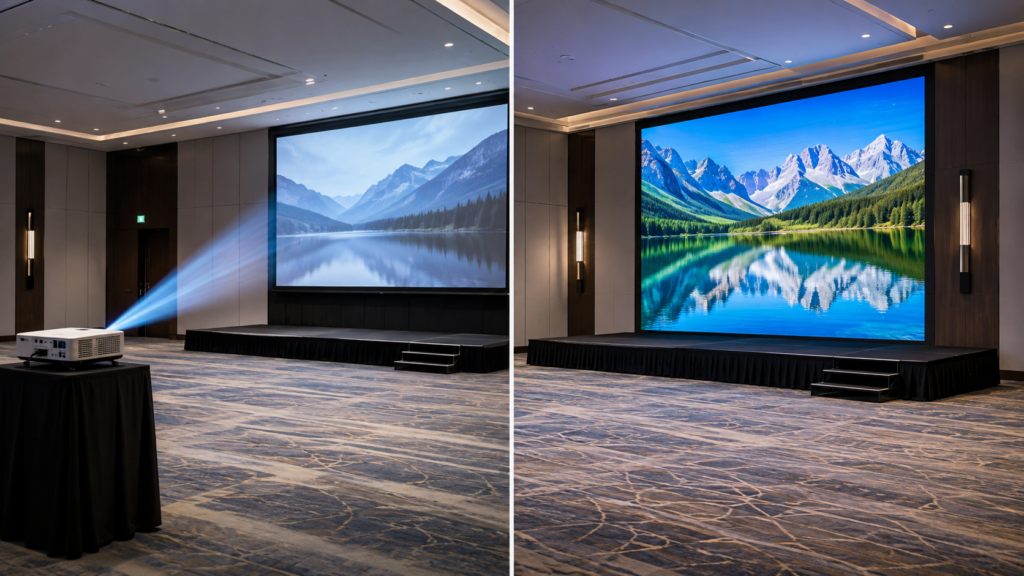
A projector can change image size through lens selection, throw distance and setup, within the limits of the chosen equipment. An LED wall changes size in cabinet increments. The requested width and height therefore may not be the dimensions that can actually be built.
For example, verified WUYESTAGE rental LED options include 500 x 500 mm and 500 x 1000 mm cabinets. A requested width that is not divisible by 0.5 m must be rounded to a complete cabinet. That affects final width, aspect ratio, content mapping, cabinet quantity and supporting structure.
Resolution is also handled differently. A projector has a fixed imaging resolution defined by its model. An LED wall’s total resolution depends on physical size and pixel pitch. The verified P3.91 reference provides 65,536 pixels/m2 and a planning viewing-distance reference above 4 m. Finer verified options include P2.976 at 112,896 pixels/m2 with a reference distance above 3 m and P2.604 at 147,456 pixels/m2 with a reference distance above 2.6 m.
These viewing distances are planning references, not universal guarantees. Content detail, audience expectations, camera distance and the actual ordered configuration still matter. Use the LED wall calculator to estimate buildable dimensions and total pixels before comparing the LED option with a projected image.
Professional conclusion 3: compare both systems at the same required image size, viewing distance and content detail. A small projected image and a much larger LED wall are not equivalent bids.
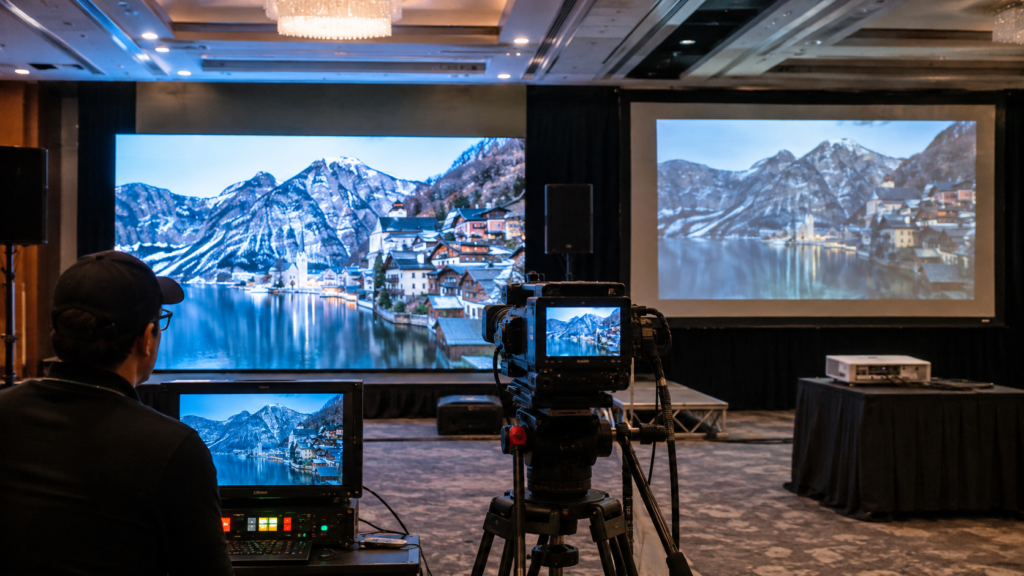
Conferences, worship productions, concerts and hybrid events often send the display image into cameras as well as to the room. A display that looks acceptable to the eye can still produce scan lines, banding, moire, exposure imbalance or colour differences on camera.
The verified WUYESTAGE rental LED range lists a 7680 Hz refresh rate. That is useful supporting evidence for camera-oriented evaluation, but refresh rate alone does not guarantee a clean recording. Scan method, processor settings, camera shutter, frame rate, exposure, viewing angle and content all influence the result.
Projectors also require a real camera test. The projector, screen surface, camera angle, exposure and ambient light can change the captured image. Do not accept a supplier’s general statement that either technology is automatically camera-safe.
Run the same acceptance sequence for both options:
For the LED option, include the ordered cabinet and processor configuration in the test. For the projector option, include the final lens, screen material, image size and installation position.
It is tempting to ask whether an LED wall or projector is cheaper per square metre. That comparison is incomplete because the two systems need different supporting equipment and labour.
An LED-wall quotation may include cabinets, spare modules, receiving components, processor, hanging or stacking structure, power distribution, signal cables, flight cases, transport, installation and technical support. A projector package may include the projector, lens, screen surface, frame, mounting hardware, signal distribution, alignment, transport, environmental protection and technical support.
Use a project-cost worksheet instead of a single equipment price:
Project cost = display hardware
             + image-processing and signal equipment
             + screen or supporting structure
             + power and cabling
             + transport and cases
             + installation and alignment labour
             + spares and service provision
             + venue modifications or protection
Then compare the cost over the intended operating model:
Do not publish or accept a universal cost winner without current quotations for the same project scope.
Use the following scorecard before requesting detailed proposals. Give one point to the technology named in each answer.
| Project condition | Point to LED wall | Point to projector |
|---|---|---|
| Significant ambient light or daytime use | 1 | 0 |
| Dark room with controlled house lighting | 0 | 1 |
| No clear projection path | 1 | 0 |
| Structure cannot support the proposed LED system | 0 | 1, subject to screen and projector mounting review |
| Outdoor exposure with a verified weather-resistant LED option | 1 | 0 |
| Moderate temporary image with suitable throw and screen position | 0 | 1 |
| Modular size changes across repeated events | 1 | 0 |
| Minimal cabinet handling and servicing capability | 0 | 1 |
The score does not replace engineering or a demonstration. Its purpose is to expose which constraints are driving the choice. If the result is close, arrange an on-site test at the real image size and ambient-light level.
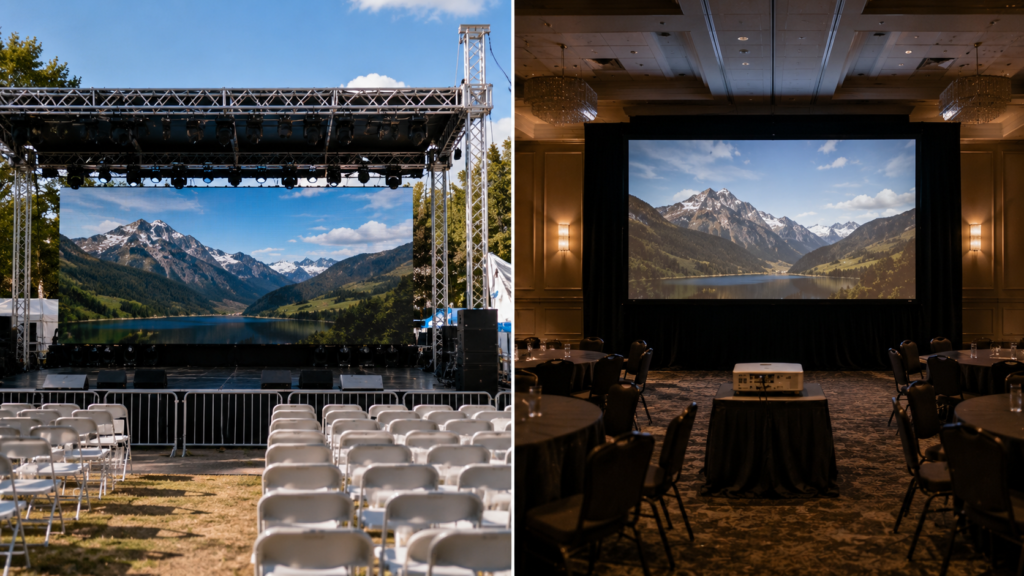
The verified P3.91 500 x 1000 LED display is a practical example for event and outdoor planning. The 500 x 1000 mm cabinet can reduce unit count on larger standard rectangular walls, while 500 x 500 mm cabinets provide more flexibility for height and shape. Verified references include 12.5 kg and 7.5 kg cabinet weights, hanging or stacking installation, 7680 Hz refresh rate and indoor or outdoor configurations.
P3.91 is not automatically suitable when the audience or cameras will be very close, when the structure cannot support the complete system, or when the requested dimensions do not fit the cabinet grid. A finer pitch such as P2.976 or P2.604 may better match closer viewing, but it changes total pixels and system design. The final selection must be calculated and tested.
A projector may be the better choice when the room is dark, the throw path is protected, the image is used occasionally and the buyer does not need a modular LED inventory. It is not enough to say that the projector has a high brightness specification; the final image size, screen and ambient light must be tested together.
To compare quotations fairly, send both suppliers the same operating brief:
Ask each supplier to state assumptions and exclusions. If one quote includes structure, processing and labour while the other includes only the display device, the total prices are not comparable.
Buyers planning a modular event system can review WUYESTAGE rental LED display solutions and the stage LED screen buying guide before preparing the brief.
Publishing instruction: Build this visible section with the Yoast FAQ block.
An appropriately specified LED wall is normally the stronger starting point in daylight because it produces light directly. Projector performance depends on the projector, image size, screen, lens and ambient light. Verify both options at the actual venue brightness rather than relying on one specification.
An outdoor LED wall with a verified brightness and protection configuration is often more practical, especially for daytime use. However, the complete structure, wind conditions, power and weather plan still require engineering. A projector would need suitable environmental protection, screen planning and ambient-light control.
It can be for some controlled indoor and temporary applications, but there is no universal answer. Compare the projector, lens, screen, mounting and labour against the LED cabinets, processor, structure, power, cabling, cases, spares and labour for the same image requirement.
No projection throw path is required. The LED wall does require physical installation depth, structure, power and signal distribution, ventilation or service access and a safe installation method.
Either system can require adjustment. Test the real LED cabinet and processor or the real projector, lens and screen with the production cameras, content, frame rate, shutter and exposure settings. Do not treat one refresh or brightness number as a guarantee.
Choose pitch from viewing distance, content detail, camera distance and total screen size. Verified WUYESTAGE planning references are above 2.6 m for P2.604, above 3 m for P2.976 and above 4 m for P3.91. Confirm the ordered configuration and run a content test.
The best LED wall vs projector decision is not based on which technology sounds more advanced. It is based on which complete system can produce the required image safely and consistently in the real venue.
Start with ambient light and throw path. Then compare buildable size, viewing distance, camera performance, structure, workflow and total project cost. When those conditions point to an LED solution, contact WUYESTAGE with the venue dimensions, audience distance and operating environment for a cabinet-layout and system discussion.